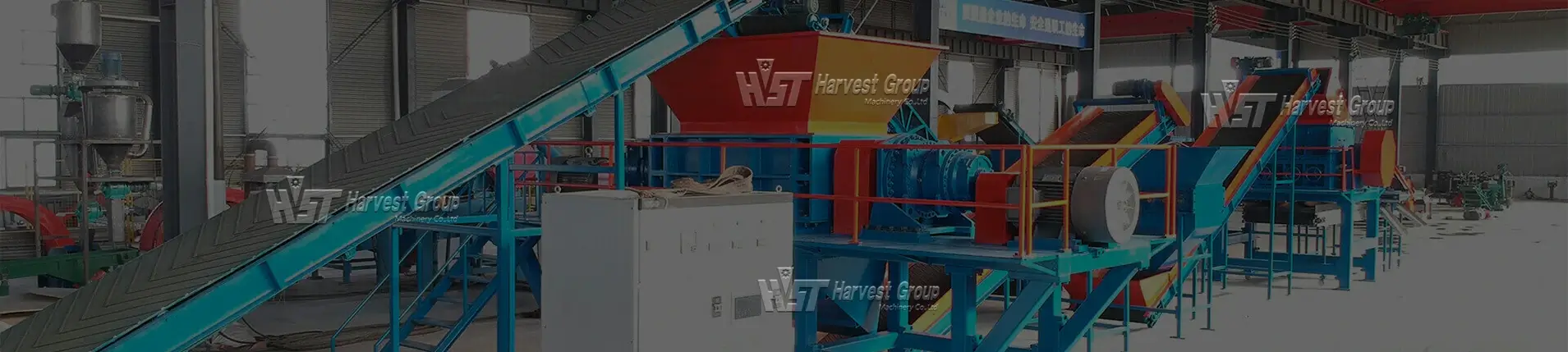
Rubber mulch is a recycled rubber material made from waste tires after shredding, steel wire removal, fiber separation, screening, and optional coloring. It is widely used in landscaping, playground surfacing, horse arenas, sports areas, garden beds, and other ground-cover applications.
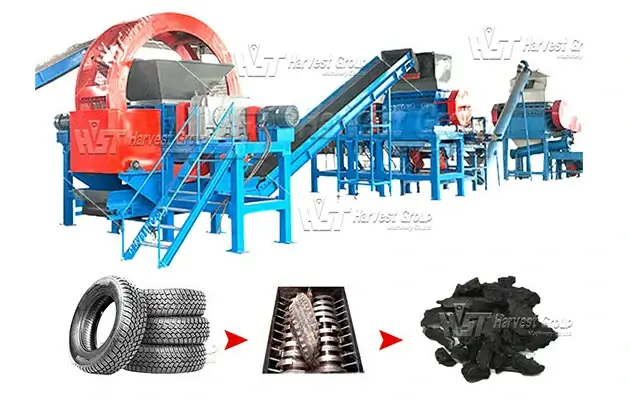
For buyers planning to produce rubber mulch, one point should be clear from the beginning: finished rubber mulch cannot be produced by one tire shredder alone. A tire shredder can only reduce whole tires into rough rubber chips. To produce cleaner and more uniform rubber mulch, additional processing steps are needed, including secondary size reduction, magnetic separation, fiber removal, particle screening, and optional coloring or packing.
For industrial production, these steps are usually connected into a complete rubber mulch production line. However, the actual equipment configuration should be selected according to tire type, required output size, steel and fiber removal standards, workshop layout, and final product application.
Many projects fail because buyers only consider a waste tire shredder machine but ignore downstream separation and screening equipment. As a result, the finished material may contain steel wire, textile fiber, dust, or uneven particle sizes, making it unsuitable for playgrounds, landscaping, or commercial supply.
This guide explains the main equipment modules needed to produce rubber mulch, how each machine works in the process, when each module is necessary, and what mistakes should be avoided when selecting tire recycling equipment for rubber mulch production.
Before choosing equipment, buyers should first confirm the required final product standard. Different applications have different requirements for particle size, rubber purity, steel residue, fiber content, and appearance.
| Inspection Item | Basic Commercial Target | Higher-Grade Product Target |
|---|---|---|
| Output particle size | 10–30 mm | 10–20 mm, adjustable and controllable |
| Rubber purity | ≥95% | ≥98% |
| Steel wire separation rate | ≥95% | ≥97% |
| Fiber residue rate | ≤5% | ≤2% |
| Applicable raw materials | Passenger car tires and light truck tires | Passenger car tires, truck tires, bus tires, and selected large tires |
Playground rubber mulch: Steel wire removal is very important. A higher-standard magnetic separation system is recommended to reduce exposed metal residue and improve product safety.
Landscaping rubber mulch: Particle size consistency and appearance are more important. Stable screening helps produce cleaner and more uniform mulch for gardens, parks, and decorative ground cover.
Sports and equestrian applications: Product elasticity, particle shape, and impurity control are important. Cleaner rubber particles improve user comfort and reduce maintenance problems.
Colored rubber mulch: If colored products are required, an additional coloring, drying, and cooling system should be considered after size reduction and impurity removal.
Rubber mulch quality depends on the complete process, not on one single machine. If the shredder, secondary processor, separator, and screen are not properly matched, the final material may have unstable size, excessive steel residue, high fiber content, or poor appearance.
A complete rubber mulch process can be divided into several major equipment modules: tire pre-processing, primary shredding, secondary size reduction, steel wire separation, fiber and dust separation, screening, conveying, electrical control, optional coloring, and optional packing.
| Processing Step | Main Purpose | When It Is Needed |
|---|---|---|
| Tire pre-processing | Remove bead wire or cut large tires | Recommended for truck tires, bus tires, heavy tires, or tires with strong bead wire |
| Primary shredding | Reduce whole tires into rubber chips | Needed for almost all rubber mulch production projects |
| Secondary size reduction | Produce mulch-size rubber particles | Needed for commercial rubber mulch production |
| Magnetic separation | Remove steel wire from rubber material | Required for playground, landscaping, and higher-grade rubber mulch |
| Fiber separation | Remove textile fiber and light impurities | Recommended for cleaner commercial rubber mulch |
| Screening | Control final particle size | Required for stable product quality |
| Coloring | Produce colored rubber mulch | Optional for value-added products |
| Packing | Prepare finished mulch for storage or sale | Optional depending on sales model |
Some waste tires contain thick bead wire, heavy sidewalls, or large tire structures. If these tires are fed directly into the shredder, they may increase blade wear, create feeding difficulty, or cause overload. Tire pre-processing equipment helps reduce these risks before primary shredding.
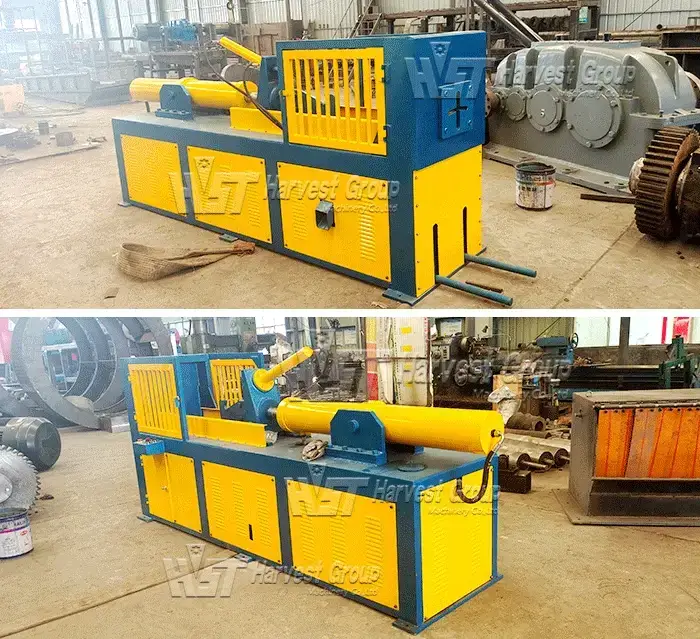
A tire debeader is used to remove bead wire from tire openings before shredding. This step is especially useful when processing truck tires, bus tires, or tires with thick bead wire.
| Selection Factor | Configuration Logic |
|---|---|
| Raw tire type | More important for truck tires, bus tires, and high steel-content tires |
| Blade protection | Removing bead wire can reduce blade wear and machine load |
| Feeding stability | Pre-processing helps reduce jams and overload risks |
| Project scale | Higher-volume production usually benefits more from pre-processing |
For small projects processing only passenger car tires, a tire debeader may be optional depending on the tire structure and target product standard.
A tire cutter is mainly used for oversized tires or tire sections that are difficult to feed into the shredder. It cuts large tires into strips, blocks, or smaller sections before primary shredding.
For standard passenger car and truck tire projects, a tire cutter may not be required. For OTR tires, mining tires, or other oversized tire materials, tire cutting can reduce feeding difficulty and improve shredding stability.
Primary shredding is the first size reduction stage. It turns whole tires or pre-processed tire sections into rough rubber chips. These chips are not finished rubber mulch yet. They still need secondary size reduction, impurity removal, and screening.
A tire shredder uses shearing and tearing force to reduce waste tires into smaller rubber pieces. The output size from this stage should match the feeding requirements of the next processing machine.
| Machine Function | Production Role | Important Selection Point |
|---|---|---|
| Primary size reduction | Turns whole tires into rubber chips | Choose according to tire size, tire type, and steel content |
| Downstream preparation | Prepares material for secondary processing | Output size should match the next machine |
| Equipment protection | Reduces tire size before fine processing | Blade material and overload protection are important |
| Process stability | Controls feeding flow for the next stage | Conveyor speed and discharge size should be matched |
A tire shredder alone cannot produce finished rubber mulch. It is only the first step in the size reduction process.
After primary shredding, rubber chips must be processed into mulch-size particles. This stage directly affects final particle size, shape, and consistency.
A rasper machine is commonly used after primary shredding. It further reduces rubber chips into larger rubber particles suitable for mulch applications and helps loosen embedded steel wire from the rubber material.
For rubber mulch production, a rasper is often more suitable than a fine granulator because the target product is larger rubber mulch, not crumb rubber or rubber powder.
| Processing Goal | Recommended Machine Type | Reason |
|---|---|---|
| 10–30 mm rubber mulch | Rasper machine | Better suited for larger mulch-size particles and steel liberation |
| 1–5 mm crumb rubber | Rubber granulator | Designed for smaller rubber granules |
| Fine rubber powder | Rubber powder grinding system | Used for much finer mesh output |
The rasper plays an important role in rubber mulch quality. If this stage is not properly selected, the final product may become too large, too fine, or inconsistent.
A rubber granulator is used when smaller rubber granules are required. It uses movable and fixed blades to cut rubber into smaller particles.
For standard rubber mulch, a granulator is usually not the main machine. If the wrong granulator is selected, the output may become too fine for mulch applications, causing product mismatch and material loss.
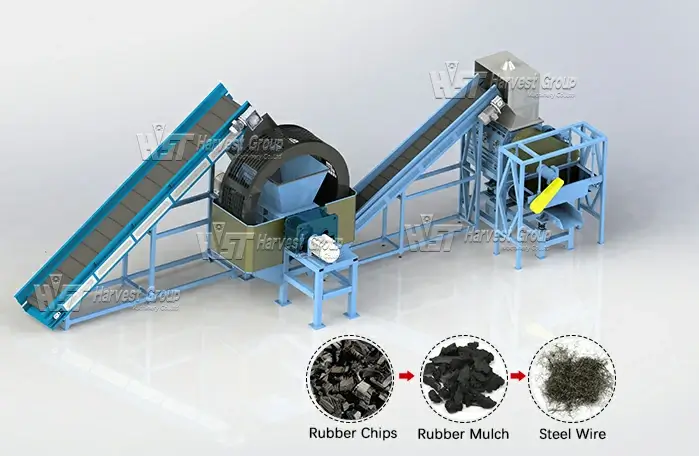
Waste tires contain steel wire, especially in bead areas and reinforced tire structures. If steel is not properly removed, the finished rubber mulch may fail safety and quality requirements.
A steel wire separator uses magnetic force to remove loose steel wire from rubber particles. For higher-grade products, more than one magnetic separation stage may be used.
| Separation Requirement | Suggested Configuration | Suitable Application |
|---|---|---|
| Basic steel removal | Single magnetic separation stage | Low-cost local recycling or rough material supply |
| Higher steel removal | Two-stage magnetic separation | Playground mulch, landscaping mulch, and cleaner commercial products |
| Strict safety requirement | Multiple inspection and separation points | Projects with strict metal residue control |
Steel separation should be matched with the upstream machine output. If the separator capacity is too small, steel wire may accumulate, reduce separation efficiency, or interrupt production.
In addition to steel wire, waste tires also contain textile fiber. After shredding and rasping, these fibers may remain mixed with rubber particles. Too much fiber can make the finished rubber mulch look dusty, white, or low quality.
A fiber separator uses airflow to separate textile fiber, nylon fiber, and light impurities from rubber particles. It also helps reduce dust in the finished product.
| Fiber Removal Level | Configuration Suggestion | Suitable Product Target |
|---|---|---|
| Basic product | Simple air separation or limited fiber removal | Low-end local material supply |
| Cleaner commercial mulch | Dedicated fiber separator | Landscaping and general commercial mulch |
| Higher appearance requirement | Stronger airflow separation and dust collection | Colored mulch, playground mulch, and branded products |
Fiber removal is not always mandatory for every low-budget project, but it is strongly recommended when the product needs a cleaner appearance and better market acceptance.
A vibrating screen is used to classify rubber particles by size. Qualified rubber mulch is discharged as finished product, while oversized material can be returned for further processing.
| Screening Function | Production Benefit |
|---|---|
| Remove oversized particles | Improves product consistency |
| Remove undersized material | Helps control finished product specification |
| Classify different sizes | Allows production of different rubber mulch grades |
| Material return | Improves yield and reduces waste |
Screening is especially important for landscaping and playground rubber mulch because customers usually expect uniform particle size and stable appearance.
Conveyors connect different processing steps and reduce manual material handling. A rubber mulch processing system may use feeding conveyors, discharge conveyors, separator conveyors, return conveyors, and finished product conveyors.
A good conveying layout improves material flow and reduces blockage. Conveyor width, belt type, feeding angle, and speed should be matched with upstream and downstream equipment.
The electrical control system coordinates the operation of shredding, size reduction, separation, screening, conveying, and optional systems. It may include motor control, overload protection, emergency stop, fault alarm, and full-process start-stop control.
| Control Requirement | Recommended Control Level | Benefit |
|---|---|---|
| Small or simple process | Basic electrical control cabinet | Lower investment and simple operation |
| Commercial continuous production | Centralized control system | Better machine coordination and lower operation risk |
| Higher automation demand | PLC control and touch screen operation | Easier monitoring, fault alarm, and process management |
A coloring system is used to produce red, green, brown, blue, or other colored rubber mulch. It usually includes mixing, coating, drying, and cooling steps.
Colored rubber mulch is often used in landscaping, playgrounds, and decorative ground-cover markets. If only black rubber mulch is required, this system can be omitted.
Dust collection equipment helps collect rubber dust and fiber dust generated during shredding, separation, and screening. It improves workshop conditions and may help meet local environmental requirements.
Packing options depend on the sales model. Bulk material can be packed in jumbo bags, while retail landscaping products may require small bags or palletized packaging.
| Optional Module | Main Function | When to Add It |
|---|---|---|
| Coloring system | Produces colored rubber mulch | Needed for landscaping, playground, and value-added products |
| Dust collection system | Collects rubber dust and fiber dust | Recommended for industrial workshops and compliance-focused projects |
| Packing system | Packs finished rubber mulch | Needed for retail sales, export, or organized bulk delivery |
Rubber mulch equipment configurations can generally be divided into basic configurations, commercial configurations, and value-added configurations. The right choice depends on product standard, budget, raw material condition, and target market.
| Configuration Type | Main Equipment | Suitable Use | Limitations |
|---|---|---|---|
| Basic configuration | Primary shredder, simple secondary processing, magnetic separator, screen, conveyors | Local landscaping material supply or rough tire processing | Product purity and particle consistency may be limited |
| Commercial configuration | Pre-processing, primary shredding, rasper, magnetic separation, fiber separation, screening, conveying, control system | Playground mulch, landscaping suppliers, and recycled rubber product manufacturers | Higher equipment matching requirements and more workshop planning needed |
| Value-added configuration | Commercial configuration plus coloring, drying, dust collection, and packing | Colored rubber mulch, retail mulch, branded products, and export supply | Requires better process control and more operating experience |
A tire shredder can only produce rough rubber chips or blocks. It cannot fully remove steel wire, separate fiber, or control final rubber mulch size. Finished rubber mulch usually requires additional size reduction, magnetic separation, fiber separation, and screening.
A rasper is more suitable for producing larger mulch-size particles, while a granulator is usually used for smaller crumb rubber. Choosing the wrong machine may cause the final product to become too fine or inconsistent.
Rubber mulch with too much steel wire or fiber is difficult to use in playground and landscaping applications. Separation equipment should be selected according to the required product standard.
If the shredder or rasper output is high but the separator or screen is too small, material may accumulate, block the system, reduce separation efficiency, or affect product consistency.
Voltage, dust emission rules, workshop layout, and safety requirements vary by country and region. These conditions should be confirmed before the equipment configuration is finalized.
Before selecting equipment, buyers should confirm the following information:
| Item to Confirm | Why It Matters |
|---|---|
| Raw tire type | Determines whether debeading, cutting, or heavy-duty shredding is required |
| Hourly processing target | Affects machine size, conveyor width, screen capacity, and control system |
| Final output size | Determines secondary processor, screen, and return system configuration |
| Steel removal requirement | Determines magnetic separation stage and product safety level |
| Fiber removal requirement | Determines whether fiber separation equipment is needed |
| Colored mulch requirement | Determines whether coloring, drying, and cooling systems are needed |
| Packing method | Determines whether manual packing, jumbo bag packing, or small bag packing is used |
| Workshop space | Affects equipment layout, maintenance access, and installation planning |
| Local voltage and regulations | Affects electrical design, dust collection, and safety configuration |
No. A tire shredder can only produce rough rubber chips or blocks. Finished rubber mulch usually requires secondary size reduction, magnetic separation, fiber removal, and screening.
Magnetic separation equipment is commonly used to remove steel wire from rubber particles. For higher-quality rubber mulch, two or more magnetic separation points may be used.
Fiber separation is recommended for cleaner commercial rubber mulch. It helps remove textile fiber, dust, and light impurities, improving product appearance and market value.
Rubber mulch is usually larger than crumb rubber. Common sizes include 10–20 mm, 10–30 mm, or customized ranges depending on the application and customer requirements.
Yes. Colored rubber mulch usually requires mixing, coating, drying, and cooling equipment. Manual coloring is not recommended for stable commercial production.
A basic configuration may be suitable for rough local recycling or low-cost landscaping material supply. A commercial configuration is recommended when the final product requires better particle consistency, lower steel residue, cleaner appearance, and stable long-term production.
Rubber mulch production is a multi-step processing system. A proper equipment configuration should include suitable tire pre-processing, primary shredding, secondary size reduction, steel wire separation, fiber removal, screening, conveying, and control equipment. Optional coloring, dust collection, and packing systems can be added according to product positioning and market requirements.
The correct configuration depends on raw tire type, processing target, output size, steel and fiber removal requirements, workshop conditions, power supply, and final sales model. If key processing steps are simplified, the finished material may have uneven particle size, high steel residue, excessive fiber content, or poor commercial value.
For buyers who need an industrial processing system, HVST can design a suitable rubber mulch machine based on tire type, required output size, impurity removal standard, coloring needs, and packing method.