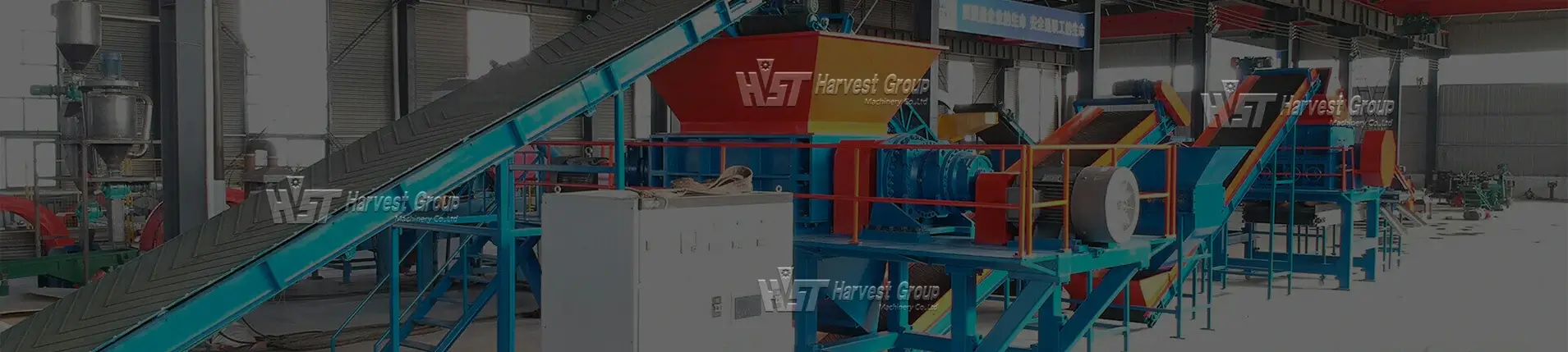
A tire shredder does not control finished chip size through blade thickness or cutter spacing alone. In a practical tire recycling line, output size is controlled by the complete system: the cutter creates the initial reduction, the screen separates acceptable material from oversize, and the return system sends oversized pieces back for another cutting opportunity.
This screening-and-recirculation loop is what turns irregular first-pass tire shreds into a more controlled product. Material that meets the required condition leaves the loop, while material that does not meet the specification remains unfinished and continues circulating.[1] For buyers comparing tire shredder machines, understanding this relationship is important because tighter size control normally requires more internal processing.
The basic process can be summarized as:
Shredding → Screening → Accepted Chips Discharge → Oversize Return → Recutting
Whole tires rarely become uniform pieces after a single pass. Rubber is flexible, steel belts resist cutting and bead sections create heavier localized loads. The first discharge can therefore contain a mixture of rubber blocks, strips, folded sections and irregular tire chips. This material should be treated as cutter discharge, not automatically as finished product.
The screen then classifies this mixed material. Chips that satisfy the pass condition continue to collection or downstream equipment. Material retained by the screen remains inside the size-reduction process. This distinction is important when measuring production because material that has merely left the cutting chamber is not necessarily accepted output.
Oversized pieces are normally transported back through a return conveyor or another recirculation route. Instead of allowing long strips and oversized fragments to continue downstream, the system gives them another cutting opportunity. Scrap-tire processing guidance also describes this general principle of screening reduced tire material and returning oversized fractions for additional size reduction.[1]
The screen itself does not make an oversized tire strip smaller. It only determines whether the material is allowed to leave the loop. The shredder performs the actual additional reduction, and the cycle continues until the material reaches the required acceptance condition.
Screen opening is an important setting, but it is only one part of the system. The shape of the first-pass material, cutter condition, return capacity and fresh-feed rate all affect how quickly material reaches the accepted-product boundary.
Blade thickness, hook geometry, cutter overlap, shaft speed and cutter condition influence the first-pass size distribution. Sharp cutters generally create cleaner shearing, while worn or damaged cutting edges can allow the rubber to stretch farther before separation. This often creates longer strips and increases the amount of material that must return for another pass.
If oversize gradually increases even though the screen opening and tire mix have not changed, cutter condition should be checked before automatically installing a smaller screen. Wrapped wire, abnormal clearances and damaged cutter hooks can all change the discharge pattern.
The screen defines the acceptance boundary, but a nominal screen opening should not be interpreted as a guarantee that every finished chip has exactly the same maximum dimension. Tire pieces are flexible and irregular, so a long narrow strip can interact with the opening differently from a compact rubber block.
A larger opening generally allows more first-pass material to leave the loop, while a tighter opening retains more pieces for recutting. Actual classification can also be influenced by aperture geometry, material depth, agitation and the way pieces approach the screen.
The return conveyor is a critical part of the size-control system. If the screen retains a large fraction of material, the conveyor must carry that load without plugging or becoming a bottleneck. Belt width, speed, lift angle, transfer points and exposed steel wire all affect return-system reliability.
Fresh tires and returned oversize also compete for the same cutter capacity. If return load is already high and fresh feed continues increasing, the cutting chamber may remain continuously loaded. Motor current can rise, automatic reversing may become more frequent and accepted production can eventually fall even though the machine appears very busy.
Screen size creates one of the main operating trade-offs in tire shredding: finer output usually requires more internal processing. A relatively coarse screen allows a larger share of first-pass material to leave the loop, while a smaller opening sends more pieces back for additional cutting.
Some returned material may need only one additional pass, while other pieces may circulate several times before being accepted. This does not mean the same tonne of tire has become several tonnes of production. It simply means more internal cutting and conveying work has been performed on the same material.
A useful process indicator is:
Return ratio = returned oversize mass ÷ fresh feed mass
Where direct weighing is impractical, the plant can still monitor return duty using consistent indicators such as belt loading or conveyor motor load. The objective is not false measurement precision, but understanding whether recirculation is increasing over time.
A shredder may appear to process a very large amount of material internally while the useful finished-product rate is much lower. As more cutter time is spent processing returned material, less cutting capacity remains available for fresh tires.
For this reason, production performance is better expressed as:
Accepted throughput (t/h) = compliant product mass ÷ stable production time
Returned material should not be counted again as new production.
| Screen Setting | Typical Output | Recirculation | Accepted Throughput | Cutting Duty |
| Larger Opening | Coarser tire chips | Lower | Generally higher | Lower repeat-cutting duty |
| Medium Opening | Balanced size control | Moderate | Balanced | Moderate |
| Smaller Opening | Finer controlled chips | Higher | May decrease | Higher repeat-cutting duty |
Every additional pass requires more cutting and conveying, so tighter output specifications can increase cutter wear and electrical energy per accepted tonne. This does not mean a smaller screen is wrong; it means the smaller product should be required by the next process or final customer.
The correct screen is not necessarily the smallest screen that can be installed. A better engineering rule is to use the largest screen configuration that reliably meets the downstream requirement. TDF production, secondary shredding, rasping and granulation do not all need the same feed condition.
Tire-derived fuel preparation, for example, should be matched to the handling and combustion requirements of the intended receiving system rather than treated as one universal particle size.[2] If the chips will enter a rubber granulator, confirm the maximum acceptable feed size of that machine before selecting the upstream screen. If the material is intended for a TDF tire recycling line, the fuel specification should determine the accepted chip condition.
A specification such as “80 mm chips” is incomplete unless the acceptance method is also defined. A more useful requirement includes target chip size, maximum acceptable dimension, allowable oversize percentage and sampling method. Where exposed steel matters to the next process, that condition should also be included.
Over-reducing material can waste capacity and blade life. If the next machine can reliably accept larger chips, forcing the upstream shredder to repeatedly cut them into a smaller size may add processing cost without improving the final product.
Different classifiers can be used after tire shredding. The correct choice depends on required chip size, material flow behavior, exposed steel, available footprint and the equipment that follows.
Disc screens use rotating shafts and screening elements to agitate and roll the material. Smaller pieces receive repeated opportunities to pass between the screening elements while larger pieces continue toward the oversize return route.
This makes disc screening useful after primary shredding where continuous coarse classification and automatic return are required. Wire snagging, disc wear and excessive bed depth must still be considered during design.
A rotary or circular screening arrangement can be integrated around or after the cutting stage. Qualified material falls through the screening area while oversized pieces remain in the system and return for more cutting.
This can create a compact closed-loop arrangement, but screen wear, material buildup and maintenance access must be considered because tire chips often contain exposed steel reinforcement.
Trommels can be used for larger shredded fractions, while vibrating screens are more commonly used farther downstream for smaller granules. Scrap-tire guidance also identifies trommels, disc-type screens and other classifiers as part of tire size-reduction systems.[3]
For finer downstream classification, HVST also provides vibrating screens for tire recycling.
| Classifier Type | Typical Role | Main Advantage | Main Concern |
| Disc Screen | Coarse tire-chip classification | Continuous agitation and oversize separation | Wire snagging disc wear and overloading |
| Rotary Screen | Closed-loop shredder classification | Compact screening and recirculation | Screen wear buildup and access |
| Trommel | Larger shredded fractions | Simple rotating classification | Footprint and residence time |
| Vibrating Screen | Finer downstream classification | Suitable for smaller granules | Normally used farther downstream |
High recirculation is not automatically a failure. It may simply be the operating cost of producing a tighter product. It becomes a problem when the internal loop consumes so much capacity that accepted production begins to fall or the system becomes unstable.
A return conveyor that remains continuously full, increasing shredder reversals and rising motor load can all indicate that too much material is circulating. The shredder may still look very busy, but a smaller percentage of its work is producing new accepted output.
Excessive repeated cutting can also increase fines and consume cutter life. Material that already satisfies the downstream requirement should ideally leave the loop rather than continue receiving unnecessary cutting.
If oversize increases while the screen opening has not changed, inspect the cutters and feed mix first. Worn cutting edges can create longer torn strips, while an increased percentage of heavily reinforced truck tires can also change first-pass cutting behavior.
If product size remains correct but accepted tonnes per hour falls, check return load and screen loading. If return duty has not changed, look at feed consistency, conveyor slipping and downstream accumulation before changing the screen.
| Observed Problem | Possible Causes | What to Check First |
| Oversize increases | Blade wear changed tire mix blocked screen | Cutter edges hooks screen condition and feed mix |
| Correct size but lower accepted t/h | Higher recirculation or partial blockage | Return load screen loading and feed stability |
| Return conveyor plugs | Insufficient capacity or wire snagging | Transfer points belt width chutes and exposed wire |
| Too many fines | Excessive recutting or overly tight screen | Downstream size requirement and return duty |
| Frequent PLC reversals | Heavy return load feed surges or obstruction | Fresh feed return load wrapped wire and cutter condition |
If a return conveyor repeatedly plugs at the same location, determine whether exposed wire is catching on a specific chute lip or transfer point. A repeated blockage at one location usually suggests a transfer-design problem, while a belt overloaded along its entire length is more likely to indicate insufficient conveyor capacity.
Too many fines often indicate that material is being cut beyond the size actually required downstream. Frequent PLC reversals should be reviewed together with return load, motor current and fresh-feed rate. If reversals increase mainly during heavy return duty, feed control may need adjustment; if they occur even at low return load, the cutting chamber should be inspected for wrapped steel, foreign material or abnormal cutter clearance.
A good screen-and-return system prevents material that already meets the required size from being cut again. This reserves cutter capacity for genuinely oversized pieces and reduces unnecessary wear and energy use.
Consistent classification can also provide a more predictable feed for secondary shredders, raspers and granulators. Large strips and uncontrolled oversize are more likely to bridge or create uneven loading in downstream machines.
Screening does not replace steel or fiber separation, but it helps downstream equipment receive material within a more controlled feed range. A complete tire recycling equipment system should therefore treat shredding, classification, steel separation, fiber separation and granulation as connected stages rather than isolated machines.
For projects requiring a complete system rather than a single machine, HVST can also configure a tire recycling plant around the tire type, required capacity and final product.
One expensive mistake is trying to produce final crumb rubber simply by fitting an extremely small screen to the primary shredder. Primary shredding and fine granulation perform different jobs.
The primary stage should reduce whole tires into controlled material that the next machine can process efficiently. If the final target is small rubber granules or rubber powder, the process normally continues through further steel liberation, granulation, fiber separation and fine grinding.
A tire grinding machine or other dedicated fine-reduction equipment should perform the duty for which it was designed rather than forcing the primary shredder to recut material far beyond its intended process role.
Ask which screen configurations are available for the shredder and what accepted output range each configuration is intended to produce under the stated tire mix. Also check access for cleaning and replacement, wear protection and areas where exposed steel can catch.
The return conveyor should be evaluated at the same time. Belt width, speed, lift height and transfer geometry determine whether retained material can return smoothly without creating a new bottleneck.
Variable-speed control may help optimize screen or conveyor operation, but it cannot compensate for incorrect screening geometry or an undersized return path. Maintenance access is equally important because screens, bearings, conveyor pulleys and cutter chambers must eventually be inspected and replaced.
A layout that appears very compact on a drawing may become expensive to operate if major components cannot be serviced without dismantling unrelated parts of the line.
A useful production test should demonstrate the complete loop rather than simply showing several tires passing through the shredder. The accepted product and test method should be agreed before the run begins.
Record the target chip size, oversize tolerance and sampling method. Use a representative tire mix rather than selecting only easy passenger tires. If truck tires are part of normal operation, they should also be included in the test.
Fresh feed should be measured once. Returned oversize is internal process material and should not be added again as new production.
The finished-product measurement point should be after classification. During the test, record accepted throughput together with return load, motor load, automatic reversals and major stoppages.
Samples should also be taken throughout the production period instead of selecting only the best-looking pile at the end. This gives a much better indication of whether the system can maintain the required output condition during stable operation.
| Common Mistake | Why It Causes Problems |
| Choosing by screen opening alone | Cutter condition classifier geometry and return design also affect performance |
| Demanding the smallest possible chips | May increase recirculation wear and energy while reducing accepted throughput |
| Counting returned material as production | The same material is being counted more than once |
| Ignoring return conveyor capacity | The conveyor can become the real bottleneck even when the shredder is correctly sized |
| Ignoring cutter wear | Worn blades can increase long strips and retained oversize |
| Testing only easy passenger tires | The result may not represent the actual production tire mix |
No. Blade geometry affects first-pass cutting, but final accepted product size depends on the complete cutting, screening and recirculation system.
No. A smaller opening can reduce oversize but may also increase recirculation, cutter wear, energy consumption and the risk of lower accepted throughput. The correct screen depends on the downstream product requirement.
A tighter screen normally retains more material for recutting. As internal recirculation increases, more cutter capacity is used by returned material and less may remain available for fresh feed.
No. Returned oversize is internal circulation. Fresh material should be counted once and finished production should be measured after the screening stage.
Worn cutting edges can allow rubber to stretch and tear into longer pieces instead of being cleanly sheared. More of these pieces are then retained by the screen and returned for another pass.
The best screen is the one that consistently produces the chip specification required by the fuel receiver while maintaining acceptable throughput and recirculation. A smaller opening should not be selected unless the product specification requires it.
Check retained material volume, screen blockage, belt width and speed, transfer chutes, wire snag points and fresh-feed surges. First determine whether the system is generating excessive return material or whether the return conveyor itself is undersized.
A tire shredder screen and recirculation system should be treated as one integrated size-control process. The shredder performs the cutting, the screen defines the accepted-product boundary, the return conveyor sends oversized material back for another cutting opportunity, and fresh-feed control keeps the loop balanced.
The best configuration is not automatically the one with the smallest screen or the highest internal circulation. It is the system that produces the required tire-chip specification at a stable accepted throughput with manageable wear, energy consumption and maintenance.
Before selecting the system, define the tire mix, the chip size actually required by the next process, the required accepted capacity and the method used to screen and return oversize. Once those conditions are clear, the screen opening, classifier design and recirculation capacity can be selected around the real production requirement.