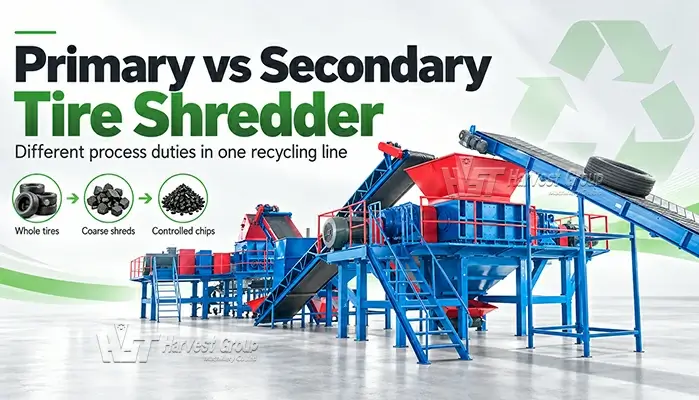
Primary and secondary tire shredders perform different jobs in a tire recycling line. A primary tire shredder is designed to accept whole tires or large tire sections and carry out the first major size reduction. A secondary tire shredder works further downstream, where the material has already been opened and reduced into chips, strips or shreds.
The difference is not simply machine size, motor power or the number of shafts. What really separates the two stages is the condition of the material entering the machine, how much additional reduction is required, and what the next process expects to receive.
In practical terms, primary shredding makes whole tires manageable. Secondary shredding makes pre-shredded tire material more consistent and better prepared for steel separation, TDF production, rubber mulch, granulation or other downstream processing.
| Comparison | Primary Tire Shredder | Secondary Tire Shredder |
| Feed Material | Whole tires or large tire sections | Pre-shredded tire chips or strips |
| Main Duty | First-stage coarse size and volume reduction | Further and more controlled size reduction |
| Main Priority | Stable intake, cutter engagement, torque and throughput | Output consistency, controlled reduction and downstream preparation |
| Typical Output | Coarse shreds, strips or chips | Smaller and more controlled tire chips |
| Steel Function | Begins opening the tire structure | Further exposes and liberates steel |
| Typical Next Equipment | Screen, conveyor, secondary shredder or rasper | Magnetic separator, granulator or further separation equipment |
| Typical Applications | Volume reduction, coarse TDF, preparation for further processing | TDF chips, rubber mulch feed, granulator feed |

The primary shredder is normally positioned near the beginning of the recycling process. Its job is to take bulky and irregular tire feedstock and convert it into material that can move through conveyors, screens and downstream equipment more reliably.
Whole tires are difficult to process because they roll, flex and enter the cutting chamber in different orientations. Passenger tires, truck tires and larger tire sections can also create very different loads. For this reason, a primary machine is usually designed around strong cutter engagement, low-speed high-torque operation, a robust cutting chamber and reliable overload protection.
The purpose of this stage is not normally to produce fine crumb rubber in one pass. Instead, it breaks the tire’s original ring structure, reduces volume and creates coarse shreds or strips that can be transferred to the next stage without constant manual intervention. Depending on the final product, this coarse output may already be usable, or it may become feed for a secondary reduction stage.
Motor power alone is therefore a poor way to compare primary shredders. Cutter geometry, shaft speed, available torque, chamber dimensions, tire type and feed behavior all influence how well the machine performs. For front-end size reduction, see HVST’s tire shredder machine solutions.
A secondary tire shredder starts where primary shredding ends. Instead of receiving intact tires, it processes material that has already been reduced into a more manageable form. This changes the duty of the machine. The emphasis shifts away from simply gripping a whole tire and toward producing a smaller, more controlled stream for the next process.
The quality of the feed becomes particularly important at this stage. Long strips, dense bead-rich sections, oversized chunks or loose wire can create very different cutting loads even when the average chip size appears acceptable. A secondary shredder should therefore be selected around a defined feed envelope rather than around a single nominal dimension such as “100 mm chips.”
Secondary reduction also helps expose steel reinforcement from the rubber. The shredder itself does not replace a magnetic separator, but further cutting can improve steel liberation so that downstream magnetic separation becomes more effective. HVST’s steel wire separation equipment can then be used to recover liberated steel.
Depending on the required final product, secondary output may already be suitable for TDF or rubber mulch, or it may continue to a rubber granulator for finer size reduction.
One common misunderstanding is that “primary shredder” automatically means one specific machine design while “secondary shredder” means another. In reality, these terms describe where the machine works in the process and what job it performs.
Dual-shaft shredders are widely used for primary whole-tire reduction because they provide strong pulling and cutting action, but the number of shafts does not by itself define the process stage. Likewise, secondary reduction may be carried out by another shredder, a rasper or another cutting machine depending on the target size and required degree of steel liberation.
In many crumb rubber lines, for example, a tyre rasper machine performs the secondary reduction duty between primary shredding and granulation. Machine architecture should therefore follow the process requirement rather than the other way around.
A useful starting point is to define four things before selecting the machine: what material enters it, what condition the output must reach, what sustainable throughput is required, and what equipment comes next. Shaft layout, screen configuration, cutter design and drive system can then be selected around those requirements.
The interface between the primary and secondary machines is one of the most important parts of a two-stage tire shredding system. A line can contain two individually capable machines and still perform poorly if the output of the first stage does not match the inlet requirement of the second.
This is why a specification such as “primary output: 100 mm” is often incomplete. Two pieces with similar nominal dimensions can behave very differently. A compact rubber block may pass easily through the next machine, while a long flexible strip of similar mass may bridge a chute, fold across the inlet or wrap around rotating parts.
Bead-rich material also deserves separate attention. A relatively small piece containing a concentrated section of bead wire can create a much harder cutting event than an ordinary rubber chip of the same size. Loose wire creates another type of risk because it may wrap around shafts, conveyors or other rotating components.
For this reason, the handoff specification should describe not only average chip size, but also oversize allowance, long-strip frequency, bead-rich pieces, loose wire condition, contamination and short-term feed surges.

| Handoff Item | What to Define | Why It Matters |
| Piece Geometry | Expected size range and oversize allowance | Large pieces may overload or bridge the next stage |
| Long Strips | Maximum recurring length or permitted frequency | Flexible strips may fold, bridge or wrap |
| Bead-Rich Pieces | Allowed size and occurrence | High local steel concentration creates harder cutting loads |
| Loose Wire | Acceptable exposed or free-wire condition | Wire loops and tails may wrap around shafts or conveyors |
| Mass Flow | Normal flow plus short-period peak feed | The secondary stage must absorb both average and peak loading |
| Contamination | Prohibited foreign material | Protects cutters, screens and downstream equipment |
Matching two catalog capacity numbers does not automatically create a balanced line. A primary shredder rated at 5 t/h on whole passenger tires and a secondary machine rated at 5 t/h on clean pre-shredded chips are not necessarily processing the same duty.
Required output size also changes real capacity. A machine producing coarse chips may achieve a much higher net throughput than the same machine operating with tighter screening and repeated recirculation. Material that remains on a return conveyor is still being processed; it is not yet accepted downstream output.
This is why accepted output is usually a better way to evaluate a multi-stage line than fresh feed alone. If 5 tons enters the system but a significant portion continues circulating because it does not yet meet the required size or condition, the useful downstream flow is lower than 5 t/h.
The intermediate buffer between the two stages provides a simple practical indication of line balance. If the buffer continues rising during stable operation, the primary stage is supplying material faster than the downstream stage can consume it. If the level remains reasonably stable, the two stages are operating at a compatible flow. If the buffer steadily falls, the secondary machine is consuming material faster than the primary stage is supplying it.

The key is to observe the trend over a meaningful operating period. A single hopper-level reading does not prove whether a line is balanced.
No. More machines do not automatically mean a better recycling line. If the final product is relatively coarse and the primary shredder can produce the required size at the required accepted throughput, a separate secondary stage may not be necessary.
This may be possible for some volume-reduction or TDF applications. However, as the required output becomes smaller and more consistent, a second reduction stage becomes increasingly useful. Rubber mulch production usually benefits from additional reduction and steel liberation, while crumb rubber production normally continues beyond secondary shredding into granulation and further separation.
Trying to force a primary shredder to perform too many reduction steps can also reduce efficiency. Repeated recutting and recirculation increase the number of cutting events per ton, which can increase wear and reduce net throughput. Dividing coarse and finer reduction between separate stages allows each machine to work closer to the duty it was designed for.

The correct number of reduction stages depends on the required final product. A coarse TDF line may need only primary shredding and screening, while rubber mulch and crumb rubber systems require progressively more size reduction and separation.

For projects that require a complete system rather than a single shredder, a tire recycling plant can integrate primary shredding, secondary reduction, steel separation, granulation and other downstream equipment according to the required capacity and final product.
| Final Product | Typical Process Route |
| Coarse TDF | Whole Tires → Primary Shredder → Screening / Secondary Reduction if Required → TDF Chips |
| Rubber Mulch | Whole Tires → Primary Shredder → Secondary Shredder / Rasper → Magnetic Separation → Rubber Mulch |
| Crumb Rubber | Whole Tires → Primary Shredder → Rasper / Secondary Reduction → Steel Separation → Granulator → Fiber Separation → Crumb Rubber |
| Rubber Powder | Whole Tires → Primary Shredding → Secondary Reduction → Granulation → Fine Grinding → Rubber Powder |
For dedicated TDF applications, see HVST’s TDF tire recycling line. Where finer products are required, a complete rubber crumb production line combines several size-reduction and separation stages rather than relying on one shredder to perform every task.
The selection process should start with the material and the required product, not with the machine model. First determine whether the feed consists of whole passenger tires, truck tires, pre-cut sections or already-shredded chips. Then define how far the material must be reduced before it reaches the next stage.
Output size should also be described as a range rather than a single nominal number. Oversize allowance, long-strip condition, exposed steel and downstream inlet limits can all affect whether the material is actually suitable for the next machine.
Throughput should be compared under equivalent conditions. A capacity figure is meaningful only when the feed type, target output, screen condition and recirculation load are also known. Two machines with the same advertised t/h may perform very differently when asked to produce different output sizes.
Finally, consider the complete plant. Cutter access, screen maintenance, overload protection, automatic reversal, conveyor interlocks, lifting space and available footprint all affect day-to-day operation. For complete system planning, see HVST’s tire recycling equipment range.
A factory acceptance test should verify more than whether each shredder can run independently. The primary stage should first be tested with representative tires, followed by the secondary stage using material within the agreed feed specification. The final step is an integrated run to confirm that both machines, conveyors and interlocks operate as one balanced system.
During the integrated test, attention should be paid to buffer behavior, overload response, return load, cutter condition and the amount of accepted product produced over a defined test period.
| Common Mistake | Why It Creates Problems |
| Choosing by motor power alone | Installed kW does not describe torque, cutter geometry, feed behavior or accepted output |
| Assuming primary always means dual-shaft | Primary and secondary describe process duties, not simply shaft count |
| Asking one machine to perform every reduction stage | Excessive recutting can increase wear, energy use and recirculation |
| Ignoring the handoff specification | Long strips, bead-rich pieces and loose wire may disrupt the secondary stage |
| Comparing throughput without output size | Coarse and fine products require different amounts of cutting work |
| Treating a granulator as another name for a secondary shredder | Granulation is generally a finer reduction stage with a different process duty |
A primary tire shredder accepts whole tires or large tire sections and performs the first coarse reduction. A secondary tire shredder receives material that has already been shredded and reduces it further into smaller, more controlled pieces.
In some applications, yes. It depends on the tire mix, required output size, recirculation and accepted throughput. If the process requires much smaller chips or greater steel liberation, separating the work into two stages is often more practical.
Secondary shredding can expose and liberate more steel, but the actual steel recovery is normally performed by magnetic separation equipment.
No. They need compatible sustainable flow under the actual operating conditions of the line. Matching two catalog t/h ratings does not guarantee that the system will remain balanced.
The main difference between a primary and secondary tire shredder is their process responsibility. The primary stage handles difficult whole tires and performs the first major reduction. The secondary stage receives already-reduced material and focuses more heavily on controlled chip size, steel liberation and preparation for downstream equipment.
When comparing equipment, do not look only at motor power or advertised tons per hour. Start with the feed condition, define the required final product, specify what the primary stage must deliver to the secondary stage, and evaluate capacity according to accepted output rather than fresh feed alone.
For a complete tire recycling project, HVST can configure the shredding, separation, granulation and downstream equipment around the required tire type, final product and plant capacity.