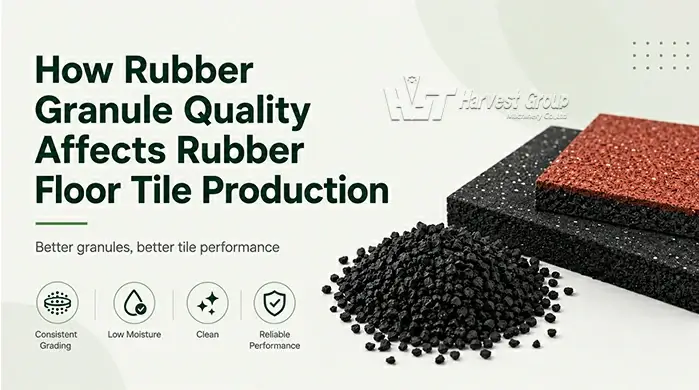
Rubber floor tiles may look like relatively simple molded products, but their final quality depends heavily on the rubber granules used as raw material. Even when two factories use similar molds, polyurethane (PU) binders and pressing equipment, the tiles they produce can differ significantly in strength, density, surface finish, edge quality and service life. In many cases, these differences are linked not to the press or mold itself, but to the quality and consistency of the rubber granules.
For flooring-grade material, particle size distribution, cleanliness, residual steel and textile fiber, dust content, moisture, particle shape, bulk density and batch consistency all matter. Some manufacturers also monitor ash content as an additional indication of non-rubber inorganic material. These properties affect how the granules mix with PU binder, how evenly the mixture fills the mold, how the tile compacts and cures, and ultimately how stable the finished product is.
For manufacturers producing gym flooring, playground safety tiles, interlocking rubber tiles, black SBR tiles or products with an EPDM surface layer, controlling raw-material quality is therefore part of controlling the entire rubber tile production process.
Most recycled rubber floor tiles are produced from SBR rubber granules, while some products use an SBR base layer combined with colored EPDM granules on the surface. The granules are screened and inspected, weighed according to the formulation, mixed with PU binder, distributed into molds, pressed or cured, demolded and finally inspected.
The process can be summarized as granule inspection → weighing → PU binder dosing → mixing → mold filling → pressing → curing → demolding → finished tile inspection. Because the rubber granules enter at the beginning of this chain, a change in particle grading, moisture, dust or contamination can influence every stage that follows.
This explains why a factory may continue using the same PU ratio, mixing time, mold and pressing settings but still obtain different results from a new batch of raw material. A stable tile formulation depends first on stable rubber granules.
It is not enough to describe a raw material simply as “1–3 mm rubber granules.” Two batches with the same nominal size can behave differently if one contains more dust, oversized particles, textile fiber or moisture. For regular rubber tile production, several properties should be considered together rather than judging the material by particle size alone.
| Quality Factor | Main Effect on Rubber Tile Production |
| Particle size and grading | Affects PU demand, packing density, porosity, cushioning and surface finish |
| Residual steel | Can affect safety, mold condition, equipment wear and finished surface quality |
| Textile fiber | Can interfere with binder distribution, purity and surface appearance |
| Dust content | Changes total surface area, PU consumption and mixing behavior |
| Moisture | Can interfere with PU curing and contribute to bubbles, voids or unstable bonding |
| Particle shape | Influences packing, mold filling and particle-to-particle contact |
| Bulk density | Affects material weight per mold, finished tile weight, thickness and density |
| Ash / non-rubber impurities | Can indicate changes in material purity or inorganic contamination |
| Batch consistency | Determines how reliably the same production formulation can be repeated |
For a factory running continuously, consistency is often more valuable than one exceptionally good batch. When grading, purity, moisture, bulk density and other basic properties remain within a stable range, the manufacturer can operate with much less adjustment from one production lot to the next.
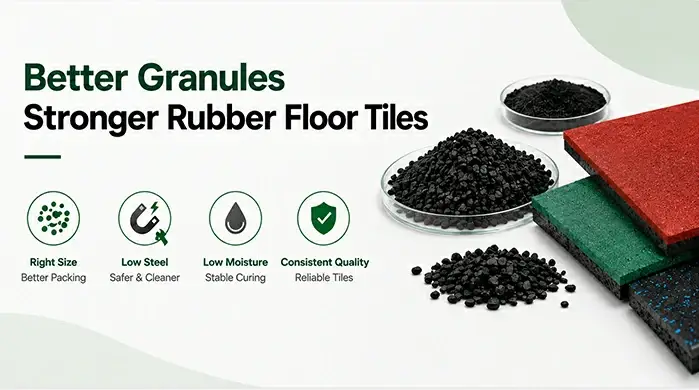
Particle size is one of the most important specifications in rubber floor tile production because it changes both the way the granules pack together and the amount of surface that must be coated by the binder. A supplier may label a product as 1–3 mm, but the actual batch can still contain material below 1 mm, particles above 3 mm and different proportions of each size.
For this reason, particle size distribution is often more useful than nominal size alone. A well-controlled grading allows smaller particles to fill some of the spaces between larger particles, helping the material compact more consistently in the mold. Poor grading, on the other hand, can create large local voids, excessive fines or unstable density.
Particle size also affects more than the visual appearance of the finished granules. It influences PU binder demand, mold filling, finished tile density, internal porosity, cushioning performance, surface smoothness and edge strength. In practical production, these factors are closely connected rather than independent.
Fine rubber granules have a larger total surface area for the same material weight. This can help produce a smoother and denser tile surface, but it also means that more particle surface must be coated with PU binder. If a formulation developed for clean 1–3 mm granules is suddenly used with a batch containing much more fine powder, the mixture may become noticeably drier and more difficult to spread.
When the available binder is no longer sufficient to coat the increased surface area, particles may separate more easily during handling, the mixture may distribute poorly inside the mold, and the finished tile may show reduced bonding or increased surface shedding. A manufacturer may initially assume that the PU binder is the problem, even though the real change occurred in the granule grading.
This does not mean fine particles are undesirable. Properly controlled fines can improve packing and surface finish. Problems usually appear when the amount of fine material changes significantly between batches and the existing production formulation is no longer matched to the raw material.
Coarser particles generally create a more open structure with larger spaces between the granules. This can be useful where cushioning, elasticity or drainage is required, but excessively large particles or poor grading may reduce effective contact between neighboring granules. The result can be rougher surfaces, uneven density or weaker tile edges.
If large particles dominate the formulation, local voids can also become more noticeable. In thicker safety tiles this may be acceptable or even useful for specific cushioning requirements, while in thinner commercial flooring the same structure may result in poor surface appearance or dimensional instability.
The correct size therefore depends on the complete product design rather than on a simple rule that finer or coarser material is always better. Tile thickness, target density, mold design, PU binder and required cushioning performance all need to be considered together.
There is no single universal particle size for all rubber tiles. The ranges below are commonly considered for different flooring applications, but the final formulation should still be verified by production trials.
| Rubber Granule Size | Typical Application | Effect on Production |
| 0.8–2.5 mm | Fine surfaces, selected sports flooring and specific base-layer applications | Denser compaction and larger total particle surface area |
| 1–3 mm | Gym tiles and general-purpose rubber floor tiles | Balance between surface finish, density and structural stability |
| 1–4 mm | Thicker tiles, outdoor flooring and selected industrial products | More open internal structure and noticeable cushioning |
| Mixed grading | Customized rubber tiles | Adjustable density, porosity, PU demand and cushioning performance |
These particle sizes are common application ranges rather than fixed formulas. A 1–3 mm product from one recycling line may not behave exactly like a 1–3 mm product from another if the actual grading curve, dust content or particle shape is different.
An ideal batch of rubber granules for floor tile production does not necessarily consist of particles that are all exactly the same size. Instead, the particles should form a controlled and suitable size distribution. Proper grading allows particles of different sizes to fill the spaces between one another, helping improve mold filling, control tile density, increase effective contact points and optimize PU bonding.
In contrast, if a batch contains both excessive rubber dust and excessive oversized particles, production may become unstable even when the “average particle size” appears acceptable. Rubber tile manufacturers should therefore ideally record sieve analysis results during incoming inspection rather than relying only on descriptions such as 1–3 mm or 1–4 mm.
Particle size is only one part of rubber granule quality. A batch may have the correct nominal size but still perform poorly because of steel, textile fiber, excessive dust, moisture or other contamination. These factors are especially important when recycled tire rubber is used as the raw material.
Waste tires contain significant amounts of steel reinforcement and textile fiber. During tire recycling, steel needs to be progressively separated from the rubber through size reduction and magnetic separation, while fiber is normally reduced through air separation, screening and dust collection.
Fine steel fragments entering mixers, conveying systems or molds can increase equipment wear. Some hard steel pieces may also scratch mold surfaces. If steel fragments enter the mold together with the rubber granules, they may eventually become exposed on the surface of the finished rubber tile, affecting appearance and creating a potential safety issue.
For rubber granules intended for floor tile manufacturing, steel removal requirements are therefore generally more demanding than those for larger tire-derived products such as TDF or coarse rubber chips.
Textile fiber is softer and less obvious than steel, but excessive fiber can still interfere with production. It occupies space inside the mixture without providing the same mechanical behavior as rubber and can change the way PU binder is distributed between neighboring particles.
If fiber accumulates locally during mixing, the actual proportion of rubber in some areas may decrease. This can affect local density and bonding. In black SBR tiles, light-colored fiber can also appear as white or gray spots on the surface, which becomes especially noticeable when the customer expects a uniform black finish.
When fiber content changes significantly from one batch to another, the same production formula may therefore produce different density, surface appearance or bonding behavior.
Some rubber granule suppliers also monitor ash content as an additional quality indicator. Ash can provide information about changes in non-rubber inorganic material, although the acceptable level depends on the raw material source, test method and intended end use.
Ash content should not be used independently to judge whether rubber granules are suitable for tile production. However, if one batch shows a significant increase compared with previous batches from the same supply system, it may be useful to check whether sand, soil, mineral particles or other inorganic contamination has entered the material.
Changes in ash content may also indicate changes in tire feedstock, cleaning efficiency or separation performance. For a rubber tile factory, maintaining reasonable batch stability in this parameter is usually more useful than applying a numerical limit copied from another supplier.
Moisture is another important factor because PU binder systems can be sensitive to water. Rubber itself does not absorb water like a sponge, but moisture can remain on particle surfaces or become trapped in dust and textile fiber.
Outdoor storage, damaged or wet packaging, high warehouse humidity, condensation, exposure during transport and packing rubber before it has cooled sufficiently can all increase the risk of unwanted moisture.
During tile production, excess moisture may interfere with the normal curing reaction. The effect can continue through several stages of the process: moist granules can affect PU reaction behavior, which can reduce curing stability, make demolding less predictable and eventually lead to defects in the finished tile.
Possible symptoms include internal bubbles, voids, local swelling, foam-like areas, surface blistering, unstable bonding or dimensional changes after production. Some moisture-affected tiles may appear normal immediately after demolding, while localized defects only become visible later.
Rubber granules should therefore be stored in a dry, well-ventilated warehouse and protected from rain, condensation and direct contact with wet floors. Some flooring-grade rubber granule suppliers establish relatively strict moisture-control requirements, but the actual limit should be determined according to the tile formulation, PU binder requirements and production conditions.
Rubber dust should be distinguished from properly graded fine particles. Controlled fines may be intentionally included as part of a formulation, whereas excessive dust is often associated with over-grinding, worn screens, poor screening efficiency, inadequate dust collection or repeated material handling.
Because very small particles create a large total surface area, a dusty batch may require more PU binder to achieve comparable coating. If the binder ratio remains unchanged, the mixture may appear dry, spread poorly in the mold and produce weaker bonding or increased surface shedding.
Simply adding more PU binder can improve the mixture temporarily, but it does not remove the underlying raw-material problem. Higher binder consumption increases production cost and may also change tile hardness, density and cushioning behavior.
If PU consumption rises unexpectedly, checking particle grading and dust content should therefore come before changing the production formula. Otherwise, the factory may compensate for inconsistent granules by continually adding more binder, making production cost and product properties less predictable.
Rubber granules produced by mechanical size reduction are naturally irregular rather than perfectly spherical. A certain degree of irregularity can increase useful contact and mechanical interlocking between particles, but the material should still be reasonably consistent.
Problems arise when the batch contains large amounts of long rubber strips, large flakes, partially processed tire pieces or oversized particles. These shapes do not distribute evenly inside the mold and may create areas that are tightly packed next to areas that remain relatively loose.
This variation can eventually result in local differences in density, tile thickness, surface flatness and edge strength. Screening therefore does more than determine the nominal granule size; it also helps the tile manufacturer obtain a more predictable material for mold filling.
Bulk density provides another practical way to monitor raw-material behavior. It represents the weight of rubber granules within a defined volume and is influenced by particle size, grading, particle shape, dust content and moisture.
If bulk density changes significantly between batches, the same volume of material may no longer represent the same weight. Even when the operator follows the same mold-filling procedure, this can result in changes in individual tile weight, thickness, finished density and cushioning performance.
Regular bulk-density checks are therefore useful for identifying changes in the raw material before they affect a larger production batch.
For continuous manufacturing, the ideal raw material is not simply one batch with excellent laboratory values. It is a material that stays predictable from shipment to shipment. Manufacturers normally want particle size distribution, dust level, purity, moisture, bulk density, color and particle shape to remain reasonably consistent.
When these properties are stable, the factory can continue using similar PU binder ratios, mixing times, material weight per mold, pressing pressure, curing temperatures and curing times. When they change frequently, operators have to compensate by repeatedly adjusting the formulation or production settings, which increases both production complexity and the risk of rejected tiles.
This is also why a fixed recipe does not automatically guarantee a fixed result. A factory can use the same weight of rubber and the same quantity of PU binder, but if the new granules contain much more dust or have a different grading, the total surface area and packing behavior have already changed.
For example, a factory may have used the same formulation successfully for months with a relatively stable 1–3 mm material. If a new batch still carries the same 1–3 mm label but contains substantially more fines, the same binder percentage can suddenly produce a dry mixture. The equipment has not changed, the PU binder has not changed and the nominal granule size has not changed, but the actual raw-material behavior has changed.
This is why a fixed production formula does not necessarily mean a fixed production result. A mature formulation can only provide good repeatability when the raw material itself remains reasonably stable.
Raw-material problems are not always obvious during incoming inspection. They often become visible only when the mixture behaves differently, mold filling becomes less consistent or finished tiles begin to show surface or structural defects.
| Production or Tile Problem | Possible Rubber Granule Cause |
| Mixture becomes unusually dry | Higher proportion of fines or rubber dust |
| Binder tends to collect in the mixer | Granules may be too coarse or poorly graded |
| Bubbles or local swelling appear | Moisture in the raw material or unstable curing conditions |
| Internal voids develop | Coarse particles, poor packing or moisture-related problems |
| Tile edges break easily | Oversized particles, uneven packing or insufficient binder coverage |
| Particles shed from the surface | Excessive dust, fiber contamination or weak bonding |
| Tile weight changes between batches | Changes in bulk density or moisture |
| White or gray spots appear on black tiles | Textile fiber or other contamination |
| Surface texture becomes inconsistent | Changes in particle grading, shape or mold filling |
| Metal points are visible | Incomplete steel separation |
| Color varies between production lots | Variation in raw material or EPDM granule batches |
These problems should not automatically be corrected by adding more PU binder or extending curing time. Such adjustments may hide the original cause while increasing production cost or changing the finished tile performance. Raw-material condition should be checked first.
Changes in rubber granule quality can often be identified by examining the finished product. A change in tile thickness may point to variation in bulk density, material weight per mold or mold filling. Changes in density may indicate that the grading or particle structure has changed.
Weak or easily damaged edges may be related to oversized particles, poor local packing or insufficient binder coverage. Surface roughness can increase when coarse particles become more dominant, while excessive fines may create a denser surface and increase binder demand.
For black SBR tiles, white or gray spots may indicate textile fiber or other contamination. In speckled or EPDM-surface tiles, changes in particle size, color or decorative granule mixing ratio can produce visibly uneven surface distribution.
Finished-product inspection therefore provides useful feedback about raw-material stability. When the same defects begin appearing across several tiles in one production lot, checking the incoming rubber granules can be more useful than immediately changing the press.
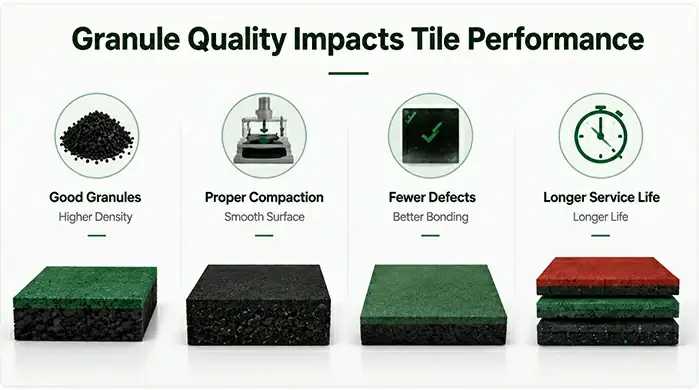
There is no single rubber granule specification suitable for every floor tile. Gym tiles, interlocking tiles, playground safety products, black SBR tiles, outdoor pavers and EPDM-surface tiles place different demands on density, cushioning, surface finish, color and dimensional stability.
| Rubber Tile Type | Typical Granule Structure | Main Quality Focus |
| Gym rubber tiles | Fine to medium SBR granules | Density, wear resistance, cushioning and edge strength |
| Interlocking rubber tiles | Relatively uniform medium granules | Dimensional accuracy, edge quality and consistent density |
| Playground safety tiles | SBR base with selected EPDM surface | Cushioning, interlayer bonding and surface quality |
| Black SBR tiles | Recycled SBR granules | Grading, purity and structural consistency |
| EPDM-surface tiles | SBR base with colored EPDM top layer | Color, surface-particle consistency and batch appearance |
| Thin commercial tiles | Finer, more tightly graded granules | Surface smoothness, thickness and density control |
| Outdoor rubber pavers | Medium or coarse granules | Compression behavior, drainage and dimensional stability |
Gym flooring normally needs a balance between cushioning and structural stability. If the particles are excessively coarse, the internal structure may become too open and the surface rougher. If the proportion of fines is too high, PU demand can increase and the tile may become denser than intended.
For free-weight areas and equipment zones, tile thickness and actual impact conditions should also be considered when selecting the granule grading. A formulation that works well for general gym traffic may not necessarily provide the same performance in areas where heavy weights are repeatedly dropped.
Interlocking rubber tiles place additional emphasis on dimensional and edge consistency because the edge profiles must fit together correctly during installation. If the granules are too coarse or mold filling is uneven, the edges may become one of the areas most likely to be damaged.
Stable grading and bulk density therefore become especially important in interlocking products, where small differences in thickness or edge structure can affect installation across a larger floor area.
Playground safety tiles generally place greater emphasis on impact cushioning and surface safety. The specific granule formulation may be adjusted according to tile thickness, target impact performance, drainage design, mold structure and manufacturing process.
Some multilayer playground tiles use a recycled SBR rubber base layer combined with a colored EPDM surface layer. The base layer mainly provides thickness, cushioning and structural support, while the top layer is responsible mainly for color, weather resistance and surface appearance.
The two layers therefore have different raw-material priorities. The SBR base is more dependent on particle grading, purity, dust control, bulk density and bonding behavior, while the EPDM surface requires tighter control of granule color, particle size and visual consistency.
The main functions of an SBR base layer generally include providing tile thickness, absorbing impact, creating cushioning, forming the main supporting structure and controlling material cost. For this reason, SBR rubber granules are commonly evaluated according to grading, dust content, steel and fiber contamination, bulk density and structural consistency.
EPDM surface layers have much higher appearance requirements. Granule color, color variation, particle size consistency, surface distribution, batch consistency, weather resistance and interlayer bonding all become important.
If EPDM particle color or size changes between batches, the finished surface may show visible differences even when the mechanical strength of the tile remains acceptable.
Good EPDM granules alone cannot prevent delamination if the SBR base contains excessive dust or fiber, or if the interlayer binder and curing conditions are unsuitable. Two-layer rubber tiles therefore need to be evaluated as a complete system involving SBR granules + PU formulation + EPDM surface layer + curing conditions.
Before full-scale production begins, compatibility between the base layer, surface layer and binder should be verified under the actual molding and curing conditions.
Not every incoming batch requires a complex laboratory testing program. Several practical checks can identify many of the problems that affect rubber floor tile manufacturing before a full production run begins.
A representative rubber granule sample can be passed through screens with specified opening sizes to determine the proportions of undersized, acceptable and oversized particles. Recording these results over time gives the manufacturer a clearer picture of batch consistency than relying only on the supplier’s nominal size description.
For example, if a supplier continues to provide material labeled 1–3 mm but sieve analysis shows that the proportion below 1 mm has gradually increased, the factory can identify the change before PU consumption or tile quality is significantly affected.
Visual inspection is also useful. Spreading the granules over a clean, light-colored surface can reveal steel wire, textile fiber, plastic, wood pieces, stones, sand, soil and partially processed tire pieces that may not be obvious when the material is stored in large bags.
A strong magnet can help identify small steel fragments that are difficult to see with the naked eye. If magnetic contamination suddenly increases, the magnetic separation system in the rubber granule production line should be checked further.
Moisture can be compared by controlled drying and weighing. This is particularly useful for raw material that has undergone long-distance transport, outdoor storage or exposure during humid weather.
Bulk density can be monitored by filling a container of known volume using the same procedure for every batch. If the weight of the same volume changes significantly, the manufacturer should check whether particle grading, dust content, particle shape or moisture has also changed.
When changing suppliers or changing rubber granule specifications, it is generally safer to conduct a small production trial before moving directly into full-scale production.
The trial shows how the new material actually behaves with the existing PU formulation, mixer, mold and curing process. The manufacturer can observe mixing behavior, PU coating, mold filling, demolding, surface appearance, tile weight, thickness, density and edge strength.
If these characteristics remain stable, the material can then move into regular production with much lower risk. If they change, the factory has an opportunity to investigate the granules or adjust the formulation before producing a large batch.
Finished tiles themselves can also provide useful information about granule consistency. A sudden change in thickness can point to bulk-density or mold-filling variation, while weak edges may indicate an increase in oversized particles or insufficient binder coverage.
A rougher surface can be linked to a higher proportion of coarse granules. White spots on black SBR tiles may justify checking fiber separation, while uneven decorative speckles may indicate changes in particle size or mixing ratio.
Monitoring these finished-product characteristics helps the factory identify raw-material variation before it affects a larger production lot.
After the rubber granules are coated with PU binder, the mixture needs to be distributed evenly into the mold. This stage directly converts the raw-material characteristics into the physical structure of the finished tile.
Particle size distribution, particle shape and bulk density all influence how the mixture occupies the mold. When the raw material is stable, the mixture can be distributed more consistently according to a predetermined weight, producing more repeatable dimensions, thickness, density and surface structure.
If the raw material varies significantly, one area of the mold may become denser while another remains relatively loose even when the same nominal material weight is used. Poor mold filling should therefore not always be treated only as a mold or press problem; the rubber granules themselves may be responsible.
There is no single fixed PU binder percentage suitable for every rubber floor tile. The appropriate dosage depends on particle size distribution, dust content, total particle surface area, tile thickness, target density, mold design, surface requirements and curing conditions.
Fine particles generally increase the total surface area that must be coated, while coarse particles create larger spaces and fewer contact points. This is why two materials with the same total weight can require different binder behavior.
If the percentage of fine particles changes, PU demand may also change. After changing the rubber granule specification, it is therefore better to repeat mixing and tile production trials rather than mechanically continuing to use the old formulation.
Mixing time should be long enough for PU binder to coat the rubber granules evenly, but it should not be extended indefinitely. If the mixing period is too long, the mixture may begin to cure significantly before mold filling is complete.
A mature production formula therefore needs to control rubber granule quality + PU ratio + mixing time + mold filling time + pressing and curing conditions as one connected system.
Any significant change in the rubber granules should be treated as a change in raw-material conditions. This includes changing suppliers, changing particle size, increasing dust content, changing bulk density or changing moisture condition.
When such a change occurs, a new small-batch trial is more reliable than simply continuing with the previous recipe. Manufacturers should not assume that because the equipment and PU binder remain unchanged, the production result will also remain unchanged.
Once a formulation has been validated, recording batch information makes it easier to identify whether later defects were associated with the granules, binder, mixing process, mold filling or curing cycle.
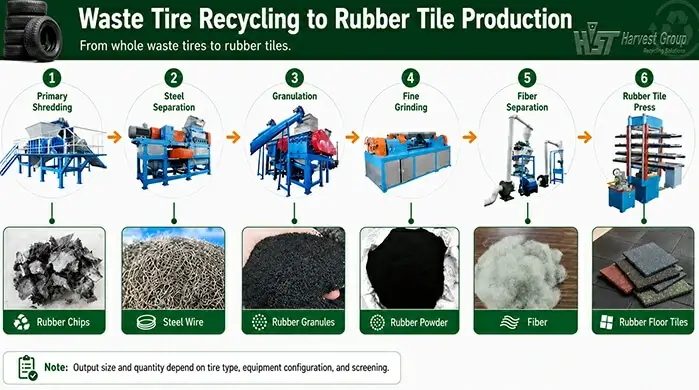
Many of the properties that matter to rubber tile manufacturers are already determined before the granules arrive at the flooring factory. A complete tire recycling plant generally involves primary shredding, secondary size reduction, steel separation, rubber granulation, fiber separation, screening and dust collection.
A complete system of tire recycling equipment, including tire shredding equipment, is required to progressively reduce the tire while controlling particle size, steel contamination, fiber content and dust.
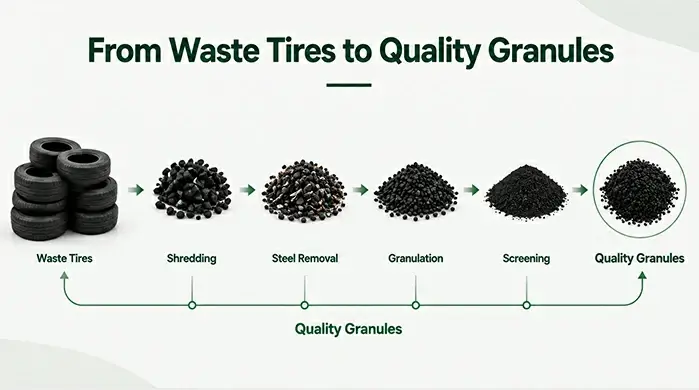
A tire shredder machine normally handles whole or pre-cut tires and produces larger rubber pieces for subsequent processing.The focus at this stage is stable feeding and initial size reduction rather than producing final flooring granules.
A rasper or secondary size-reduction machine then reduces the material further and promotes additional separation between rubber and steel. This stage is important because steel embedded in the tire structure needs to be sufficiently liberated before magnetic equipment can remove it efficiently.
The rubber granulator reduces the rubber to smaller particle sizes suitable for crumb rubber or flooring-grade products. Depending on the final specification, the system may be configured to produce ranges such as 1–4 mm, 1–3 mm or other customized particle sizes.
The granulator alone, however, cannot guarantee final product quality. Magnetic separators are needed to remove steel liberated during size reduction, while air-based fiber separation systems reduce textile contamination.
If the magnetic separation capacity is insufficient or the separator locations are poorly designed, fine steel wire may remain in the final product. If airflow, separator capacity or operating adjustment is unsuitable, textile fiber can remain in the rubber granules even though the particle size itself appears correct.
For flooring-grade rubber granule production, the quality of these separation stages therefore matters just as much as the size-reduction equipment.
Vibrating screens classify the rubber into the required particle ranges and return oversized material for further processing where necessary. If screening accuracy is poor, the finished product may contain excessive oversized particles, fine dust or particles outside the target specification even when the upstream granulation process is stable.
Dust collection affects not only the production environment but also final granule quality. Excessive rubber dust in the finished product changes PU binder demand and mixing behavior at the tile factory.
For this reason, screening and dust collection should not be treated as secondary accessories. When the end product is intended for rubber floor tile manufacturing, they are part of the quality-control system.
If the finished material will be supplied to rubber tile manufacturers, production capacity is only one part of the project. The line should also be evaluated according to target final particle size, grading stability, steel removal, fiber separation, dust control, screening accuracy, product purity and batch-to-batch consistency.
A production line capable of processing more tons per hour is not necessarily more valuable if the final granules require repeated reprocessing or create problems in downstream molding.
For flooring-grade rubber granules, commercial value is closely connected to the ability to supply a predictable material that downstream manufacturers can use without repeatedly changing their production formulations.
A stable rubber floor tile formula starts with a clearly defined raw-material specification. The manufacturer should know the acceptable particle size distribution, dust level, steel and fiber contamination, moisture condition, bulk-density range, color and visual requirements before finalizing the PU binder ratio and processing parameters.
Production trials can then be used to determine binder dosage, mixing time, material weight per mold, pressing conditions, curing temperature and curing time. Only when both the raw material and production process remain stable can a formulation achieve true repeatability.
Keeping batch records makes this much easier. When a defect appears, the factory can compare rubber granule quality, PU binder batch, mixing conditions, mold filling and pressing data rather than trying to correct the problem through repeated trial and error.
Not necessarily. The purchase price of rubber granules is only one part of the total cost of producing rubber floor tiles.
A cheaper material with excessive dust, unstable grading, residual steel, higher fiber contamination or inconsistent moisture may require additional PU binder, more production adjustment and more inspection.
If the material also increases rejected tiles, rework, downtime, labor requirements or customer complaints, the apparent raw-material saving can quickly disappear.
For a factory operating continuously, stable rubber granules can therefore be more economical than simply choosing the lowest-priced material. Predictable granules reduce unnecessary changes in PU consumption, shorten adjustment time and make finished tile quality easier to control.
A stable raw material allows a factory to keep the same basic formulation for longer periods. Operators spend less time changing PU ratios, adjusting material weight per mold or modifying curing conditions simply to compensate for variation in the granules.
This also makes production planning easier because tile weight, density, thickness and curing behavior become more predictable. Even if a higher-quality rubber granule costs slightly more per ton, the total production cost may still be lower when reduced binder consumption, lower rejection rates and fewer production interruptions are taken into account.
Rubber granule quality affects rubber floor tile production from the first mixing step through mold filling, pressing, curing and final inspection. Particle size distribution determines how the material packs and how much particle surface must be coated with binder; steel and fiber contamination affect purity and appearance; dust changes PU demand; moisture can interfere with curing; and bulk-density variation can change tile weight, thickness and density.
The overall relationship can be summarized as rubber granule quality → PU binder mixing → mold filling → pressing → curing → demolding → finished rubber tile quality. A change at the raw-material stage can continue through the entire production process.
For example, an increase in fine rubber powder increases total particle surface area, which may lead to insufficient PU coverage, a drier mixture, poorer mold filling and eventually particle shedding from the finished tile. Excess moisture can affect PU curing, create internal bubbles and result in unstable tile structure.
When rubber granules are clean, consistently graded and stable from batch to batch, the manufacturer can maintain a more repeatable formulation, reduce unnecessary PU consumption and produce rubber tiles with more consistent dimensions, density, surface appearance and edge strength.
For waste tire recycling companies supplying raw material to gym tile, playground tile, interlocking flooring and EPDM-surface tile manufacturers, this also means that a recycling line should be evaluated by more than processing capacity alone.
Primary shredding, secondary size reduction, steel separation, rubber granulation, fiber separation, screening and dust collection need to work as a complete system. Only by consistently controlling particle size, residual steel, textile fiber, dust and batch quality can a tire recycling line produce high-quality recycled rubber granules suitable for downstream rubber floor tile manufacturing.