Crumb rubber size has a direct influence on how a rubber floor tile looks, feels, bonds and performs. Granules that are too fine may produce a smooth, dense surface, but they also increase the total surface area that must be coated with binder. Material that is too coarse can leave visible pores, create uneven density and make it more difficult to form clean corners or interlocking edges.
For most general-purpose rubber floor tiles, 1–3 mm crumb rubber is a practical starting range. It is fine enough to fill a mould evenly while still retaining the resilient granular structure expected from recycled rubber flooring. A finer 0.8–2.5 mm grade may be preferred for thinner gym tiles or products that need a tighter surface, while 1–4 mm and 2–4 mm grades are often considered for thicker safety tiles and cushioning layers.
These size ranges should be treated as manufacturing guidelines rather than universal standards. The final choice depends on the tile thickness, mould design, target density, binder system, pressing conditions and required impact performance.
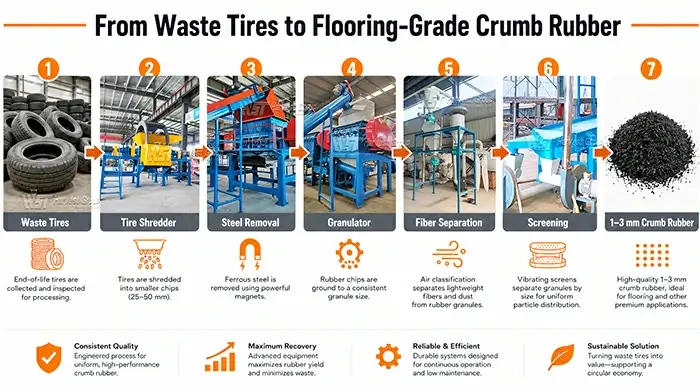
Crumb rubber is recycled vulcanized rubber produced by reducing scrap tires into controlled particle sizes. During processing, steel wire and textile fibre are removed, the rubber is granulated, and screens classify the material into commercial grades. Oversized pieces are normally returned to the size-reduction process, while magnets, air separators and dust-control systems improve the purity of the finished rubber.
The term covers a broad range of material, from relatively coarse granules to fine rubber powder. Floor-tile manufacturers normally purchase a defined particle range rather than an uncontrolled mixture because consistent sizing makes it easier to manage tile weight, density, binder consumption and surface appearance.
| Flooring Product | Typical Crumb Rubber Range | Why It Is Used |
| General rubber floor tiles | 1–3 mm | Provides a practical balance of density, resilience, surface texture and mould filling |
| Gym and fitness tiles | 0.8–2.5 mm or 1–3 mm | Creates a stable surface while retaining shock and vibration absorption |
| Interlocking rubber tiles | 1–3 mm | Helps form cleaner corners, edges and interlocking profiles |
| Playground safety tiles | 1–4 mm or a controlled blend | Combines structural support with cushioning in thicker products |
| Thick impact-absorbing tiles | 2–4 mm or blended granules | Creates a more open internal structure with greater compression space |
| Two-layer SBR and EPDM tiles | 0.8–2.5 mm, 1–3 mm or 2–4 mm for the base | The base size is selected according to tile thickness, density and impact requirements |
| Colored EPDM wear layer | Fine, uniformly graded EPDM granules | Improves color distribution and produces a more consistent visible surface |
| Industrial rubber tiles | 1–3 mm or 1–4 mm | Provides durability, dimensional stability and a practical production cost |
A 1–3 mm grade is small enough to spread evenly across the mould and enter corners, surface patterns and interlocking details. At the same time, the particles remain large enough to preserve the granular structure of recycled tire rubber. This makes the range suitable for many standard moulded tiles without requiring the additional grinding stages needed for fine rubber powder.
Coarser material can work well in thick products, but it may not fill narrow profiles as consistently. Very fine material packs closely but normally requires more careful control of binder coverage, dust and compaction.
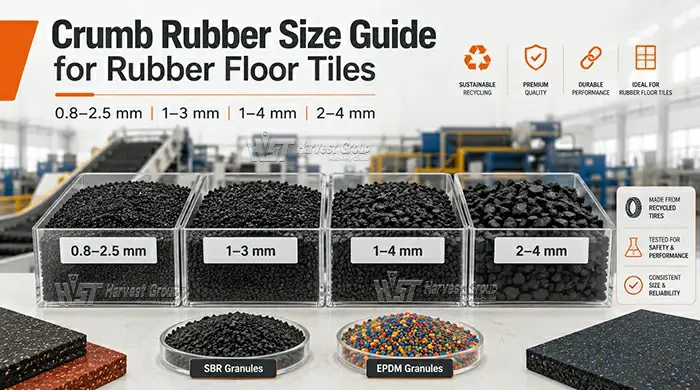
Tiles made with 1–3 mm granules usually retain a visible recycled-rubber texture without appearing excessively coarse. The surface can remain sufficiently dense for gyms, commercial flooring and interlocking tiles while still providing traction and resilience.
Where a smoother finish is required, manufacturers may move toward 0.8–2.5 mm or introduce a finer surface layer. Where appearance is less important than cushioning, a wider or coarser grade may be more economical.
Medium-size crumb rubber flows, screens and mixes more predictably than very fine powder. It is also less likely to produce the heavy dust loading associated with additional grinding. For a plant supplying several flooring customers, 1–3 mm is a flexible commercial grade that can be tested in gym tiles, mats, interlocking products and other compression-moulded items.
Fine granules fill small spaces between particles and normally produce a closer, more uniform surface. Grades such as 0.5–2 mm or 0.8–2.5 mm may therefore suit thinner tiles, decorative products and visible wear layers where large pores are undesirable.
Coarse granules create a more pronounced texture. In a thick playground tile or impact pad, that open structure may be useful because the product has more space to compress. In a thin commercial tile, however, the same material may leave a rougher finish and make dimensional control more difficult.
Particle size affects how closely the rubber packs under pressure. Fine and medium particles tend to form a denser structure, while coarse material leaves larger voids. Neither structure is automatically better. A gym tile must remain stable beneath exercise equipment, whereas a playground tile needs sufficient deformation to absorb impact.
The correct density is therefore application-specific. Increasing pressure or adding more fine material may improve dimensional stability, but excessive compaction can reduce the resilient feel that buyers expect from recycled rubber flooring.
Interlocking tiles and products with detailed mould profiles benefit from a uniform medium or fine grade. Irregular oversized pieces may bridge across narrow sections of the mould, leaving incomplete corners, weak locking tabs or small gaps after installation.
Particle uniformity is especially important when the same mould is expected to produce tiles with consistent length, width and thickness over long production runs. Stable granules reduce the need to adjust charge weight and pressing conditions from batch to batch.
Coarse particles can create a more open internal structure and provide additional deformation space in thick flooring products. This is one reason wider or coarser grades are often considered for playground tiles and shock-absorbing base layers.
Particle size alone does not establish impact performance. Tile thickness, density, binder content, substrate, pressing conditions and the complete layer structure must be evaluated together. Playground surfacing should be tested as a finished system according to the standards applicable to the intended market rather than approved solely on the basis of granule size.
| Particle Range | Typical Characteristics | Floor-Tile Considerations |
| Below 0.5 mm | Very high surface area and powder-like behavior | More often used as a controlled filler or blended fraction than as the only tile material |
| 0.5–2 mm | Fine texture and close packing | Useful for smooth surfaces, thin tiles and decorative wear layers |
| 0.8–2.5 mm | Medium-fine structure with relatively uniform compaction | Suitable for gym tiles, indoor flooring and selected SBR base layers |
| 1–3 mm | Balanced density, elasticity and processability | A practical general-purpose range for many rubber floor tiles |
| 1–4 mm | Wider grading with both fine and coarse particles | Commonly considered for thicker tiles and safety flooring when the distribution is controlled |
| 2–4 mm | Coarser texture and more open internal structure | Better suited to thick cushioning layers than to thin, detailed interlocking tiles |
| Above 4 mm | Large particles with wider spaces between granules | Normally blended with smaller material or reserved for specialized thick products |
The two ranges overlap substantially, so one cannot be described as universally better than the other. A 0.8–2.5 mm grade contains a slightly finer upper and lower range and may produce a tighter surface in thin gym tiles or products with detailed edges. It can also be useful where the manufacturer wants a more refined appearance without changing to rubber powder.
A 1–3 mm grade is slightly broader and remains a versatile option for ordinary floor tiles, interlocking products and general moulded rubber flooring. It may offer a practical balance between surface quality, elasticity, processing cost and commercial availability.
The difference should be confirmed through tile trials. Two suppliers can use the same nominal size description but deliver different particle distributions, dust levels and proportions of oversized material. For that reason, a sieve analysis is often more useful than the product name alone.
Yes. A controlled 1–4 mm blend can be used in general-purpose tiles, playground products and thicker cushioning surfaces. The smaller fraction fills some of the voids between larger granules, while the coarse fraction retains a more open and resilient structure.
The word controlled is important. A properly classified 1–4 mm product is different from a random stream containing powder, irregular chips and material above the specified range. If coarse particles dominate the blend, thin tiles may develop rough surfaces or incomplete edges. If fines are excessive, binder consumption and tile density may change unexpectedly.
A narrow particle range makes it easier to repeat tile weight, density, surface texture and binder dosage. It is often preferred for standardized gym tiles, precision interlocking products and production lines where consistency is more important than maximizing the use of every screened fraction.
A blend of fine and coarse granules can improve packing without eliminating all internal voids. This approach is useful in thick products where the manufacturer wants enough density for structural support but still needs resilience and impact absorption.
The formulation should specify the percentage of each fraction, the maximum allowable fines and the tolerance for oversized particles. Simply mixing every available output together is unlikely to produce a stable floor-tile formulation.
Recycled rubber floor tiles are commonly produced by mixing crumb rubber with a polyurethane binder before the material enters the mould. The next step is to use suitable rubber tile making machine to complete mould filling, pressing and curing, ensuring consistent tile thickness and density.
Coarse granules expose less surface area, but the spaces between them are larger. Insufficient binder can leave weak contact points and reduce cohesion. Adding excessive binder is not an ideal solution because it increases cost and can alter hardness, flexibility, curing behavior and surface appearance.
The working ratio should be established through production trials using the intended particle distribution, tile thickness, mould pressure and binder grade. A formulation developed for 0.8–2.5 mm granules should not automatically be applied to a 2–4 mm product without verification.
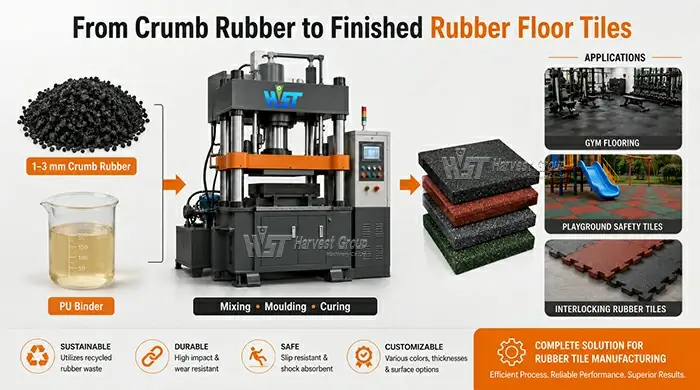
Uniform granules spread more evenly across the mould and make it easier to control the material charge in each cavity. Fine and medium particles normally enter corners and interlocking details more readily than oversized pieces. Poor distribution at this stage may remain visible after pressing as low-density areas, open pores or incomplete edges.
Pressure determines how closely the rubber particles are packed and helps establish the final tile thickness. Fine material generally compacts more tightly, while coarse granules retain more void space. The pressing program must match the intended density instead of using the same settings for every particle grade.
Depending on the binder system and tile process, controlled heat may be applied during pressing or the moulded product may undergo a separate curing stage. Curing time varies with the binder, tile thickness, mould temperature and production method. Incomplete or inconsistent curing can contribute to weak bonding, dimensional instability and premature surface breakdown.
A product labeled 1–3 mm should contain a predictable percentage of material within that range. Excess powder increases the area requiring binder, while oversized granules interfere with mould filling and surface uniformity. An unstable particle distribution also forces the tile manufacturer to keep adjusting charge weight, mixing time and press settings.
ASTM D5644 provides a method for determining the particle-size distribution of recycled vulcanizate particulate rubber, while ASTM D5603 provides a classification framework for this type of recycled rubber material. These references are useful when buyers and producers need a clearer specification than a broad commercial size description.
Flooring-grade crumb rubber should contain very low levels of exposed steel and textile fibre. Residual wire can damage downstream machinery or create sharp inclusions in the finished tile. Excess fibre can interfere with binder contact, create an uneven texture and reduce batch consistency.
Effective tire recycling therefore relies on several separation stages rather than a single magnet or air separator. The required purity should be agreed before the recycling plant is configured, especially when the output will be used for playground, indoor or precision-moulded products.
Dust is not simply a housekeeping issue. Excess fine material can absorb additional binder and change the way the mixture flows into the mould. Screening and de-dusting should therefore be designed to maintain a stable fines content rather than removing material only when visible dust becomes excessive.
Wet crumb rubber can interfere with some polyurethane binder systems and contribute to foaming, bubbles or inconsistent bonding. Granules should be stored under dry conditions, and moisture limits should follow the binder supplier’s recommendations and the manufacturer’s own production trials.
Particle size cannot compensate for an unstable binder or poorly processed feedstock. A consistent tile requires repeatable rubber composition, particle distribution, binder quality, mixing conditions and curing control. These factors should be evaluated as one formulation rather than as independent purchasing specifications.
Single-layer tiles use one rubber-and-binder mixture throughout the product thickness. A 1–3 mm grade is a practical choice for many gym tiles, mats and general-purpose interlocking products because it offers consistent appearance and manageable moulding behavior.
Thicker single-layer tiles may use a wider distribution when additional cushioning is required, but the effect on density, surface texture and edge strength should be confirmed before continuous production.
Two-layer tiles normally use recycled black SBR crumb rubber in the structural base and colored EPDM granules in the visible wear layer. The base provides most of the tile thickness and impact response, while the upper layer controls color, weathering performance and appearance.
The SBR base may use 0.8–2.5 mm, 1–3 mm, 2–4 mm or a controlled blend, depending on the required thickness and density. The EPDM surface is usually made from a relatively uniform colored granule so that the finished tile has an even visual texture. The two layers do not need to use the same particle size because they perform different functions.
Many international projects describe crumb rubber in millimeters, while some buyers use mesh terminology. The two systems should not be treated as interchangeable product names without clarification. A mesh designation describes the screen through which material passes or on which it is retained, and terms such as “20 mesh minus” indicate a passing requirement rather than a narrow millimeter range.
| Specification Method | What It Describes | What the Buyer Should Confirm |
| Millimeter range | A stated lower and upper particle-size range | Percentage within range, allowable fines and allowable oversize |
| Mesh designation | The sieve opening used to classify the rubber | Sieve standard, retained percentage and whether the grade is a minus specification |
| Commercial product name | A supplier’s general description of the output | Actual sieve-analysis report and batch tolerance |
For equipment selection and international quotations, specifying the required millimeter distribution together with permitted fines and oversize is normally clearer than relying on mesh terminology alone.
Whole tires first pass through a waste tire shredder machine, which reduces them to manageable tire shreds or rubber chips. The purpose of this stage is not to produce finished floor-tile granules, but to prepare a consistent feed size for downstream steel liberation and granulation.
Raspers or secondary reduction machines continue breaking down the tire chips and expose the embedded steel. Magnetic separation removes the liberated wire before the rubber enters the finer granulation stages. The arrangement must suit the tire feedstock because passenger tires, truck tires and OTR tires contain different proportions and structures of reinforcement material.
Granulators reduce the cleaned rubber to several millimeters. Air separation removes textile fibre, while vibrating screens divide the material into saleable grades such as 0.8–2.5 mm, 1–3 mm and 2–4 mm. Oversized material can be recirculated to the granulator instead of entering the finished product.
A complete selection of tire recycling equipment must therefore be evaluated as a connected system. Shredder capacity, separation efficiency, granulator load and screen area all affect whether the final crumb rubber remains clean and consistent.
A tire recycling plant intended to supply rubber-flooring manufacturers should be designed around the required output sizes and hourly demand. After producing qualified crumb rubber, manufacturers can further process the material into finished products with a rubber floor tile production machine for different applications such as gym flooring, playground tiles and interlocking rubber tiles.
The crumb rubber line should also be matched to the downstream tile operation. Producing more 1–3 mm material than the tile presses can consume creates unnecessary storage, while insufficient granulation capacity can leave the moulding section waiting for raw material.
| Project Information | Why It Matters |
| Target crumb rubber size | Determines granulator duty, screen openings and recirculation requirements |
| Required hourly capacity | Sets the capacity of shredding, separation, granulation and screening stages |
| Feed tire type | Affects steel content, fibre content, cutter configuration and equipment load |
| Number of finished grades | Determines the screen deck arrangement and product collection system |
| Maximum steel and fibre content | Defines the required magnetic and air-separation stages |
| Tile type and thickness | Helps establish the most useful granule range and production balance |
| Binder and moulding process | Affects the acceptable fines content, moisture requirement and particle distribution |
| Packaging and storage method | Influences finished-product handling and moisture control |
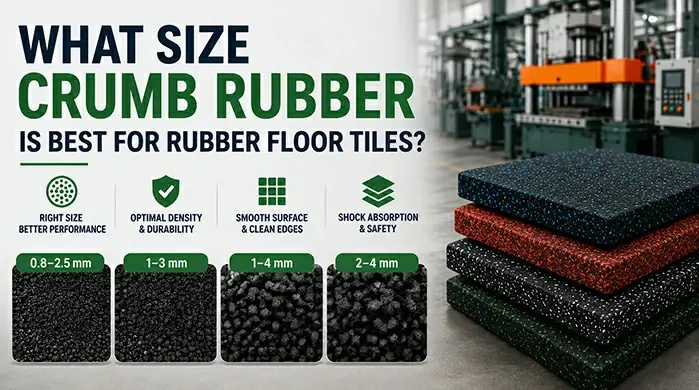
Most gym and fitness tiles can be developed using 0.8–2.5 mm or 1–3 mm crumb rubber. The finer grade may produce a tighter surface, while 1–3 mm remains a versatile option for general gym flooring. Final selection depends on tile thickness, equipment load, binder ratio and target density.
Playground tiles may use 1–4 mm granules, 2–4 mm granules or a controlled blend, particularly in thick cushioning layers. The size alone does not establish fall protection. The complete installed surfacing system should be tested for the required impact attenuation and critical fall height.
Not necessarily. Fine material can improve surface smoothness and edge formation, but it increases the total area requiring binder and may create an excessively dense product. The correct size depends on whether the tile requires firmness, cushioning, appearance or a combination of these properties.
It can be used in sufficiently thick products, but coarse or irregular particles may not fill detailed locks and thin edges as consistently as a medium-size grade. Trial moulding is recommended before a coarse formulation is approved for continuous production.
A controlled fine fraction may fill some spaces between larger particles, but excessive powder can increase binder demand and change density. The powder percentage should be part of a defined formulation rather than an uncontrolled by-product of poor screening.
Yes. Fine particles expose more surface area, while coarse particles leave larger gaps. Both conditions affect how the binder coats and connects the rubber. Binder dosage should be tested with the actual particle distribution rather than calculated only from the nominal product size.
No. ASTM standards covering rubber floor tiles and bonded rubber crumb floor coverings address product characteristics and performance requirements, but they do not establish 1–3 mm as a universal raw-material size. The granule range is selected by the manufacturer according to the product design and verified through finished-product testing.
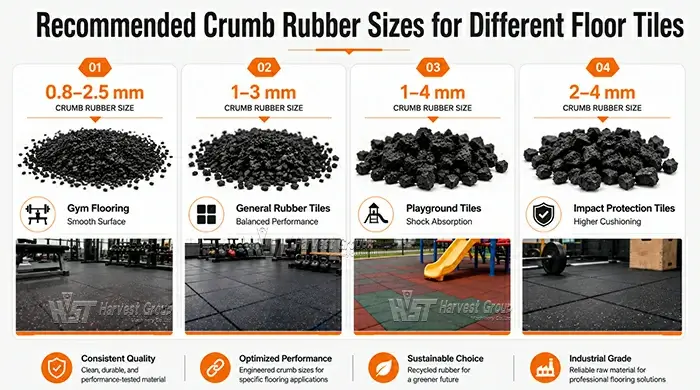
For most general-purpose rubber floor tiles, 1–3 mm crumb rubber offers a reliable balance of mould filling, surface quality, density, resilience and production cost. A 0.8–2.5 mm grade is useful when the tile needs a tighter surface or more precise edge formation, while 1–4 mm and 2–4 mm grades may be better suited to thick cushioning products and structural base layers.
The nominal size is only one part of the specification. Particle distribution, fines, oversize, steel, fibre, moisture, binder quality, pressure and curing conditions all influence the final tile. The most dependable approach is to define the intended floor tile first, produce a controlled crumb rubber grade, and confirm the formulation through moulding and performance tests.
1. U.S. Environmental Protection Agency. Tire Crumb Questions and Answers . Information on tire-crumb production, scrap tire size reduction, steel and fabric removal, screening, magnetic separation and air separation.
2. ASTM International. ASTM D5644-23 — Standard Test Method for Determination of Particle Size Distribution of Recycled Vulcanizate Particulate Rubber . A test method for determining the particle-size distribution of recycled vulcanized rubber using mechanical sieve analysis.
3. ASTM International. ASTM D5603-23 — Standard Classification for Recycled Vulcanizate Rubber . A classification covering recycled vulcanized particulate rubber produced to a desired particle-size distribution.
4. ASTM International. ASTM F3041-14(2024) — Standard Specification for Bonded Rubber Crumb Floor Coverings . Requirements concerning the compound and physical characteristics of bonded rubber crumb floor coverings.
5. ASTM International. ASTM F1344-21a — Standard Specification for Rubber Floor Tile . Requirements for the compound and physical characteristics of homogeneous and layered rubber floor tiles.
6. U.S. Consumer Product Safety Commission. Public Playground Safety Handbook, July 2025 . Guidance on unitary playground surfacing, rubber mats and tiles, impact testing, installation and maintenance.
7. ASTM International. ASTM F1292-22 — Impact Attenuation of Surfacing Materials Within the Use Zone of Playground Equipment . Performance and testing requirements concerning the impact attenuation of playground surfacing materials.
8. ASTM International. ASTM F1951-21 — Accessibility of Surface Systems Under and Around Playground Equipment . A specification for evaluating the accessibility of playground surface systems.
The particle-size ranges in this article are typical manufacturing and purchasing references, not universal product standards. Final crumb rubber size, binder ratio, tile density, curing conditions and finished-product performance should be verified according to the tile design, intended application and standards applicable in the target market.