Rubber tiles are widely used in community walkways, children’s playgrounds, gyms, sports fields, and other applications because of their anti-slip, wear-resistant, shock-absorbing, environmentally friendly, and recyclable properties. Recycled crumb rubber from waste tires is one of the main raw materials used in rubber tile production.
Compared with conventional plastic materials, recycled tire crumb rubber offers better cost performance and higher resource recycling efficiency, making it a mainstream material for environmentally friendly rubber tile production. However, coarse crumb rubber that has not undergone deep purification usually contains residual steel wire, textile fiber, dust, and other impurities, which directly affect the finished quality and market compliance of rubber tiles.
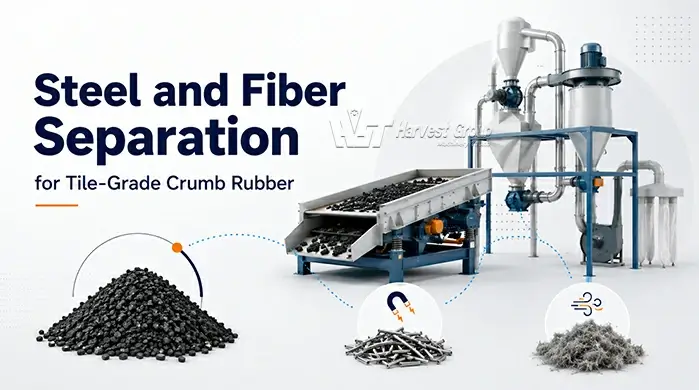
During the molding and vulcanization of rubber tiles, residual contaminants in crumb rubber can cause a series of production problems and quality defects.
Fine steel wire contaminants have high hardness. They can wear or block production equipment and molds, shorten equipment service life, and create surface bumps and black spots after the rubber tiles are formed. These defects can affect the flatness and appearance of the tiles. In serious cases, steel contamination may cause local stress concentration, resulting in cracking or damage during use.
Textile fiber from tires is fluffy and highly absorbent. When evenly mixed into crumb rubber, it can prevent the adhesive from fully bonding with the rubber particles, resulting in poor bonding, particle shedding, and delamination after tile molding. This significantly reduces the wear resistance and service life of rubber tiles.
Fiber contamination can also make crumb rubber appear fluffy and gray, resulting in uneven color and a rough texture in finished rubber tiles, making it difficult to meet the requirements of high-quality engineering projects.
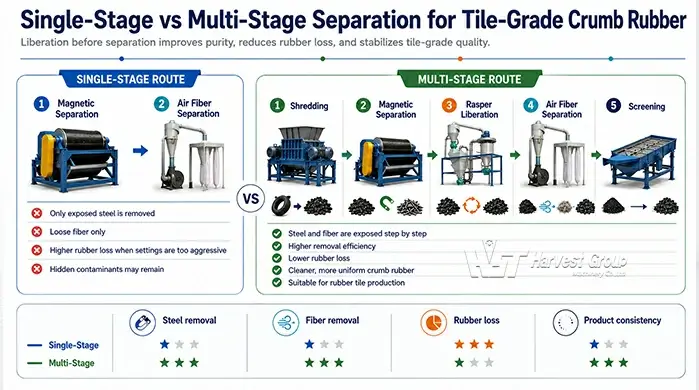
To control production costs, some small crumb rubber processing plants use only a single magnetic separator for steel removal and a single air separator for fiber removal.
This simple impurity-removal process can only remove large exposed steel wires and loose fibers from the surface of the crumb rubber. It cannot effectively remove hidden contaminants embedded inside the rubber particles. As a result, the impurity removal qualification rate is generally low, making it difficult to meet the raw material requirements for rubber tile production.
To improve impurity removal, single-stage separation equipment often operates with stronger airflow or greater magnetic force. This approach can easily cause unnecessary loss of high-quality rubber particles and reduce raw material utilization.
At the same time, fine steel fragments and short fiber contaminants may still remain in the product, creating the production problem of “incomplete impurity removal combined with high raw material loss.” This process is therefore unsuitable for large-scale production of high-quality crumb rubber for rubber tiles.
According to U.S. EPA (Environmental Protection Agency) standards for recycled tire crumb rubber production, the core logic for producing high-quality industrial crumb rubber is progressive size reduction, gradual impurity liberation, precise classification and separation, and particle-size grading.
Unlike ordinary crushing processes, the purpose of producing crumb rubber specifically for tiles is not simply to reduce rubber particle size. Instead, multiple size-reduction stages are used to gradually separate the steel wire and textile fiber that are tightly bonded to the rubber matrix, creating the conditions required for precise impurity removal.
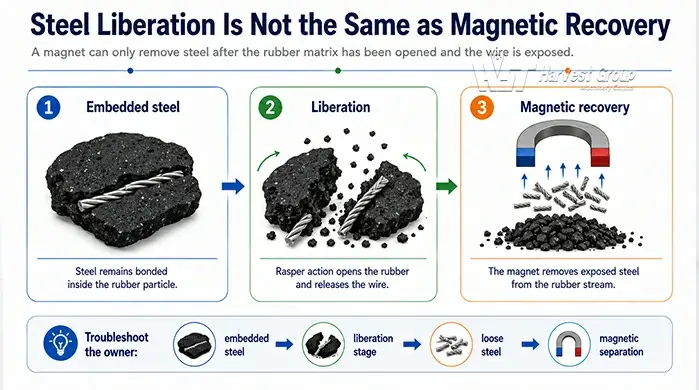
Waste tires are a tightly bonded composite consisting of rubber, steel reinforcement layers, and textile cords.
After initial shredding, the rubber material may appear to have already been reduced into particles, but large quantities of fine steel wire and short fiber can still remain embedded inside the rubber.
No separation equipment can effectively remove hidden contaminants that have not yet been liberated. Therefore, complete impurity liberation is the basic requirement for efficient separation and the core design principle of a multi-stage purification process.
Only through progressive crushing and grinding can embedded contaminants be fully exposed and separated from the rubber matrix, allowing steel and fiber to be thoroughly removed.
| Comparison Item | Traditional Single-Stage Separation | Multi-Stage Liberation and Separation | Suitability for Rubber Tile Production |
| Steel Removal Rate | 85%–90% | ≥99.9% | Multi-stage process fully meets requirements |
| Fiber Removal Rate | 80%–88% | ≥99.5% | No residual fluffy fiber with multi-stage process |
| Rubber Material Loss Rate | 8%–12% | 2%–3% | Multi-stage process significantly reduces costs |
| Ability to Remove Hidden Contaminants | None; only surface contaminants are removed | Strong; contaminants are thoroughly removed after liberation | Single-stage process cannot meet high-end tile requirements |
| Finished Crumb Rubber Uniformity | Uneven, with dust and fiber contamination | Uniform particle size, clean and dry | Multi-stage process is suitable for compression molding |
Based on the high-purity raw material requirements of rubber tile production, the commonly used standardized multi-stage purification process is as follows:
Whole Tire Feeding → Primary Shredding → Primary Magnetic Steel Separation → Fine Liberation and Grinding → Secondary Magnetic Steel Separation → Precision Granulation → Air Fiber Separation → Multi-Stage Screening → Deep Final Purification → Finished Crumb Rubber for Tile Production
This standardized process can be integrated into a complete tire recycling plant according to the required crumb rubber size and purity.
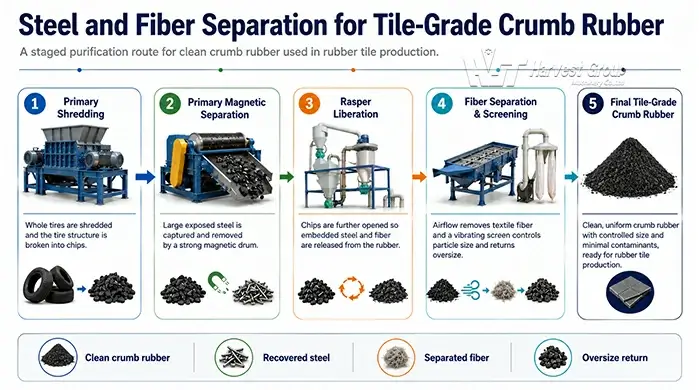
<1. Primary Shredding: Whole waste tires are shredded into 5–10 cm rubber blocks using a tire shredder machine. This breaks the overall tire structure, separates most large steel wires and surface fibers, reduces the material size, and prepares it for subsequent fine liberation.
2. Primary Magnetic Separation: High-strength magnetic equipment completely recovers large exposed steel wires and steel sections after primary shredding, preventing large metal contaminants from damaging downstream fine grinding equipment and completing the initial steel-removal stage.
3. Fine Liberation and Grinding: This is the core liberation stage. A dedicated rasper is used to process the rubber blocks so that fine steel wires and short fibers embedded inside the rubber are completely stripped and exposed without damaging the quality of the rubber particles, achieving complete impurity liberation.
4. Secondary Magnetic Steel Separation: Fine steel fragments and tiny steel particles exposed after liberation are precisely captured and removed, compensating for the limitations of the primary magnetic separation stage and achieving complete removal of steel contamination.
5. Precision Granulation: Clean rubber material after steel removal is processed into uniformly sized rubber granules. At the same time, bonded fibers are further loosened, creating a suitable material condition for air separation.
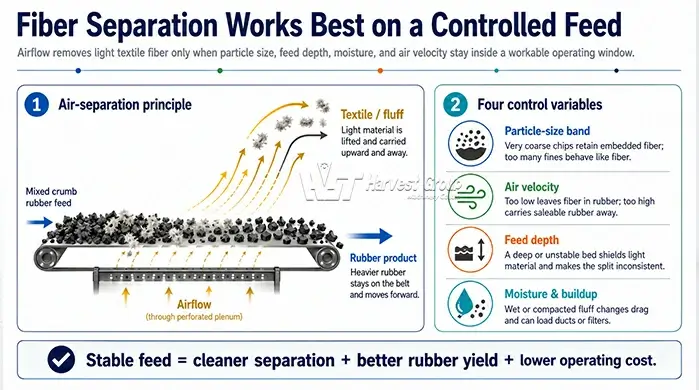
6. Air Fiber Separation: Based on aerodynamic principles and the difference in specific gravity between rubber and fiber, lightweight textile fibers, dust, and fluffy contaminants are accurately removed while high-density clean rubber particles are retained.
7. Multi-Stage Screening and Deep Purification: Multi-layer vibrating screens classify the crumb rubber by particle size and select particles that meet rubber tile production standards. At the same time, residual fine contaminants are removed again, resulting in high-purity crumb rubber with no steel wire or fiber contamination.
The multi-stage separation process follows the principle of “coarse separation before fine separation, and liberation before purification.” It can thoroughly remove both large and small steel contaminants as well as long and short fiber contaminants, with an impurity removal rate of more than 99.9%.
The finished crumb rubber has high purity, uniform particle size, and no fluffy fiber residue. Rubber tiles produced from this material have a flat surface, uniform color, and strong bonding performance, significantly improving the finished-product qualification rate and service life.
Compared with the aggressive impurity-removal approach of a single-stage process, a multi-stage process removes contaminants selectively at different stages without excessively processing high-quality rubber particles.
This effectively reduces raw material loss and improves the utilization rate of rubber from waste tires while lowering production costs and maintaining product quality.
The complete process offers a high degree of automation and standardized operation, making it suitable for large-scale production in major crumb rubber processing plants.
The finished crumb rubber can meet the raw material requirements for high-end applications such as playground rubber tiles, gym flooring tiles, and municipal walkway tiles, and is suitable for most rubber tile production processes.
| Inspection Item | Industry Qualification Standard | Multi-Stage Process Product Specification | Effect of Exceeding the Limit |
| Residual Steel Content | 0 contaminants | 0 contaminants | Mold wear, surface protrusions, and tile cracking |
| Residual Fiber Content | ≤0.05% | ≤0.01% | Bonding failure, particle shedding, and delamination |
| Dust Contamination | ≤0.1% | ≤0.03% | Dull tile color and rough surface texture |
| Particle Size Uniformity | ±0.5 mm tolerance | ±0.2 mm tolerance | Uneven molding thickness and uneven stress distribution |
Liberation and grinding are critical to successful impurity removal. Grinding speed and material feeding rate must be strictly controlled to ensure that embedded contaminants are fully liberated.
At the same time, excessive grinding must be avoided because it can produce excessively fine rubber particles and affect the molding performance of rubber tiles.
The magnetic strength of magnetic separation equipment and the air velocity of fiber separation equipment should be adjusted according to material particle size and impurity content.
Parameters should be precisely matched to fine contaminants to prevent either incomplete impurity removal or unnecessary rubber material loss.
Rubber tiles used in different applications require different crumb rubber particle sizes.
Multi-stage screening should therefore be used for precise classification, and finished crumb rubber should be stored separately according to particle size so that production can be matched to specific requirements and stable tile molding performance can be maintained.
| Production Stage | Key Control Parameters | Standard Value Range | Control Purpose |
| Fine Liberation and Grinding | Equipment Speed, Feeding Rate | 300–400 r/min, Uniform Feeding | Fully liberate contaminants and avoid over-grinding |
| Secondary Magnetic Steel Separation | Magnetic Field Strength | 8000–10000 GS High-Strength Magnetic Field | Thoroughly capture fine steel fragments |
| Air Fiber Separation | Air Velocity, Air Pressure | 12–15 m/s Air Velocity, Constant Negative Pressure | Precisely remove fiber without losing rubber particles |
| Multi-Stage Screening | Screen Mesh Selection | 10–40 Mesh Classification as Required | Match different rubber tile production requirements |
Residual steel and fiber contamination are key factors affecting rubber tile quality. Traditional single-stage impurity-removal processes cannot meet the production requirements of high-quality rubber tiles.
By following the core principle of “progressive liberation and step-by-step precision separation,” a standardized process combining multi-stage shredding, multi-stage magnetic separation, air fiber separation, and classified screening can thoroughly remove various contaminants from crumb rubber and produce high-purity, high-quality recycled crumb rubber specifically for rubber tile production.
This process not only ensures the molding quality, wear resistance, and appearance of rubber tiles, but also improves the efficient recycling of waste tire resources. It is currently one of the most compliant and efficient crumb rubber purification solutions for the rubber tile industry.
For industrial production, the complete purification system can be integrated with professional tire recycling equipment according to the required production capacity and finished crumb rubber specification.
Note: Some content may have been AI-generated.
1. Federal Highway Administration. Scrap Tires: Material Description . Engineering reference covering tire size reduction, magnetic steel removal, fiber separation, screening, and crumb rubber processing.
2. U.S. Environmental Protection Agency. Tire Crumb Questions and Answers . Process reference covering progressive tire size reduction, magnetic metal removal, air separation of textile fiber, screening, and oversize return.
3. ASTM International. ASTM D5603-23 — Recycled Vulcanizate Rubber Classification . Classification framework for recycled vulcanized rubber based on material origin and particle-size distribution.
4. ASTM International. ASTM D5644-23 — Particle Size Distribution of Recycled Vulcanizate Particulate Rubber . Standard test method for particle-size distribution and quality control of recycled rubber particles.
5. CalRecycle. What Is a Waste Tire? . Regulatory reference defining crumb rubber as waste-tire-derived rubber granules at or below 6 mm.