A tire cutting machine is used to reduce whole waste tires into manageable sections before shredding, crushing, granulating or grinding. In many tire recycling projects, cutting is an important preprocessing stage because oversized or difficult tires can be reduced to a size that is easier for the downstream shredder to receive and process.
However, not every waste tire requires the same cutting equipment. Passenger car tires, truck tires and giant mining tires differ significantly in diameter, width, weight, tread thickness and steel reinforcement. A standard tire cutter is mainly used for conventional automotive tires, while an OTR tire cutter is designed for large off-the-road tires from mining, quarrying, earthmoving and heavy construction applications.
The difference is not simply that an OTR tire cutter is a larger version of a standard machine. Tire structure, cutting force, material handling, output size and the requirements of the downstream tire shredder machine all influence the correct equipment selection. For this reason, the cutter should be chosen as part of the complete tire recycling process rather than as an isolated machine.
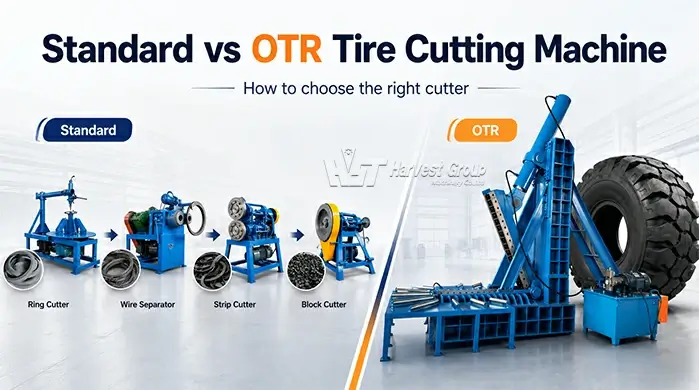
Standard and OTR tire cutters perform the same general function: they reduce whole tires or large tire sections before the next recycling stage. The main difference is the size and construction of the tires they are expected to handle.
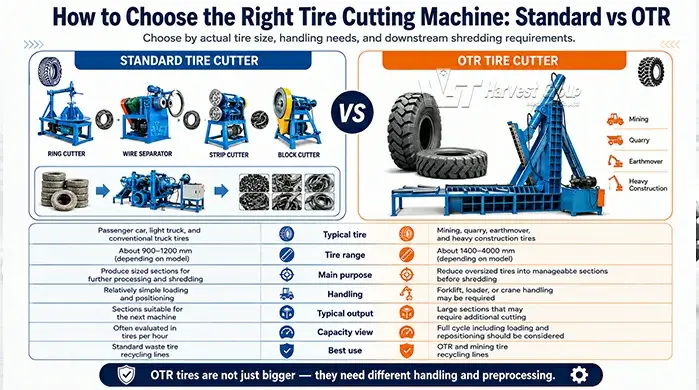
For one typical tire cutting equipment range, standard machines may be configured for automotive tires around 900–1200 mm in diameter, while OTR tire cutters may process oversized tires from approximately 1400 mm up to 4000 mm. These figures should be regarded as machine-specific working ranges rather than a universal industry boundary. Tire diameter is important, but width, weight, tread thickness, bead structure and the required cutting route can also have a major influence on the actual cutting load.
| Comparison | Standard Tire Cutter | OTR Tire Cutter |
| Typical Tire Type | Passenger car, light truck and conventional truck tires | Mining, quarry, earthmover and heavy construction tires |
| Typical Tire Range | About 900–1200 mm depending on model | About 1400–4000 mm depending on model |
| Main Purpose | Prepare conventional tires for shredding | Reduce oversized tires into manageable sections before shredding |
| Tire Handling | Relatively simple loading and positioning | Forklift, loader, crane or other handling equipment may be required |
| Tread and Sidewall | Conventional automotive tire construction | Much thicker rubber sections may be encountered |
| Bead and Steel | Normal automotive bead and steel reinforcement | Heavy bead sections and substantial steel reinforcement |
| Machine Structure | More compact cutting system | Larger and heavier-duty structure and working platform |
| Typical Output | Tire sections suitable for the next machine | Large sections that may require additional cutting |
| Capacity Evaluation | Often expressed in tires per hour | Loading, repositioning, cutting and discharge should all be considered |
| Typical Application | Standard waste tire recycling line | OTR and mining tire recycling line |
A standard cutter is therefore normally the more practical solution for ordinary passenger and truck tires, while OTR tire processing requires a machine designed around much larger and heavier material. The selection becomes especially important when oversized tires must be reduced before entering a shredder with a limited feed opening.
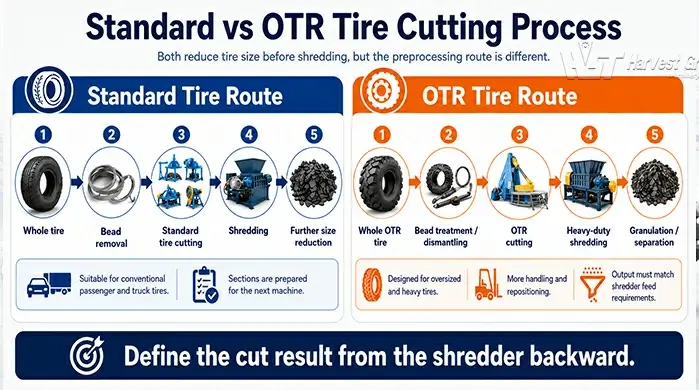
A standard tire cutting machine is mainly used for passenger car, light truck and conventional truck tires that need to be reduced before shredding. In a typical automatic preprocessing system, the bead wire is removed first and the tire is then placed on the cutter platform. The hydraulic system drives the blade through the tire to produce sections that can be handled more easily by the next machine.
The cutting process itself is relatively straightforward. Once the tire has been positioned, the hydraulic cylinder drives the cutting blade downward. After the cut is completed, the blade returns to its original position and the next cutting cycle can begin. The objective is not normally to produce final rubber chips directly, but to create a suitable feed material for subsequent shredding and size reduction.
A standard waste tire cutter is useful when whole tires cannot be fed conveniently into the selected shredder, when more consistent feed dimensions are preferred, or when the recycling line uses a smaller front-end size reduction system. A typical route can be arranged as waste tire → bead removal → tire cutting → shredding → further size reduction.
For smaller-capacity projects, conventional tires can also be processed with a combination of a tire sidewall cutter, strip cutter and block cutter. This semi-automatic arrangement can reduce the initial investment where labor is available and production capacity is moderate. Larger automated projects normally use a more integrated preprocessing system to improve material flow and reduce manual handling.
Not every passenger or truck tire must be cut before shredding. Some industrial shredders are designed to receive whole conventional tires directly. Whether a cutter is necessary depends on tire dimensions, shredder opening, shaft configuration, feeding method and required plant capacity.
An OTR tyre cutting machine is designed for off-the-road tires used on mining trucks, loaders, earthmoving equipment, quarry machinery and other heavy industrial vehicles. These tires are generally much larger and heavier than conventional passenger or truck tires and can contain thick tread sections, dense sidewalls and substantial steel reinforcement.
OTR should not be treated as one fixed tire size. Mining, quarrying and construction equipment use a wide range of tire dimensions and constructions. Two tires that are both described as OTR tires may have very different outside diameters, widths, weights and bead structures. For this reason, selecting an OTR cutter only from a catalog maximum diameter can lead to an unsuitable machine configuration.
The physical structure of the tire changes the cutting task. A large mining tire may weigh hundreds of kilograms or considerably more, making manual positioning impractical. Its tread can be much thicker than that of a standard road tire, while the bead area can contain dense steel wire surrounded by heavy rubber. These characteristics create much higher demands on the cutter frame, hydraulic system, blade travel and tire support system.
Material handling also becomes part of the machine selection. A large tire has to be loaded onto the working platform, positioned correctly, restrained during cutting and often repositioned after the first section has been removed. The remaining carcass may lose its original stable ring shape after cutting, so the plant needs a practical method for controlling and moving the material before the next cut.
The main purpose of OTR tire cutting is normally to convert an oversized tire into sections that can be accepted by downstream recycling equipment. The cutter is therefore a preprocessing machine rather than the final size-reduction equipment.
Depending on the project, an OTR processing route may include a tire debeader machine, tire dismantling equipment, an OTR cutter and a heavy-duty shredder. Some projects require only basic sectioning, while others need additional treatment of bead-rich or sidewall sections before shredding. The correct process depends on the actual tire and the input requirements of the next machine.
The most obvious difference between standard and OTR tires is size, but tire diameter alone does not explain why the machines are different. Tire width, weight, tread thickness, steel content and material handling requirements all affect how the cutter must be designed.
Standard automotive tires can normally be loaded and positioned with relatively simple equipment. Large mining tires require a different approach. As tire weight increases, the working platform must support a much heavier load and the plant may require a forklift, loader or crane to move the tire into position.
The same issue continues after the first cut. An opened OTR carcass can be awkward to rotate and reposition, while the finished sections can still be too heavy for manual handling. A practical OTR cutting system therefore needs enough space around the machine for loading, repositioning and material discharge. These requirements can affect workshop layout almost as much as the cutter itself.
OTR tires are built for severe working conditions and can contain much thicker rubber sections than ordinary road tires. The cutter must maintain stable blade movement while resistance changes through tread rubber, sidewalls and reinforced areas. This is one reason why motor power or hydraulic pressure should not be used as the only basis for comparing machines.
The bead is particularly important. Dense bead wire surrounded by reinforced rubber can create a high cutting load and may also be difficult for the downstream shredder. In some recycling processes, bead-rich sections are removed or isolated before shredding. In other systems, the shredder is configured to accept tire sections with attached steel. The correct approach depends on the complete line design and the final product.
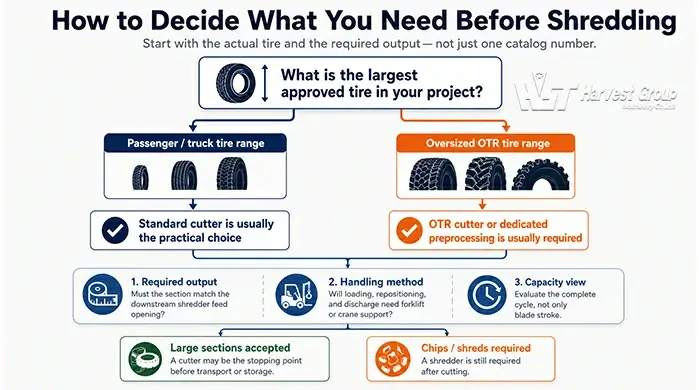
Standard and OTR tire cutters may both use hydraulic cutting principles, but the actual operating sequence differs because the materials are different. Standard tires are smaller and easier to control, while OTR tires often require several stages of positioning and cutting before the material reaches a suitable size.
For conventional tires, the preprocessing route can be relatively simple. After bead wire removal, the tire is positioned on the cutting machine and divided into sections before entering the shredder. The basic process can be described as whole tire → bead wire removal → tire cutting → tire sections → shredding.
The required number of cuts depends on the tire size and downstream shredder. If the shredder already has a sufficiently large feed opening and suitable shaft configuration, some conventional tires may bypass the cutter and enter the shredder directly.
Large OTR tires generally require more controlled preprocessing. The tire may first undergo bead treatment or dismantling before an initial cut opens the casing and reduces its overall geometry. The remaining sections can then be repositioned and cut again until they reach dimensions suitable for the next machine.
A typical OTR route can therefore be described as whole OTR tire → bead treatment or dismantling → initial sectioning → repositioning → additional cutting → heavy-duty shredding. For the largest mining tires, this front-end processing is particularly important because feeding the complete tire directly into a conventional shredder may be impractical.
The final cut size should be determined by the downstream equipment rather than by appearance alone. A section that looks small enough may still bridge across a shredder hopper or be difficult for the shafts to grip. Cutter output should therefore be matched to the actual shredder opening, loading orientation and accepted feed condition.
Tire cutting is only one stage of the overall recycling process. Its main value is preparing difficult feed material for the machines that follow. When selecting complete tire recycling equipment, the cutter output should match the input requirements of the shredder, granulator and separation system.
A typical automatic line for passenger and truck tires may include bead removal → tire cutting → shredding → steel separation → granulation → fiber separation → screening. After primary shredding, the rubber is further reduced with a rubber granulator, while steel and textile fiber are removed before the final rubber material is classified by particle size.
The exact equipment configuration depends on the required product. A plant producing larger rubber chips does not need the same downstream processing as a plant producing fine crumb rubber or rubber powder.
OTR projects normally add a heavier preprocessing stage before the main recycling line. A typical route may include OTR tire debeading or dismantling → OTR tire cutting → heavy-duty shredding → granulation → separation → final sizing.
Once oversized tires have been reduced to manageable sections, much of the downstream process follows the same principles used for conventional tire recycling. The main engineering challenge is creating a stable transition from a very large whole tire to material that the standard shredding and granulation stages can process reliably.
If the final product is crumb rubber, shredded material continues through additional granulation, steel removal, fiber separation and screening. For fine rubber powder, the material may require additional processing with a tire grinding machine or cracking mill.
A complete rubber powder production line therefore depends on correct front-end preparation. Oversized or irregular feed can create problems later in the process, while properly prepared tire sections help maintain more consistent material flow through shredding, granulation and separation.
For an integrated project, the cutter should therefore be selected together with the complete tire recycling plant. This allows the cutting stage, shredder capacity and final product requirements to be matched from the beginning.
Selecting the correct machine should start with the actual tires rather than a single specification such as motor power or hydraulic force. The supplier should know the typical and maximum tire diameter, width, approximate weight and tire type. For OTR projects, tire photographs, markings, rim size and information about the equipment application can provide a much clearer picture of the real material than a simple statement such as “maximum tire diameter 3000 mm.”
Passenger tires, truck tires, agricultural tires, construction tires and mining tires can require very different cutting methods even when some of their dimensions overlap. Tire condition also matters. Remaining tread, damaged sidewalls, exposed steel and bead condition can affect how the tire sits on the machine and how much resistance is created during cutting.
For mixed feedstock, it is useful to identify the proportion of each tire type rather than design the whole preprocessing system around one occasional oversized tire. Standard tires may be able to use a faster conventional route while large OTR tires are directed to a separate heavy-duty cutting section.
The phrase “cut the tire into pieces” is not a complete technical requirement. The correct output depends on what the material will be used for next. Large sections may be sufficient when the purpose is only volume reduction or easier transport, while material intended for shredding needs to match the feed opening and shaft engagement of the actual shredder.
If bead-rich sections must be treated separately, the preprocessing route may need additional equipment. If the pieces are intended for another batch process, storage or pyrolysis, the preferred section dimensions may be different again. Defining the required output first makes it much easier to choose the correct cutter.
Standard cutter capacity can often be expressed relatively easily in tires per hour because tire dimensions and handling steps are more consistent. OTR capacity needs more careful evaluation because the visible blade stroke is only one part of the process.
A complete OTR cycle includes bringing the tire to the cutter, positioning and restraining it, completing the required cuts, repositioning the opened carcass when necessary, removing the finished sections and preparing the working area for the next tire. For this reason, a machine advertised with a fast cutting stroke does not necessarily provide a high number of completed OTR tires per hour.
Automation, labor and available handling equipment should also be considered. Smaller standard tire recycling projects may use semi-automatic sidewall, strip and block cutting equipment to reduce initial investment, while higher-capacity plants may benefit from integrated hydraulic cutting. OTR projects should include the cost and operating time of forklifts, loaders, cranes or other tire handling equipment in the overall evaluation.
One of the most common mistakes is choosing a machine according to tire diameter alone. Maximum diameter is important, but tire width, weight, construction and steel reinforcement can change the cutting requirement considerably. An OTR tire should therefore not be approved simply because its outside diameter falls below the maximum number shown in a catalog.
Another mistake is comparing machines only by hydraulic force, motor power or a single cutting stroke. These specifications are useful, but they do not describe how the tire is supported, how far the blade can travel, how the casing is repositioned or how the finished sections are removed. For large OTR tires, these practical handling steps can determine actual production capacity.
The downstream tire shredder is equally important. The correct cutter output is not simply a smaller tire section. It must be a section that the shredder can receive and grip consistently. Ignoring this interface can result in repeated manual adjustment, unstable feeding and lower line efficiency.
Mixed-feed recycling projects should also avoid forcing every tire through the same preprocessing route. In a crumb rubber production line, standard car and truck tires may be processed through the normal front-end system while only oversized OTR tires use a dedicated heavy-duty cutter. This helps prevent the slowest preprocessing stage from becoming a bottleneck for the entire plant.
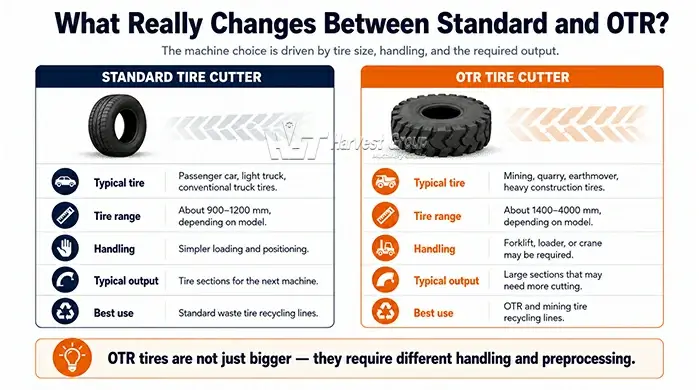
A standard tire cutter is mainly designed for conventional passenger car and truck tires, while an OTR tire cutter is intended for larger and heavier off-the-road tires used in mining, quarrying and construction. OTR machines generally require a larger working platform, heavier structure, greater cutting range and more extensive material handling.
Only when the actual tire falls within the approved dimensions, weight, construction and cutting capability of the machine. There is no universal diameter at which every tire automatically changes from standard to OTR. Large mining and earthmoving tires generally require equipment designed specifically for oversized tire processing.
No. Some industrial tire shredders can accept whole passenger and truck tires directly. Pre-cutting becomes more important when the tire is too large for the shredder opening, creates unstable feeding, contains difficult heavy sections or is inconvenient to handle as a complete tire.
OTR bead areas can contain dense steel reinforcement surrounded by thick rubber. These sections create higher cutting resistance and can also increase the load on downstream shredding equipment. Depending on the recycling process, bead-rich sections may be removed, isolated or processed with equipment specifically configured for steel-containing tire material.
There is no single correct size for every recycling project. The appropriate section dimensions depend on the shredder hopper, shaft configuration, loading method and accepted feed condition. The objective is to create material that can enter the shredder consistently without repeated manual repositioning.
Yes. A mixed tire recycling facility can use separate front-end routes. Conventional car and truck tires may enter the standard cutting or shredding system, while oversized OTR tires pass through dedicated preprocessing equipment. After the OTR material has been reduced to a compatible size, it can join the main shredding and downstream recycling process.
OTR capacity should be evaluated according to the complete tire cycle rather than the cutting stroke alone. Loading, positioning, all required cuts, repositioning, section removal and preparation for the next tire all contribute to real production time.
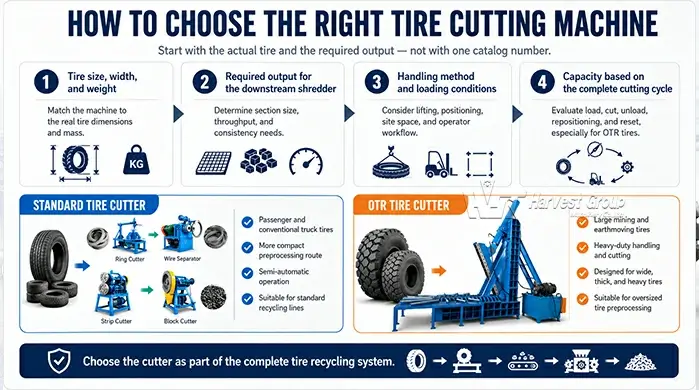 ete Recycling System
The difference between a standard tire cutter and an OTR tire cutter goes beyond maximum tire diameter. Tire width, weight, tread thickness, bead reinforcement, handling method, required output and downstream equipment all influence the correct machine selection.
For conventional passenger and truck tires, a standard cutter provides a compact and efficient way to prepare tires for shredding. For mining, quarrying and earthmoving tires, an OTR cutter provides the heavier structure, larger working range and material handling capability required for oversized material.
Most importantly, a tire cutting machine should be considered as part of the complete recycling process. When the cutter, shredder, granulator and separation equipment are selected according to the same feedstock and final product requirements, the entire recycling line can maintain more consistent material flow and avoid unnecessary bottlenecks.