
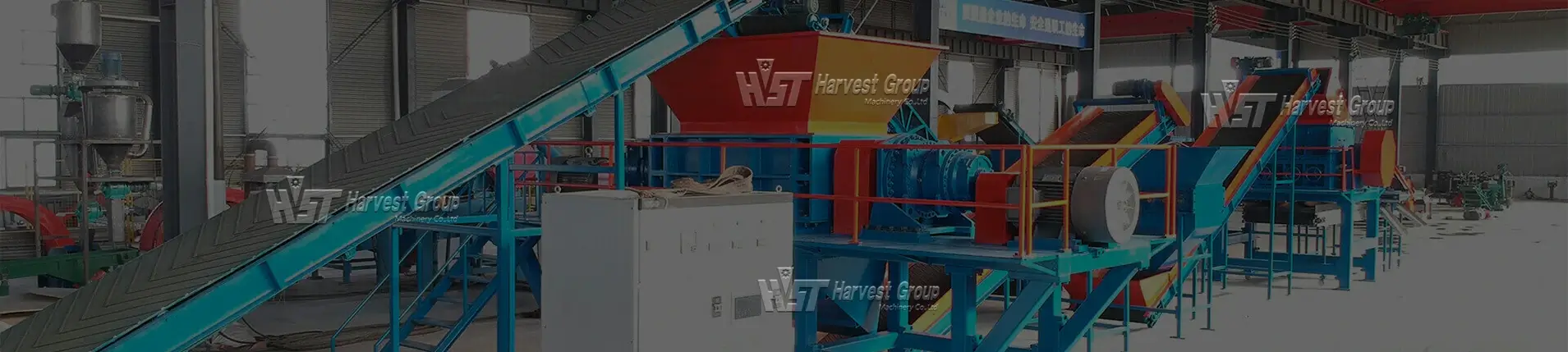
When purchasing waste tire recycling equipment or designing a production line, a tire shredder and a tire crusher are the two core types of equipment most frequently confused by industry buyers. Many purchasers inquire about a “tire crusher,” while their actual production requirement is to process whole passenger car tires, truck tires, or OTR tires. In these applications, a tire shredder is the correct equipment choice.
Although both machines are used for tire material size reduction, they differ fundamentally in their position in the production process, feed material requirements, working principles, steel wire tolerance, output particle size, and final product applications. Incorrect equipment selection may directly cause machine blockage, abnormal blade wear, motor overload, insufficient capacity, and, in serious cases, shutdown of the entire tire recycling line.
Therefore, when comparing tire shredder vs tire crusher, do not make a decision based only on the equipment name, motor power, or quotation. Four key factors should be considered: the condition of the raw material, the amount of remaining steel wire, the required output size, and the stage at which the equipment will be installed in the process.
In simple terms, a tire shredder opens and reduces whole tires or large tire sections during primary processing. A tire crusher performs finer size reduction on prepared rubber blocks, improving material uniformity and purity. The two machines are complementary pieces of equipment used at different stages and cannot be replaced arbitrarily.
Why Are Tire Shredders and Tire Crushers So Easily Confused?
In both the international tire recycling equipment market and actual industry operations, the names and functions of the two machines are frequently mixed up. This is one of the main reasons inexperienced buyers select the wrong equipment. The confusion mainly results from three common industry problems.
Equipment Naming Systems Are Not Standardized
Names such as tire shredder, tire crusher, rubber crusher, tire granulator, and rubber grinder are often used interchangeably, and there is no completely unified naming standard.
Some manufacturers simplify their marketing by describing a whole-tire shredder as a “tire crusher.” Other manufacturers label secondary rubber granulators or rubber grinding machines as crushers. For this reason, the actual function of a machine cannot be determined from its product name alone.
Buyers Focus on the Result but Ignore the Process
Most buyers focus only on the desired result of “crushing tires into small pieces” while overlooking the technical difficulty of processing the material.
Whole tires have high elasticity and strong rebound characteristics. They also contain bead wire, steel cord, nylon fiber, and other composite reinforcement structures. Their large and irregular feeding condition places high demands on machine torque and cutting capability.
Fine processing of pre-shredded rubber blocks, on the other hand, focuses more on particle size uniformity and product purity. These two processing tasks follow completely different mechanical principles.
Translation and Industry Terminology Can Be Misleading
In some overseas markets and international trade applications, the word “crusher” is broadly used for almost all material size-reduction equipment.
This unclear translation habit may cause buyers to overlook important structural differences, including the shaft arrangement, operating speed, screen configuration, maximum feed size, and cutting mechanism. As a result, the wrong equipment may be selected.
What Is a Tire Shredder?
A tire shredder is the front-end primary size-reduction machine in a waste tire recycling line. It is also an essential core machine for projects that begin with whole tires.
The machine is specifically designed for complete, highly resilient, steel-reinforced waste tires. It performs the first size-reduction stage of the production line. Its main function is to break the complete tire structure and convert large tire materials into intermediate feedstock that can be processed steadily by downstream equipment.
A tire shredder is not designed to produce fine rubber powder directly.
Tire Shredder Positioning and Working Principle
Industrial tire shredders generally use a heavy-duty, low-speed, high-torque, dual-shaft shearing structure. Two cutter shafts rotate synchronously in opposite directions. High-strength alloy blades grip the tire edges and tire body, gradually breaking down the whole tire through a combination of shearing, squeezing, and tearing forces.
This working method overcomes rubber rebound, steel wire resistance, and fiber entanglement. The machine is normally equipped with overload protection and automatic reverse functions, helping prevent blockage and overload failures during long-term continuous operation.
The complete operating process is:
Whole tires or pre-cut tire sections enter the shredding chamber → blades grip and hold the material → the high-torque system continuously shears the tires → qualified coarse material is discharged → oversized pieces are screened and returned for a second shredding cycle.
The entire process can operate without manual intervention. Compared with high-speed impact equipment, low-speed, high-torque shredding is more suitable for highly elastic composite materials containing steel wire, textile cord, and other impurities.
Tire Shredder Feed Materials and Pretreatment Requirements
A professional waste tire shredder machine has a wide feed-material range and can process many categories of waste tires. However, large and heavy-duty tires may require pretreatment according to their size and structure.
| Raw Material Type | Typical Processing Method | Pretreatment Requirement |
|---|---|---|
| Passenger car tires | Direct processing with a dedicated whole-tire shredder | No pretreatment required; steel wire may be removed when necessary |
| Truck and bus tires | Processed by a specially configured heavy-duty shredder | Bead wire removal, bead cutting, or pre-cutting is recommended |
| Agricultural tires | Machine selected according to tire diameter and carcass thickness | Large tires must normally be pre-cut |
| OTR tires | Cut into standardized feed sections before shredding | Sectioning and pretreatment are required |
| Mixed waste tires | Processed with a compatible heavy-duty machine | The range of tire sizes must be strictly controlled |
| Pre-cut tire sections | Stable and continuous feeding | Adjusted according to the remaining steel wire content |
Tire Shredder Output Sizes and Applications
Tire shredder output mainly consists of irregular coarse materials. The size can be adjusted to some extent through screening and return systems. High particle-size precision is not normally required because the machine is primarily used for initial recycling and tire-derived fuel processing.
| Output Type | Reference Output Size | Main Application |
|---|---|---|
| Coarse tire shreds | 150–300 mm | Tire volume reduction, storage, transportation, and secondary processing feedstock |
| TDF chips | 50–150 mm | Alternative fuel for cement kilns and industrial boilers |
| Medium rubber blocks | 20–80 mm | Steel wire separation and secondary crushing feedstock |
| Customized intermediate material | Customized according to project requirements | Feedstock for rasper machines, rubber granulators, and other downstream equipment |
Main Advantages and Limitations of a Tire Shredder
Main advantages: A tire shredder can process large, highly resilient tires containing steel reinforcement. Its low-speed operation produces relatively little dust and heat. Heavy-duty shafts and wear-resistant blades can withstand the impact of rubber, steel wire, and fiber composite materials.
The machine can also be connected to an automatic screening and return system, reducing manual sorting and lowering operating and maintenance costs. It is suitable for continuous, high-volume, coarse tire processing.
Equipment limitations: A tire shredder cannot produce highly precise, uniform rubber granules or fine rubber powder. It only performs primary opening and volume reduction. Fine processing requires downstream crushing, grinding, screening, and separation equipment.
What Is a Tire Crusher?
There is no completely unified industry definition for a tire crusher. In a broad sense, the term may include a rubber crusher, rubber granulator, rasper, fine crusher, or rubber grinding machine used during secondary tire processing.
A tire crusher is a core machine used during the middle or downstream stages of a tire recycling line. It can process only prepared and relatively uniform rubber blocks. It is not generally designed to process whole tires directly.
Its primary functions are to reduce the particle size further, improve material uniformity, separate impurities more thoroughly, and produce higher-value recycled rubber products.
Tire Crusher Positioning and Working Principle
A tire crusher uses high-speed impact grinding and precision cutting. High-speed rotors, moving and stationary knives, or grinding discs process the rubber blocks produced by the tire shredder.
Multi-layer screens, magnetic separation systems, and fiber separation equipment may be used together to standardize the particle size and remove remaining steel wire and textile fiber.
Compared with a primary tire shredder, a tire crusher operates at a higher speed and has stricter feed-uniformity requirements. Its main objective is product precision and purity rather than basic volume reduction.
Tire Crusher Feed Requirements and Restricted Operating Conditions
A tire crusher is highly sensitive to the condition of the feed material. It is suitable only for regularly sized, pre-processed rubber materials with controlled steel wire content.
Whole tires and large tire sections containing heavy steel wire must not be fed directly into an ordinary secondary tire crusher. Incorrect feeding may cause multiple equipment failures.
| Incorrect Feeding Problem | Main Cause | Direct Consequence |
|---|---|---|
| Difficult feeding and unstable capacity | Whole tires are large, irregularly shaped, and highly elastic | Frequent manual intervention and lower production efficiency |
| Machine blockage and material entanglement | Rubber rebound and combined steel-fiber structures wrap around the rotor | Frequent shutdowns and production interruptions |
| Blade breakage and abnormal wear | Unremoved high-strength bead wire impacts the blades | Rapid wear-part consumption and sharply increased maintenance costs |
| Motor overload and equipment damage | Feed size exceeds the machine’s designed load | Motor protection shutdown or transmission-system failure |
| Excessive material temperature and uneven output | Repeated high-speed friction and inconsistent feed specifications | Rubber adhesion and a lower qualified-product rate |
Tire Crusher Output Sizes and High-Value Applications
Tire crusher output is adjustable and relatively uniform. The equipment can cover product sizes ranging from small and medium rubber granules to fine rubber powder.
The finished products have higher purity and market value than coarse tire shreds. Typical output includes 10–30 mm small rubber blocks, 1–20 mm standardized rubber granules, and 20–120 mesh fine rubber powder.
These recycled rubber materials are widely used for:
- Rubber running tracks
- Playground safety surfacing
- Rubber floor tiles
- Rubber-modified asphalt
- Waterproof construction materials
- Industrial rubber fillers
If ultrafine rubber powder is required, a dedicated rubber powder grinding machine and classification screening system can be added for further processing.
Main Advantages and Limitations of a Tire Crusher
Main advantages: The output particle size is uniform and controllable, and the finished-product purity is high. The equipment can help separate residual steel wire, nylon fiber, and other impurities.
It is suitable for producing various high-value recycled rubber products and can operate together with magnetic separators, dust collection equipment, and screening systems. A higher degree of automation can significantly increase the profit potential of a tire recycling project.
Equipment limitations: A tire crusher has strict feed requirements and limited adaptability to inconsistent materials. During high-speed operation, blades and screens wear faster, so the maintenance frequency is generally higher than that of a primary tire shredder.
It cannot independently complete whole-tire recycling and must be combined with primary shredding or other pretreatment equipment.
Tire Shredder vs Tire Crusher: Complete Comparison Table
The following table compares tire shredders and tire crushers across ten important production, operation, maintenance, and purchasing factors.
| Comparison Factor | Tire Shredder | Tire Crusher | Main Purchasing Consideration |
|---|---|---|---|
| Position in the production line | Front-end primary shredding and volume reduction | Middle or downstream secondary crushing and granulation | Confirm the equipment installed before and after the machine |
| Main working principle | Low-speed, high-torque, dual-shaft shearing and tearing | High-speed grinding, precision knife cutting, and compression | Check shaft structure, speed, and torque |
| Suitable feed material | Whole tires, large tire sections, and steel-reinforced tire carcasses | Uniform rubber blocks after shredding with controlled steel content | Confirm maximum feed size and steel wire condition |
| Typical output specification | 50–300 mm irregular coarse material and TDF chips | 1–50 mm uniform granules and 20–120 mesh rubber powder | Define the output using a specific size range |
| Steel wire tolerance | Relatively strong; heavy-duty machines can process steel-reinforced tire materials | Relatively weak; most bead wire should be removed beforehand | Confirm whether wire drawing or bead cutting is required |
| Output uniformity | Relatively low but can be improved through screening and return systems | High, with particle size controlled by screens | Select the machine according to final product accuracy |
| Dust and temperature | Low-speed operation with less dust and lower temperature rise | High-speed grinding with more dust and easier temperature increase | Fine-processing lines require dust and temperature control |
| Maintenance cost | Wear-resistant blades, relatively low failure rate, and simpler maintenance | Faster wear-part consumption and more detailed maintenance requirements | Calculate long-term spare-parts replacement costs |
| Finished-product value | Lower-value material for fuel, roadbed filling, and basic applications | Higher-value marketable products for advanced recycled rubber applications | Select according to the project’s profit model |
| Main production risks | Insufficient torque and inconsistent oversized output | Screen blockage, blade wear, heat buildup, and rubber adhesion | Request a test video using the same material |
How Tire Shredders and Tire Crushers Work Together in a Tire Recycling Plant
A complete tire recycling plant follows the basic process logic of primary shredding, secondary crushing, staged separation, and gradual particle-size reduction.
A tire shredder and tire crusher perform complementary functions. They are not direct substitutes and work together to process whole tires into higher-value rubber granules or rubber powder.
Complete Standard Tire Recycling Process
Waste tire pretreatment, including wire drawing, bead cutting, and large-tire sectioning → feeding and conveying → primary crushing with a tire shredder → disc screening and automatic return of oversized material → initial steel wire separation → secondary fine crushing with a tire crusher → multi-stage magnetic separation and fiber separation → precision vibrating screening → rubber powder grinding when required → finished-product classification and storage.
The tire shredder solves the problems of difficult whole-tire processing, irregular feeding, and blockage. It supplies stable intermediate material to downstream equipment.
The tire crusher performs finer particle reduction and purification, increasing the market value of the recycled rubber product.
Equipment Configurations for Different Tire Recycling Projects
| Project Type | Tire Shredder | Tire Crusher | Main Supporting Equipment |
|---|---|---|---|
| Whole-tire volume reduction, storage, and transportation | Essential core machine | Not required | Feeding and conveying equipment |
| TDF tire-derived fuel production | Core machine | Not required | Screening system, return equipment, and basic magnetic separator |
| Coarse rubber mulch production | Required | Optional according to output size | Steel separator and screening equipment |
| 10–30 mm rubber block production | Required | Optional according to the process | Rasper, magnetic separator, and screening system |
| 1–5 mm fine rubber granule production | Required | Core machine | Magnetic separator, fiber separator, and precision vibrating screen |
| 20–120 mesh fine rubber powder production | Required | Required | Rubber powder grinder, classification screen, impurity separation, and dust collection system |
| Secondary processing of purchased tire shreds | Not required | Required | Impurity separation and screening equipment selected as needed |
Output Size: The Simplest and Most Important Selection Standard
For most buyers, the target output size is the most practical standard for selecting the correct equipment and process.
Many selection problems result from unclear descriptions such as “small pieces” or “fine rubber.” These terms do not have a universal technical definition.
For a TDF project, 100 mm material may already be a qualified final product. For a rubber powder project, 5 mm material is still only intermediate feedstock. Clearly defining the required size range is therefore essential.
Tire Processing Size-Reduction Stages
| Processing Stage | Material Condition | Reference Size | Main Processing Equipment |
|---|---|---|---|
| Raw material stage | Whole passenger car or truck tires | 600–1200 mm or larger | Pretreatment and feeding equipment |
| Primary shredding stage | Coarse tire blocks | 150–300 mm | Double-shaft tire shredder |
| TDF finished-product stage | Tire-derived fuel chips | 50–150 mm | Tire shredder, screening, and return system |
| Intermediate size-reduction stage | Steel-containing rubber blocks | 20–80 mm | Coarse crusher or rasper |
| Granulator feeding stage | Uniform rubber blocks | 10–30 mm | Rubber crusher or rubber granulator |
| Rubber granule stage | High-purity rubber granules | 1–5 mm | Crusher, impurity separation, and screening system |
| Rubber powder stage | Fine rubber powder | 20–120 mesh | Rubber powder grinder and classification system |
How Output Size Determines the Tire Recycling Process
The lower the required output precision, the simpler the production process and the lower the equipment investment.
Coarse tire shreds can be produced through shredding and screening. Fine rubber powder requires multiple stages, including crushing, steel separation, fiber separation, precision screening, and circulating grinding.
This difference is the main reason that basic TDF lines and complete rubber powder production lines have very different investment levels.
When Should You Choose a Tire Shredder?
- The raw material consists of whole passenger car tires, truck tires, or OTR tires that must be processed from the beginning.
- The main products are TDF tire-derived fuel, roadbed filling material, landfill covering material, or other coarse products with low particle-size precision requirements.
- The main project requirement is tire volume reduction, centralized collection, storage, or transportation without deeper processing.
- The raw material includes mixed waste tires with thick bead wire and complex reinforcement structures.
- The project has a limited initial budget and will be developed in stages, beginning with a primary tire recycling line.
When Should You Choose a Tire Crusher?
- The project already has primary tire shredding equipment, and the raw material consists of uniformly sized rubber blocks requiring further processing.
- The target products are high-value materials such as running-track granules, rubber powder for modified asphalt, or raw material for rubber floor tiles.
- The finished product must meet strict requirements for particle uniformity and residual steel wire or fiber content.
- The project produces standardized recycled rubber products and requires controllable and adjustable output sizes.
- The business focuses on selling higher-value recycled rubber products and improving the overall return on investment.
Common Tire Recycling Equipment Purchasing Mistakes
Based on practical tire recycling production-line experience, the following eight purchasing mistakes frequently cause equipment mismatch, insufficient capacity, and excessive maintenance costs.
Mistake 1: Selecting Equipment Based Only on Motor Power
Machines with the same motor power may have very different shaft torque, chamber dimensions, blade materials, and reducer configurations.
Motor power alone cannot determine whether a machine can process steel-reinforced tires. Selecting a machine only by power may result in insufficient capacity and frequent blockage.
Mistake 2: Ignoring Bead Wire
Truck tires and OTR tires contain high-strength bead wire that significantly increases machine load.
If the machine and pretreatment process are not selected according to this condition, the blades may wear rapidly and require frequent replacement.
Mistake 3: Confusing TDF and Rubber Powder Production Lines
TDF and rubber powder production lines require different equipment configurations, impurity-removal standards, and processing stages.
Using the wrong process may produce an unqualified product that cannot meet downstream market requirements.
Mistake 4: Feeding Whole Tires into an Ordinary Tire Crusher
This is one of the most serious selection mistakes. A normal secondary crusher does not have the required whole-tire shearing ability.
Direct feeding may cause motor damage, blade breakage, blockage, and production-line shutdown.
Mistake 5: Comparing Only Theoretical Capacity
Actual equipment capacity changes according to the tire type and required output size.
Passenger tires and truck tires have different processing capacities. Producing coarse tire shreds and fine rubber granules also results in very different output rates. A theoretical capacity without testing conditions has limited value.
Mistake 6: Ignoring the Return Screening System
A tire shredder without automatic screening and return equipment may produce output with large size variations.
This increases downstream screening loads, manual sorting requirements, and overall operating costs.
Mistake 7: Believing One Machine Can Complete the Entire Process
No single machine can efficiently complete the entire process from whole tires to fine rubber powder.
Fine recycled rubber products require several machines working together through multiple size-reduction and separation stages.
Mistake 8: Comparing Quotations Only by Equipment Name
Equipment naming is not standardized among manufacturers.
Buyers must compare the actual machine structure, suitable working conditions, supporting systems, output requirements, and production testing instead of relying only on the machine name and price.
How HVST Tire Recycling Equipment Fits Different Projects
A professional tire recycling equipment solution should be designed according to the raw material, capacity, and finished-product requirements rather than applying the same machine to every project.
Whole-Tire Shredding and TDF Production Solution
The main configuration consists of a heavy-duty double-shaft tire shredder, disc screening system, automatic return conveyor, and basic magnetic separation equipment.
A secondary rubber crusher is not required. This solution focuses on tire volume reduction and TDF chip production, providing efficient operation with relatively low investment.
Rubber Granule Processing Solution
This solution uses a tire shredder and tire crusher in sequence, together with multi-stage magnetic separation, fiber separation, and vibrating screening systems.
It can produce 1–20 mm high-purity, uniform rubber granules for the medium-value recycled rubber market.
For projects producing landscaping, playground, or colored rubber mulch, a dedicated rubber mulch production line can be configured according to the required particle size and final application.
Fine Rubber Powder Production Solution
This complete multi-stage production line includes tire pretreatment, primary shredding, secondary crushing, fine rubber grinding, classification screening, and complete dust and impurity separation systems.
It produces high-mesh, high-purity rubber powder for higher-value construction materials, modified asphalt, and other industrial applications.
All equipment is optimized for its specific process stage. The tire shredder is strengthened for higher torque and wear resistance to process heavy-duty tires. The tire crusher is optimized for grinding accuracy and screening efficiency to reduce uneven output and residual impurities.
A complete customized tire recycling line can be designed according to the raw material, target capacity, output size, workshop layout, and project budget.
Key Information to Send a Tire Recycling Equipment Supplier
Before requesting a quotation, buyers should provide accurate operating conditions and product requirements. This helps the supplier recommend the correct equipment configuration and avoids unsuitable or incomplete proposals.
| Consultation Factor | Information to Provide | Effect on Equipment Selection |
|---|---|---|
| Tire material type | Passenger car tires, truck tires, agricultural tires, OTR tires, or mixed tires | Determines machine strength and pretreatment method |
| Material size and condition | Whole tires, pre-cut tire sections, shredded material, maximum diameter, and remaining steel wire | Determines the machine type and feeding configuration |
| Target finished product | TDF chips, rubber granules, or fine rubber powder with a specified size or mesh | Determines the number of processing stages and supporting equipment |
| Capacity and working hours | Required hourly or daily capacity and operating shifts | Determines the equipment model and main-machine specifications |
| Finished-product purity | Maximum permitted residual steel wire and fiber content | Determines the number of magnetic and fiber separation stages |
| Workshop and power supply | Workshop dimensions, installation space, voltage, frequency, and transformer capacity | Affects equipment layout and electrical configuration |
| Environmental requirements | Local dust, noise, fire safety, and emission standards | Determines the dust collection, noise reduction, and safety systems |
Buyers may also request a test video using similar tires, output samples, a capacity report, wear-part prices, and an after-sales service proposal to verify whether the machine is suitable for the project.
Final Recommendation: Tire Shredder or Tire Crusher?
A tire shredder and tire crusher cannot be judged simply as better or worse. The only correct selection standard is whether the equipment matches the actual material and its position in the tire recycling process.
For every project beginning with whole waste tires, a tire shredder is the essential front-end machine. It opens whole tires, reduces their volume, and creates stable feedstock for downstream processing.
If the project only performs primary recycling or TDF production, a tire shredder can be installed independently with the required screening and steel-handling systems.
If the objective is to produce higher-value rubber granules or fine rubber powder, the line must combine front-end tire shredding with secondary tire crushing, impurity removal, screening, dust collection, and grinding equipment.
The standardized process principle is:
First control the tire size and steel wire through pretreatment, then use a tire shredder for primary size reduction, and finally use tire crushing and grinding equipment for progressive and classified fine processing.
FAQ About Tire Shredder vs Tire Crusher
Are a Tire Shredder and a Tire Crusher the Same Machine?
No. Although some manufacturers use the names interchangeably, a tire shredder is normally a low-speed, high-torque machine for primary whole-tire size reduction. A tire crusher is generally a secondary machine used for finer rubber processing. Their process positions, functions, and suitable applications are different.
Can a Tire Crusher Process Whole Tires Directly?
An ordinary secondary tire crusher cannot process whole tires directly. Only a heavy-duty whole-tire machine specifically designed with a shredding structure can process them.
Feeding complete tires into a normal crusher may cause blockage, overload, blade damage, and other serious failures.
Can a Tire Shredder Produce Fine Rubber Powder Directly?
No. A tire shredder performs only primary coarse size reduction. It cannot control the final particle uniformity and purity required for fine rubber powder.
Fine rubber powder requires secondary crushing, multiple impurity-removal stages, rubber grinding, and classification screening.
What Equipment Is Required for a TDF Production Line and a Rubber Powder Line?
A TDF production line uses a tire shredder as its core machine, together with screening, return conveying, and basic steel separation equipment.
A rubber powder line requires a tire shredder, tire crusher, and a complete set of impurity separation, grinding, screening, and dust collection equipment.
Which Machine Has a Lower Investment Cost?
For a single machine, a tire shredder usually has a lower overall process investment and simpler maintenance, making it suitable for initial or small-scale projects.
A tire crusher requires more supporting systems and usually operates together with a tire shredder. The total investment is higher, but the finished products also have greater market value. For long-term fine-processing projects, this may provide a better return.
Why Is Tire Bead Wire Important for Equipment Selection?
Tire bead wire has high strength and toughness. It can significantly increase blade wear and machine load.
Heavy-duty tires may require bead wire drawing, bead cutting, or other pretreatment. Otherwise, equipment service life may be reduced and maintenance downtime may increase.
What Is the Correct Standard for Comparing Equipment Quotations?
Avoid comparing only the price, motor power, or product name.
Different quotations should be compared under the same raw material, output size, production capacity, and supporting-equipment scope. Buyers should also review spare-parts costs, after-sales support, actual production-test data, and the complete process configuration.