A tire sidewall cutter and a tire debeader are both used in the pre-processing section of a tire recycling plant, but they deal with the bead area in different ways. A sidewall cutter removes the sidewall or bead-sidewall section by cutting around the tire, while a debeader is designed to pull the concentrated bead wire out of the tire.
This difference affects much more than the working principle of the machine. It changes the material that leaves the pre-processing stage, the amount of steel entering the next machine, and the type of equipment required later in the line. In some projects the sidewall is removed before additional cutting; in others, bead wire is extracted first and the prepared tire is sent directly to a shredder.
For this reason, tire recycling equipment should not be selected from machine names alone. Terms such as tire sidewall cutter, bead cutter, bead remover, wire drawing machine and tire debeader sometimes overlap between suppliers. The more useful comparison is the actual operation of the machine and the material it produces.
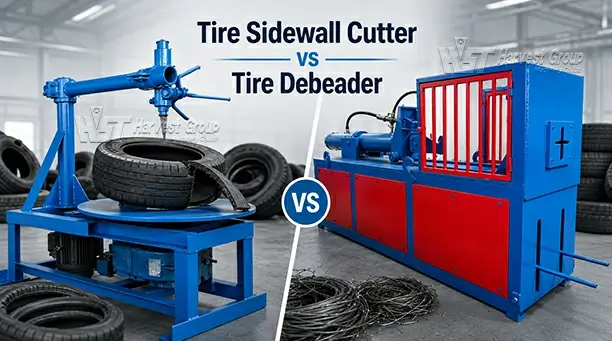
A tire sidewall cutter removes the sidewall or bead-sidewall section from the main tire body. The tire is positioned on the machine and cut around the circumference close to the bead area. Depending on the design, one sidewall, both sidewalls or a wider bead-sidewall ring can be removed.
After cutting, the tire body and the removed ring become separate material streams. This makes the remaining tread section easier to handle in many cutting-based recycling systems, particularly when it will be flattened, sectioned or fed into another machine.
The important detail is that the bead wire normally remains inside the removed ring. Sidewall cutting separates a section of the tire, but it does not automatically separate the rubber from the steel contained in that section. If the project requires cleaner bead-wire recovery, the removed ring must be processed further.
A whole tire is a flexible closed ring, and that shape can make it awkward to handle in equipment that was not designed for direct whole-tire feeding. Once the sidewall is removed, the remaining tread section is easier to position and can often be prepared more efficiently for strip cutting, block cutting or other size-reduction steps.
Some plants also separate the sidewall because they want to handle the tread and sidewall as different feed fractions. This does not mean that either fraction is chemically pure, but separating them at the front end can make later material handling more controlled.
A tire debeader machine works differently. Instead of cutting off the complete sidewall section, it targets the bead wire itself. The bead is the reinforced inner ring of the tire and contains a concentrated bundle of high-strength steel wire embedded in rubber.
Most mechanical or hydraulic debeaders use a hook or pulling mechanism to engage the bead area and draw the wire bundle out of the tire. The result is a prepared tire body and a separate bead-wire stream. Some rubber may remain attached to the extracted wire, but the process removes much more concentrated steel at the front end than sidewall cutting alone.
The bead contains one of the heaviest concentrations of steel in a tire. If the selected recycling process benefits from removing this material before primary size reduction, a debeader can prevent the complete bead bundle from entering the next cutting or shredding stage.
Debeading should not be confused with removing all steel from a tire. Radial tires still contain steel belts and other reinforcement after the bead wire has been extracted. These materials are released later as the tire is shredded, rasped or granulated and are normally recovered by magnetic separation.
This distinction is also important in technical descriptions. Bead wire refers to the concentrated steel around the inner circumference of the tire. Steel belts are reinforcement layers located mainly under the tread. A tire debeader removes bead wire, not all steel belts from the tire.
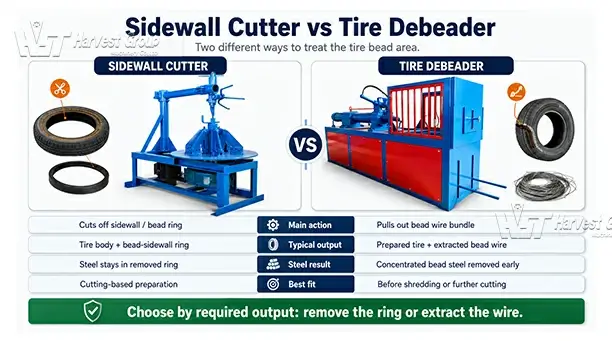
The clearest comparison is the output. A sidewall cutter separates a rubber section that may still contain steel. A debeader aims to remove the steel bead bundle itself.
| Comparison | Tire Sidewall Cutter | Tire Debeader |
| Main Operation | Cuts around the sidewall or bead-sidewall area | Pulls or extracts the bead-wire bundle |
| Typical Output | Main tire body and sidewall/bead ring | Prepared tire body and extracted bead wire |
| Primary Purpose | Separate the sidewall and change tire geometry | Remove concentrated bead steel |
| Steel After Processing | Bead wire may remain embedded in the removed ring | Bead wire is removed as a separate material stream |
| Effect on Tire Shape | Physically opens or reduces the tire body | Basic tire geometry generally remains similar |
| Typical Downstream Step | Further cutting, shredding or bead-wire separation | Tire cutting or shredding |
This is why a sidewall cutter cannot automatically be used as a replacement for a debeader. If the goal is simply to remove the sidewall and prepare the tread section for another cutting operation, the cutter may already provide the required output. If the objective is to recover bead steel before shredding, direct bead-wire extraction may be the more suitable route.
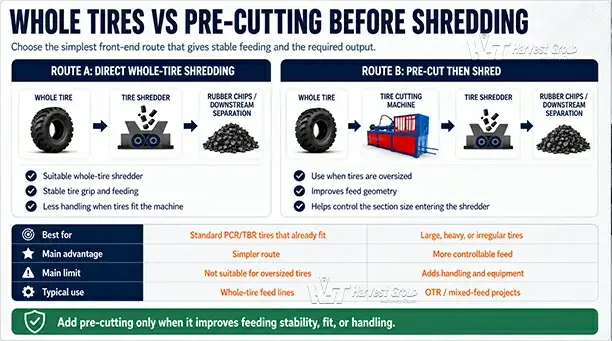
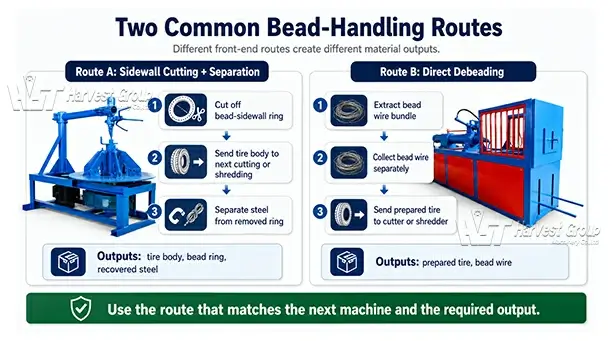
There are two common approaches when a recycling project wants to treat the bead area before the tire enters the main size-reduction equipment. The first approach removes the bead-sidewall section and processes it separately. The second extracts the bead wire directly from the tire.
In a cutting-based system, the sidewall or bead section is removed first. The main tire body continues to the next cutting or shredding stage, while the steel-containing ring is handled separately. If the recycler wants to recover steel from this ring, it can then be processed by a steel wire separator.
This creates a two-stage bead treatment process. The cutter is responsible for isolating the bead-rich section, while the separator performs the more detailed separation between rubber and steel. This approach can be useful when the plant already uses a cutting-based front end or when the bead section is intended to be treated as a separate material stream.
The alternative is to extract the wire directly. A debeader eliminates the separate bead-ring cutting and wire-separation sequence for the main bead extraction step. The prepared tire can then continue to a cutter or shredder, while the extracted bead wire is collected separately.
This arrangement can reduce the number of machines in the front-end section, but that does not automatically make it the better solution. Capacity, tire size, loading method and the required condition of the downstream feed all need to be considered. A small passenger-tire system and a heavy truck-tire system may use completely different debeader configurations.
| Comparison | Sidewall Cutting + Separation | Direct Debeading |
| Process | Cut bead section first, separate steel later | Extract bead wire directly |
| Equipment Arrangement | Usually requires two processing stages | Usually uses one primary extraction stage |
| Intermediate Material | Bead-sidewall ring containing rubber and steel | Extracted bead-wire bundle |
| Main Tire Body | Sidewall or bead ring has been removed | Tire usually remains close to its original overall shape |
| Best Fit | Cutting-based preparation and separate bead processing | Early bead-wire extraction before further size reduction |
The tire cutting machine is another piece of equipment that often appears in the same front-end section, but its purpose is different from both sidewall cutting and debeading.
A sidewall cutter follows the sidewall or bead circumference. A debeader acts on the bead wire. A tire cutting machine makes larger sectioning cuts through the tire body. Its purpose is to reduce the dimensions of the tire when the whole tire or prepared casing is still too large for the next machine.
| Machine | Main Function | Typical Output | Why It Is Used |
| Tire Sidewall Cutter | Removes sidewall or bead-sidewall section | Tire body and sidewall/bead ring | Sidewall separation and easier further handling |
| Tire Debeader | Extracts bead wire | Tire body and bead-wire bundle | Early removal of concentrated bead steel |
| Bead Wire Separator | Separates steel from a previously removed bead section | Recovered steel and bead rubber | Further steel recovery |
| Tire Cutting Machine | Sections the tire body | Large tire sections | Reduce oversized feed before shredding |
| Tire Shredder | Performs primary size reduction | Tire shreds or chips | Prepare material for downstream recycling |
In practice, these machines are sometimes used together rather than being alternatives. A tire may first have its bead treated, then be sectioned because of its size, and finally enter a shredder. Another tire within the shredder’s approved feed range may require none of these extra cutting stages.
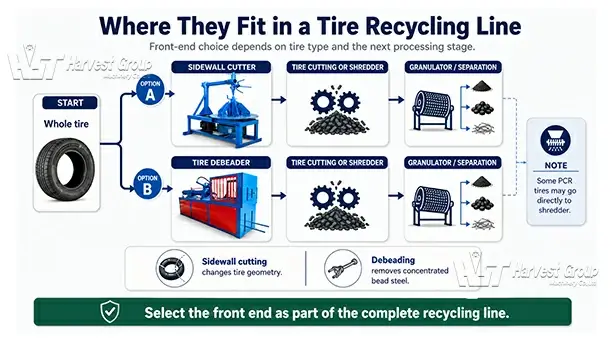
Front-end equipment should be selected as part of the complete tire recycling plant. The next machine is particularly important because it determines the acceptable size, shape and steel condition of the incoming tire.
In a small cutting-based line, sidewalls may be removed before the tire body is sectioned further. This arrangement is common where tires are reduced progressively before they reach the main crushing equipment. A plant using a heavy-duty whole-tire shredder may take a different approach and remove bead wire first, then feed the prepared casing directly into the shredder.
A third configuration processes the bead section separately. After sidewall cutting, the bead-rich ring goes to wire separation while the remaining tire body continues through the size-reduction line. The extra stage makes sense only when the plant has a reason to handle the bead section separately.
There is also a fourth possibility: no sidewall cutter and no debeader. Some tire shredder machines are designed for direct whole-tire feeding within a defined tire range. If the tire fits the feed system, engages the cutters reliably and remains within the approved machine limits, additional pre-processing may only add handling and equipment cost.
After primary shredding, the material can move through secondary size reduction and separation. A rubber granulator, magnetic separation, fiber removal and screening equipment are commonly used when the final target is rubber granules or crumb rubber rather than coarse tire chips.
Passenger car tires are relatively small and many industrial shredders are designed to accept them whole. In such a plant, removing the sidewall or bead wire first may not be necessary.
Smaller semi-automatic recycling systems can use a different route. The sidewall may be removed first, followed by strip or block cutting before the rubber reaches the main size-reduction machine. Some plants also choose debeading when they prefer to recover bead steel before further processing.
Truck and bus tires have heavier bead structures and stronger steel reinforcement, so front-end preparation becomes more dependent on the selected shredder and cutter. One line may remove the bead wire and shred the remaining casing whole, while another may remove the sidewall and then cut the tire into smaller sections.
For this reason, a TBR project should be evaluated using the largest tire in the expected feed stream. Tire diameter, width, bead structure, required capacity and the actual opening of the next machine are more useful than simply classifying the material as “truck tires.”
OTR tires are substantially different from normal road tires. Their diameter, weight, tread thickness and bead construction make it impractical to assume that standard passenger or truck-tire equipment will be suitable.
Large OTR tires commonly require a combination of bead or sidewall treatment and heavy sectioning before the material can be processed by conventional downstream equipment. A dedicated OTR tire cutting machine is used when the objective is to turn an oversized tire into sections that can be handled and fed to the next machine.
The correct section size depends on the downstream equipment. Cutting an OTR tire into more pieces is not automatically better; the objective is to produce a practical feed size without adding unnecessary cutting and handling.
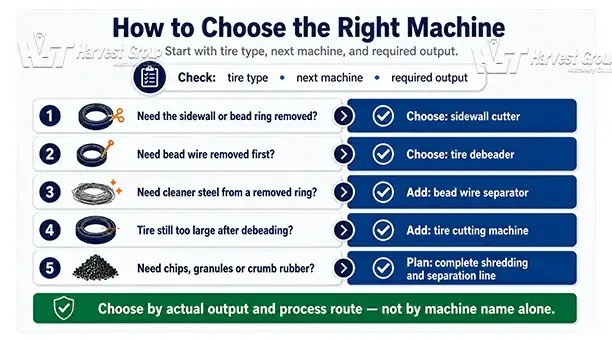
The decision becomes easier once the required output is clear. If the plant wants the sidewall or bead-sidewall ring removed from the tire body, a sidewall cutter is the more direct machine. This is common in cutting-based systems where the remaining tread section will be flattened or reduced further.
If the objective is to remove the concentrated bead-wire bundle before the tire reaches the next machine, a debeader is the more direct solution. The tire body still needs subsequent cutting or shredding, but the main bead steel has already been removed as a separate stream.
There are cases where neither machine solves the complete problem. A truck or OTR tire may still be physically too large after debeading, in which case a tire cutting machine is needed before shredding. Conversely, a sidewall cutter may remove the difficult ring but leave the steel inside that ring, making additional bead-wire separation necessary.
The final product also matters. A TDF line mainly needs stable size reduction to the specified chip size, while a rubber crumb production line continues through much finer size reduction and requires more complete steel and fiber separation. The front-end process should therefore be selected with the full line in mind.
| Required Result | Typical Equipment Choice |
| Remove sidewall or bead-sidewall section | Tire sidewall cutter |
| Extract concentrated bead wire | Tire debeader |
| Recover steel from an already removed bead ring | Bead wire separator |
| Reduce an oversized tire into sections | Tire cutting machine |
| Produce primary tire chips or shreds | Tire shredder |
| Produce rubber granules or crumb rubber | Complete shredding, granulation and separation system |
One of the most common mistakes is treating every machine associated with the tire bead as the same piece of equipment. A machine that cuts off a bead-sidewall ring and a machine that pulls out the bead wire may both be described as “bead removal equipment,” even though the output is different. Checking the actual working video and final material is therefore more useful than relying on the product name alone.
Another mistake is assuming that sidewall cutting automatically produces clean recovered steel. The bead wire can remain surrounded by rubber after the ring is cut from the tire. If clean steel recovery is part of the process, the removed ring needs another separation stage or the plant should consider direct bead extraction.
It is also common to assume that a debeader eliminates the need for tire cutting. This is only true when the remaining tire already fits the downstream machine. Large truck, agricultural and OTR tires may still require sectioning after the bead wire has been removed.
Finally, adding more pre-processing equipment does not automatically increase line capacity. Every extra stage introduces loading, unloading, maintenance and material transfer. If a shredder is already designed to accept the tire stream directly, additional cutting can become a bottleneck rather than an improvement.
A tire sidewall cutter and tire debeader solve two different front-end recycling problems. The sidewall cutter separates part of the tire body and changes its geometry. The debeader removes the concentrated bead-wire bundle. Neither machine should automatically be treated as a replacement for a tire cutting machine or a primary shredder.
For passenger tires, direct whole-tire shredding may be the simplest arrangement. Truck tires require closer consideration of bead construction and shredder feed limits. Large OTR tires normally need a more specialized front end in which bead handling and heavy cutting are considered together.
The most practical way to select equipment is to start with the actual tire stream and the next processing stage. Confirm tire type, maximum diameter and width, approximate weight, bead construction, required capacity and final product, then determine whether the tire needs sidewall removal, bead-wire extraction, sectioning or direct shredding.
Designing the process in this order helps keep the line simple while ensuring that each machine receives material in the condition it was designed to handle.
No. A sidewall cutter normally separates the sidewall or bead-sidewall section from the tire body. A debeader removes the bead-wire bundle by pulling or extraction. Supplier terminology varies, so the machine action and actual output should always be checked.
Not necessarily. The sidewall or bead ring can be cut away while the steel wire remains embedded inside the rubber. Further bead-wire separation may be required when cleaner steel recovery is needed.
A tire debeader removes the concentrated bead-wire bundle around the inner circumference of the tire. Steel belts and other reinforcement remain in the tire and are normally separated later in the recycling process.
It depends on the shredder and tire type. Some shredders accept whole tires, while other recycling systems benefit from removing the bead wire first. The decision should be based on the machine’s approved feed range and the actual tire stream.
If the prepared tire is still too large for the next machine, yes. Debeading removes steel from the bead but does not substantially reduce the outside diameter of the tire.
Only when the process requires the bead-sidewall section to be removed rather than the bead wire itself. If the required output is extracted bead wire, sidewall cutting alone is not the same process.
There is no single answer. Some truck-tire lines use direct debeading before shredding, while others use sidewall cutting followed by further sectioning. The correct choice depends on tire size, bead construction and the feed requirements of the downstream equipment.
Large OTR and mining tires require a dedicated evaluation. Standard passenger or truck sidewall cutters and debeaders should not automatically be assumed suitable. Tire diameter, width, weight, bead construction and the required size after cutting should be confirmed before selecting the front-end equipment.