A tire cutting machine is used to reduce whole waste tires into sections that are easier to load, handle and feed into downstream recycling equipment. In some tire recycling projects, pre-cutting is an important step before shredding. In others, whole passenger or truck tires can be fed directly into a properly selected shredder without a separate cutting stage.
The decision therefore should not be based on the assumption that every tire must be cut before shredding. Tire diameter, width, weight, bead structure, tread thickness, shredder opening, shaft design, production capacity and the required final product all influence whether pre-cutting is useful. This becomes particularly important when the feedstock includes large truck tires, agricultural tires or oversized OTR mining tires.
This guide explains when a tire cutting machine should be installed before a shredder, when whole-tire feeding may be more practical, and how cutting, debeading and shredding should be combined in a complete tire recycling system.
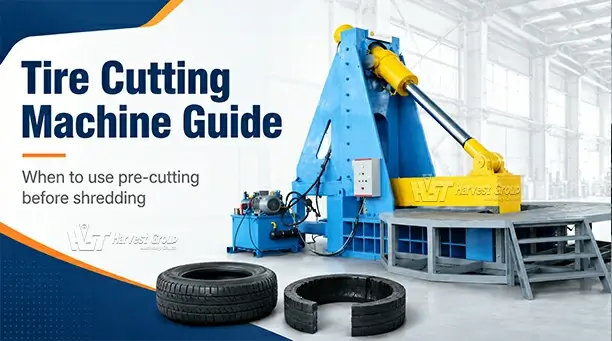
Tire pre-cutting is a front-end size reduction process. Instead of trying to produce final rubber chips, crumb rubber or powder, the cutter divides a whole tire into several manageable sections so that the material can be accepted more consistently by the next machine.
The most important function is to change the geometry of the tire. A complete tire is a flexible ring that can roll, bend and bridge across a feed opening. Once it is divided into sections, the material is easier to position and can present a more suitable shape to the shredder shafts. For oversized tires, pre-cutting also reduces the physical dimensions of the material to a size that can enter the hopper.
A tire cutter should therefore be viewed differently from a tire shredder machine. The cutter performs controlled preprocessing on individual tires or large tire sections, while the shredder continuously pulls material between rotating shafts and reduces it into smaller chips or shreds.
In a typical recycling process, the relationship may be:
Whole waste tire → optional bead treatment → tire cutting when required → tire shredding → further size reduction and separation
The word “optional” is important. The correct route depends on the actual tire and the equipment selected for the project.
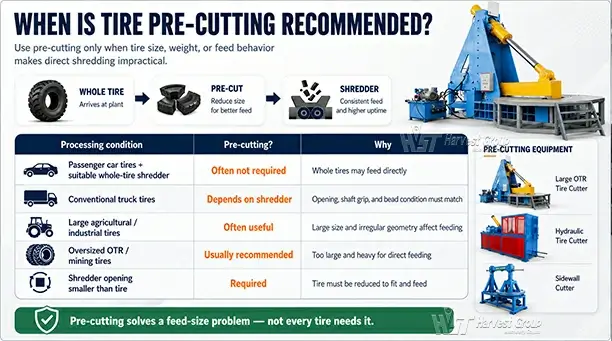
Pre-cutting becomes valuable when the complete tire is difficult for the downstream shredder to receive, grip or process efficiently. This is common with oversized tires, but size alone is not the only reason. Tire construction and feeding behavior also matter.
| Processing Condition | Is Pre-Cutting Usually Needed? | Main Reason |
| Passenger car tires with a suitable whole-tire shredder | Often not required | The shredder may accept whole tires directly |
| Conventional truck tires | Depends on shredder configuration | Feed opening, shaft engagement and bead construction must be checked |
| Large agricultural or industrial tires | Often useful | Large diameter and irregular geometry can make feeding difficult |
| Oversized OTR and mining tires | Usually recommended | Whole tires may be too large and heavy for direct feeding |
| Mixed tire feedstock with occasional oversized tires | Recommended for oversized material only | A separate cutting route prevents large tires from disrupting the main line |
| Small shredder opening compared with tire diameter | Required | The tire must be reduced to fit the hopper and cutting chamber |
| Downstream equipment requires controlled section dimensions | Recommended | Pre-cutting creates a more predictable feed size |
The clearest reason to use a tire cutter is a physical mismatch between the tire and the shredder. If the complete tire cannot enter the hopper or cannot reach the shafts in a stable orientation, changing motor power alone will not solve the feeding problem. The tire first needs to be reduced to a compatible geometry.
This situation is common in OTR tire recycling. Mining, quarrying and earthmoving tires can be much larger than conventional road tires, and the dimensions may vary substantially between different applications. Rather than designing every downstream machine around the largest possible whole tire, many recycling plants use a dedicated preprocessing stage to reduce oversized tires before they enter the main shredding system.
Tire weight changes the entire feeding method. Passenger tires can normally be moved and positioned easily, while large industrial and OTR tires may require a forklift, loader, crane or other mechanical handling equipment.
Once an oversized tire has been divided into several sections, those sections are easier to move and orient toward the shredder. This does not necessarily eliminate mechanical handling, but it reduces the size of each individual piece and makes the following operation more controllable.
A tire that technically fits inside a hopper may still feed poorly. Whole tires can rest across the opening, rotate without engaging the shafts or require repeated repositioning. The actual behavior depends on tire size, sidewall stiffness, remaining tread, shredder hopper geometry and shaft configuration.
Pre-cutting can improve feeding by replacing a large flexible ring with smaller sections that present edges and surfaces the shredder can grip more consistently. This is particularly useful where stable production is more important than simply proving that one whole tire can eventually be processed.
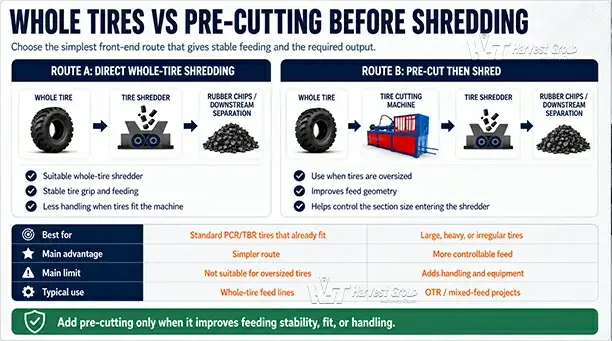
A separate cutter is not automatically required in every tire recycling line. Many industrial shredders are designed specifically to process whole passenger car tires and conventional truck tires. If the hopper, shafts, blades, drive system and feeding arrangement are suitable for the tire being processed, direct shredding can eliminate an unnecessary preprocessing step.
For standard tire recycling, the key question is not whether a cutter is available but whether adding one improves the overall process. A cutter that is not needed can increase equipment investment, floor space, labor and material handling without providing a meaningful production benefit.
Direct whole-tire shredding is generally more practical when the tire fits comfortably into the feeding system, the shafts can grip it reliably, the bead and steel content are within the shredder’s approved feed condition, and the required capacity can be achieved without repeated operator intervention.
This is why the shredder should be evaluated together with the feedstock. A large whole-tire shredder designed around whole-tire feeding may require much less preprocessing than a smaller machine intended to receive prepared tire sections.
One of the most common mistakes in tire preprocessing is treating all tires as if they only differ in diameter. Standard road tires and OTR tires can differ in weight, tread thickness, sidewall construction, bead reinforcement and handling requirements. These differences affect both the machine and the cutting process.
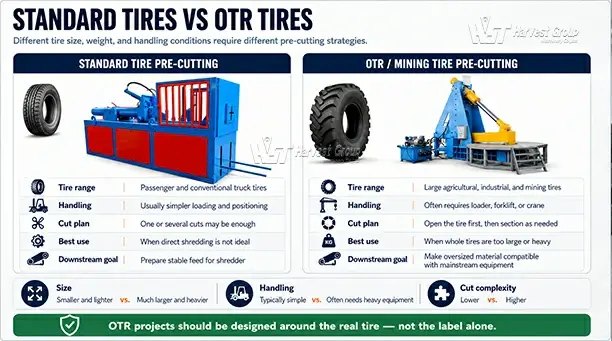
For passenger and conventional truck tires, a standard tire cutting machine can be used where the project requires tires to be divided before shredding. The process is relatively compact because tire size and handling requirements are moderate compared with giant OTR applications.
Depending on the production concept, another option is to use several separate preprocessing machines. The sidewalls can be removed first, the remaining tread ring can be cut into strips, and the strips can then be reduced into blocks. This type of semi-automatic arrangement can be appropriate for smaller projects where lower initial investment is more important than high automation.
For a higher-capacity automated line, a hydraulic cutter can reduce the number of separate manual operations. The preferred route depends on the tire range, labor cost, required throughput and the specifications of the downstream shredder.
OTR tires require more attention because the objective is often to make an otherwise unmanageable tire compatible with mainstream downstream equipment. An OTR tyre cutting machine may first open or divide the casing, after which the remaining sections are repositioned and cut again if necessary.
The process should be designed around the real tire rather than a general label such as “OTR.” A wide flotation tire, construction tire and giant mining tire may all be described as off-the-road tires while presenting very different cutting and handling requirements.
For the largest tires, the preprocessing system may also include bead removal or dismantling before final sectioning. The objective is not to force every OTR tire through exactly the same sequence, but to reduce difficult parts of the tire in a controlled way until the material meets the feed requirements of the shredder.
Debeading and tire cutting perform different functions and should not be treated as interchangeable processes. A tire debeader machine removes or extracts the heavy bead wire from the tire, while a tire cutter changes the size and geometry of the casing. Whether both are necessary depends on the recycling route.
Removing bead wire before shredding can reduce the amount of concentrated steel entering downstream size reduction equipment. This can be useful in lines designed to produce cleaner rubber granules or powder and can reduce the burden on later steel separation stages. However, some tire shredders and processing systems are designed to accept tires with the bead still attached.
A tire sidewall cutter performs another function. It separates the sidewall area from the tread section and may be used as part of a semi-automatic tire preprocessing route. In other projects, a dedicated debeader extracts the wire while leaving more of the tire body intact.
| Equipment | Main Function | Typical Position in the Process | When It Is Useful |
| Tire Debeader | Removes or extracts bead wire | Before cutting or shredding | When concentrated bead steel should be removed early |
| Sidewall Cutter | Separates tire sidewall from tread section | Front-end preprocessing | Common in semi-automatic cutting systems |
| Tire Cutting Machine | Divides whole tires into manageable sections | Before shredding | When tires are oversized or difficult to feed |
| Tire Shredder | Continuously reduces tires or tire sections into shreds | Primary size reduction | Required when smaller rubber chips are needed for further recycling |
The right question is therefore not simply whether a recycling line needs a cutter or a debeader. The front-end equipment should be selected according to the steel condition that the shredder can accept and the quality of material required by the following stages.
There is no single cut size that is correct for every tire shredder. The appropriate section dimensions depend on the hopper opening, shaft length, cutting chamber, shaft engagement, loading direction and material condition accepted by the machine.
For standard tires, one or several cuts may be enough to convert the casing into sections that enter the shredder smoothly. For large OTR tires, the first cut may only open the tire. Further sectioning may be needed before the material is suitable for loading into the downstream machine.
The cutter output should therefore be specified from the shredder backward. Rather than asking only how many pieces the tire cutter can produce, the project designer should determine the maximum tire section that the shredder can receive reliably and then select the cutting route required to achieve that condition.
This is especially important in high-capacity projects. A section that can technically be forced into the hopper may still create frequent bridging or require repeated loader adjustment. A slightly smaller and more consistent feed size can sometimes provide better overall line performance even if it requires an additional cutting operation.
The real value of tire pre-cutting appears when the cutter is integrated with the rest of the tire recycling equipment. Cutting is only the first size-reduction decision. After the tire enters the shredder, the rubber still needs to pass through additional crushing, separation and classification stages according to the required final product.
For projects producing larger rubber chips or tire-derived material, the process may be relatively short. Tires are prepared as required, fed into the shredder and reduced to a specified chip size. Steel may be removed during or after this stage depending on the equipment configuration.
Where the plant handles oversized tires, pre-cutting prevents the front end from becoming a bottleneck. Standard tires may bypass the cutter while only the large material is routed through preprocessing before joining the same primary shredding stage.
When the target product is smaller rubber granules, shredded tire material passes through additional size reduction. A rubber granulator reduces the rubber further while additional steel and fiber are released from the material.
A complete rubber crumb production line normally combines several stages rather than relying on one machine to perform all size reduction. The tire cutter prepares difficult whole tires, the shredder performs primary reduction, and the granulation and separation system produces cleaner and more consistent crumb rubber.
Fine rubber powder requires further processing after shredding and granulation. Depending on the required mesh size and production process, additional grinding can be performed with a tire grinding machine or other fine-size reduction equipment.
In a rubber powder production line, proper front-end preparation helps stabilize every downstream stage. If oversized or irregular tire sections repeatedly interrupt the shredder, the entire line can lose efficiency even when the granulator and grinding equipment have sufficient capacity.
This is why tire preprocessing should be planned as part of the complete rubber recycling plant. The best configuration is the one in which the output of one machine matches the feed requirements of the next machine without unnecessary handling or duplicate size reduction.
 achine
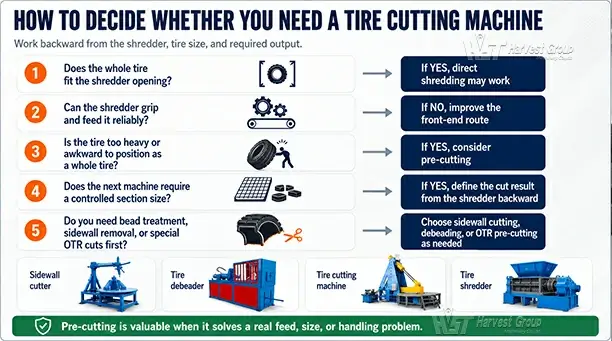
The decision should start with the actual waste tires and the actual shredder. Record the normal and maximum tire diameter, overall width, approximate tire weight, tire type and condition. For OTR projects, tire photographs, markings and rim sizes are useful because they show much more than a single maximum diameter.
Next, confirm the shredder feed requirements. The hopper opening, shaft dimensions, loading method and accepted bead condition determine whether the complete tire can be processed directly. If direct feeding is stable and the required throughput can be achieved, a separate cutting machine may not add enough value to justify another preprocessing step.
If the whole tire is too large, too heavy or too difficult to engage reliably, pre-cutting becomes much more useful. The required cut result should then be defined according to the shredder rather than simply asking the cutter supplier to “cut the tire smaller.”
Capacity also needs to be evaluated differently for standard and OTR tires. Standard tire cutting can often be expressed in tires per hour because the workpieces are relatively consistent. For OTR tires, the complete cycle includes loading, positioning, cutting, repositioning, additional cuts and section removal. A fast hydraulic stroke alone does not represent the real throughput of an OTR preprocessing system.
For a mixed tire stream, it is often unnecessary to make every tire pass through the same front-end equipment. Passenger and conventional truck tires can follow the most direct approved route, while oversized material is diverted to the cutter. This approach prevents the slower OTR preprocessing stage from limiting the production capacity of the entire plant.
One common mistake is selecting a tire cutter only from the maximum tire diameter listed in a catalog. Diameter is important, but two tires of similar outside size can have very different width, weight, tread thickness and steel reinforcement. These differences can change both cutting resistance and material handling requirements.
Another mistake is assuming that pre-cutting automatically improves every recycling line. If a shredder is already designed to process the complete tire efficiently, adding an unnecessary cutter increases handling and equipment cost without improving the final product. Pre-cutting should solve a real feeding or size problem.
The opposite mistake is trying to feed oversized material directly simply because the shredder has sufficient motor power. Motor power does not determine whether a tire can physically enter the hopper or whether the shafts can grip it consistently. Feed geometry and material handling need to be considered separately from drive power.
Projects should also avoid evaluating the cutter independently from downstream machinery. A tire section is only useful when the next machine can process it. Cutter output, shredder feed condition and subsequent granulation capacity should be designed as one connected material flow.
No. Many shredders can process whole passenger car and conventional truck tires. A tire cutting machine is more useful when tires are oversized, difficult to feed, too heavy to handle efficiently as whole tires, or larger than the accepted shredder opening.
They can when the shredder is designed and approved for the actual truck tire size and construction. The hopper, shafts, loading method and bead condition should all be checked rather than assuming that every truck tire can be processed in the same way.
Large OTR and mining tires commonly require pre-cutting because their diameter, width and weight make direct feeding difficult or impossible for conventional tire shredders. The exact cutting route depends on the tire dimensions, construction and the feed requirements of the downstream equipment.
It depends on the preprocessing route. Some systems remove concentrated bead wire before cutting or shredding, while other machines are designed to process tire sections containing attached steel. The correct arrangement should be based on the cutter, shredder and required downstream rubber quality.
A tire cutter divides whole tires into several large sections and is mainly used for preprocessing. A tire shredder continuously reduces whole tires or prepared tire sections into smaller shreds or chips for subsequent recycling.
There is no universal size. The section should match the hopper opening, shaft engagement, loading orientation and approved feed condition of the selected shredder. For large OTR tires, several cutting stages may be required before the material reaches a suitable size.
Yes, after suitable preprocessing. A plant can use separate front-end routes for different tire types. Standard tires may enter the primary shredder directly or after simple preprocessing, while oversized OTR tires are cut into compatible sections before joining the main recycling line.
A tire cutting machine is valuable when it solves a specific front-end problem. For conventional passenger and truck tires, a properly configured whole-tire shredder may eliminate the need for pre-cutting. For large agricultural, industrial and OTR tires, cutting can be essential for reducing dimensions, improving handling and creating material that the shredder can receive consistently.
The most effective approach is to work backward from the downstream equipment. Determine what tire size the shredder can accept, what steel condition is allowed and what production capacity is required. Then decide whether the tires need debeading, sidewall removal, sectioning or direct shredding.
When the tire cutter, shredder and downstream rubber processing equipment are selected as one system, preprocessing becomes more than an extra cutting operation. It becomes the first controlled step in a stable tire recycling process, helping oversized and difficult waste tires move efficiently from whole tire feedstock to rubber chips, crumb rubber or fine rubber powder.