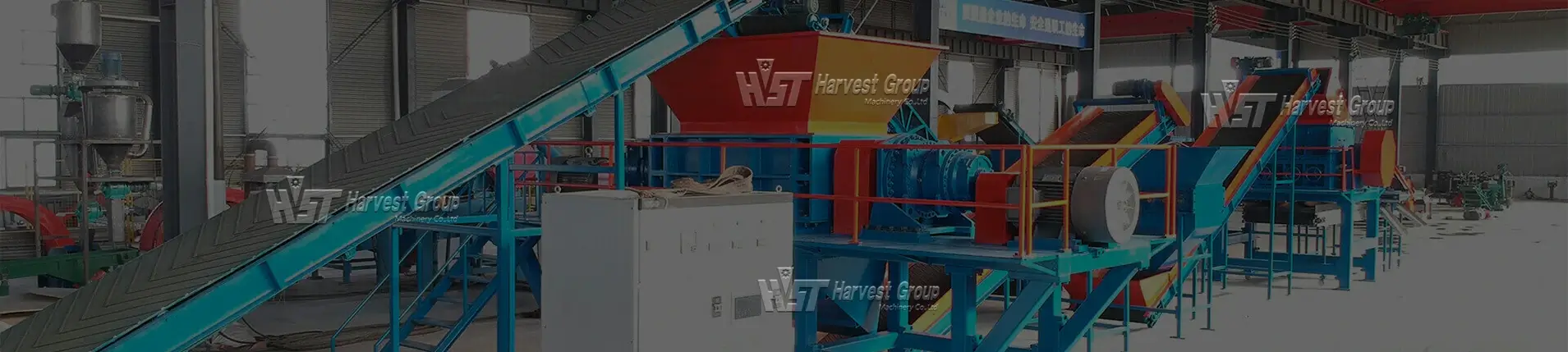
A tire shredder is industrial tire recycling equipment designed to reduce waste tires into smaller rubber pieces through shearing, tearing, and crushing actions. Tire shredders are widely used in tire recycling plants, TDF production systems, rubber mulch processing, and crumb rubber production lines.
Tire shredding reduces tire volume, lowers transportation costs, and improves steel wire separation efficiency. It also creates uniform raw materials for downstream recycling applications such as TDF, rubber mulch, and crumb rubber production.
Single-shaft tire shredders use one rotating shaft combined with fixed knives to cut and crush materials. These machines are suitable for fine shredding applications where more uniform output size is required.
Double-shaft tire shredders are the most widely used machines in the tire recycling industry. They use two low-speed, high-torque shafts rotating in opposite directions to tear whole tires into rubber chips.
Main advantages include high shredding efficiency, strong cutting force, low noise and dust, and wide tire compatibility.
Four-shaft tire shredders use four independently driven shafts for stronger gripping force and more uniform output size control. These machines are commonly used for large engineering tires, OTR tires, and high-capacity recycling systems.
The following table compares the main differences between double-shaft and four-shaft tire shredders.
Double-Shaft vs Four-Shaft Tire Shredder Comparison Table
|
Comparison Dimension |
Double-Shaft Tire Shredder |
Four-Shaft Tire Shredder |
|
Cutting Structure |
Two shafts rotate in opposite directions |
Four shafts provide stronger gripping |
|
Processing Capacity |
5–20 tons/hour |
10–35 tons/hour |
|
Output Size |
50–150 mm rubber chips |
20–50 mm adjustable output |
|
Energy Consumption |
Lower |
Higher |
|
Maintenance Cost |
Lower |
Higher |
|
Applicable Materials |
Passenger and truck tires |
OTR and engineering tires |
The following table compares stationary, portable, and mobile tire shredders.
Stationary vs Portable vs Mobile Tire Shredder Comparison Table
|
Comparison Dimension |
Stationary |
Portable |
Mobile |
|
Typical Capacity |
10–30 tons/hour |
1–5 tons/hour |
5–20 tons/hour |
|
Mobility |
Fixed installation |
Trailer/skid-mounted |
Fully mobile |
|
Installation |
Permanent factory |
Minimal preparation |
Simple leveling |
|
Advantages |
High capacity |
Quick deployment |
Flexible and efficient |
|
Applications |
Large recycling plants |
Temporary projects |
Regional operations |
Primary shredders are used to process whole tires into coarse rubber chips for volume reduction and easier transportation. Typical output size is 50–150 mm rubber chips.
Secondary shredders further reduce tire chips into smaller rubber pieces while improving steel wire separation efficiency.
Small recycling operations may use portable or small double-shaft shredders, while large industrial recycling plants usually require stationary double-shaft or four-shaft shredders.
If the target product is TDF fuel, coarse shredding equipment may be sufficient. For crumb rubber production, secondary shredding systems are usually required.
Electric tire shredders are suitable for fixed recycling plants with stable power supply, while diesel-powered shredders are more suitable for mobile and remote operations.
Operators should consider blade replacement frequency, energy consumption, maintenance convenience, and long-term operating costs.
Shredded tire chips are widely used as alternative fuel in cement plants and industrial boilers.
Rubber mulch produced from shredded tires is commonly used for playgrounds, landscaping, and safety flooring.
Fine rubber granules and crumb rubber are used in sports surfaces, rubber tiles, modified asphalt, and recycled rubber products.
Recycled tire materials are also used in rubberized asphalt and road engineering applications.
High-quality shredder blades, durable cutter shafts, and reliable motors are essential for stable long-term operation.
Modern tire shredders may include overload protection, automatic reversing systems, PLC control, and intelligent monitoring functions.
Reliable technical support, spare parts supply, and operator training are important factors when purchasing industrial tire shredders.
Most industrial tire shredders can process passenger tires, truck tires, bus tires, OTR tires, and some rubber products.
Double-shaft shredders are more suitable for coarse shredding and lower operating cost, while four-shaft shredders provide more uniform output and stronger processing capability for difficult materials.
The price depends on processing capacity, machine configuration, automation level, and application requirements.
Different tire shredders are designed for different recycling applications. Choosing the right equipment depends on tire type, production capacity, output size requirements, operating environment, and investment budget.