
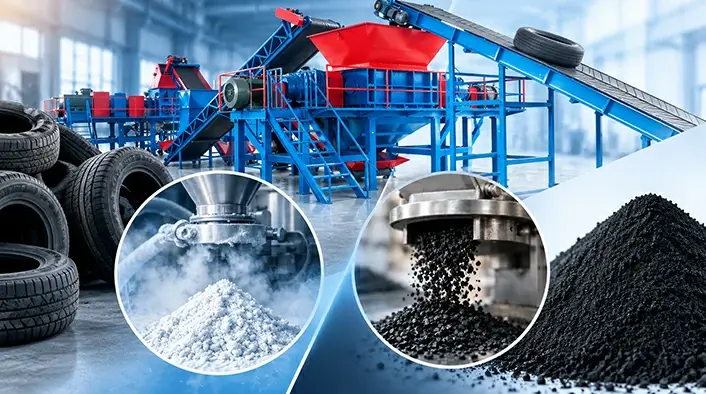
Ambient grinding is generally the more practical starting point for conventional tire rubber powder production, while cryogenic grinding may be preferable when demanding particle-size or process requirements justify liquid nitrogen and specialized equipment. Both methods convert prepared waste-tire rubber into usable powder, but they differ in how rubber fractures, the particles they produce, their achievable output under specific conditions, and their total production costs. The best choice is not simply the process that makes the finest powder. It is the one that consistently meets the buyer’s specification at an acceptable cost per tonne of saleable material.
For tire recyclers evaluating a new plant or an expansion, the comparison should cover feed preparation, final particle-size distribution, steel and fiber contamination, cooling, finished powder throughput, and downstream applications. The following guide examines these factors from an equipment-selection perspective rather than treating grinding as an isolated machine operation.
- 1. Ambient vs Cryogenic Grinding: Key Differences at a Glance
- 2. How Do Ambient and Cryogenic Tire Rubber Grinding Work?
- 3. How Does Each Grinding Method Affect Rubber Powder Quality?
- 4. How Do Temperature and Mesh Size Affect Grinding Capacity?
- 5. Which Is More Cost-Effective: Ambient or Cryogenic Grinding?
- 6. Which Grinding Method Is Better for Different Rubber Powder Applications?
- 7. How to Choose the Right Tire Rubber Powder Grinding System
- 8. Frequently Asked Questions
- 1. Rubber Crumb Production: Process, Equipment and Applications
- 2. How to Produce Fine-Mesh Rubber Powder from Recycled Tire Chips
- 3. How Waste Tires Are Transformed into Rubber Powder Through Shredding
- 4. What Is Crumb Rubber Used For?
- 5. Wide Application of Rubber Powder: Uses, Process and Business Profit Guide
- 6. How to Make Rubber Granules With a Rubber Granulator?
- 7. How to Choose Tire Recycling Equipment for Different Output Sizes
- 8. Tire Recycling Process: A Complete Step-by-Step Guide
Ambient vs Cryogenic Grinding: Key Differences at a Glance
Ambient grinding uses mechanical cutting, shearing, compression, or friction to reduce rubber size without intentionally freezing the material. Cryogenic grinding cools rubber until it becomes sufficiently brittle for efficient impact fracture. Neither technique is universally superior: the value of each depends on the specified product and production conditions.
| Comparison Factor | Ambient Rubber Grinding | Cryogenic Rubber Grinding |
| Material condition | Rubber remains relatively elastic during size reduction | Rubber is cooled until it becomes brittle enough to fracture |
| Main reduction mechanism | Shearing, cutting, compression and repeated mechanical work | Low-temperature conditioning followed by impact or other suitable milling |
| Typical particle morphology | More irregular, torn and relatively rough surfaces | Often smoother surfaces and more defined fracture edges |
| Particle-size control | Depends on grinder, cooling, screening and return-load capacity | Depends on cooling uniformity, mill selection and classification |
| Heat management | Air or water cooling, feed control and heat removal | Liquid nitrogen or another suitable cryogenic cooling system |
| Plant infrastructure | Mechanical equipment, electrical supply, cooling and dust extraction | Mill and separators plus cryogen storage, dosing, insulation and safety controls |
| Main operating-cost drivers | Electricity, wear parts, cooling, screening and recirculation | Liquid nitrogen, electricity, cryogenic equipment and maintenance |
| Typical investment fit | Conventional crumb rubber and rubber powder lines | Specialized powder specifications where testing demonstrates an advantage |
A lower mill power requirement does not automatically mean lower total production cost. Equally, a finer nominal mesh does not prove that one plant produces a higher percentage of acceptable powder. These questions must be tested at the same feed quality and finished specification.
How Do Ambient and Cryogenic Tire Rubber Grinding Work?
How Ambient Mechanical Grinding Works
In an ambient process, vulcanized tire rubber is reduced through successive mechanical stages. A typical whole-tire route includes initial shredding, secondary size reduction, steel liberation, granulation, fiber separation, and final grinding. These stages matter because the fine mill should receive reasonably clean, consistently sized rubber feed rather than whole tires mixed with bead wire and textile reinforcement.
Depending on the tire type and plant design, pretreatment may begin with a tire cutting machine followed by a tire shredder. A secondary rasper opens the rubber around embedded steel, and a rubber granulator prepares smaller particles for separation and fine grinding. Mechanical reduction does not require liquid nitrogen, but the process still needs cooling because repeated deformation and friction generate heat.
For final powder production, an appropriate rubber cracking mill or tire grinding machine further reduces prepared granules. The acceptable size fraction is collected after classification, while oversize material may be returned for additional grinding. The complete process is designed around the target powder specification, not merely the grinder’s nominal inlet capacity.

How Cryogenic Grinding Uses Liquid Nitrogen
In a cryogenic process, prepared rubber is exposed to a low-temperature cooling medium, commonly liquid nitrogen, so that its normally elastic behavior changes toward brittle fracture. The cooled material is then processed in a suitable impact or pin mill. Liquid nitrogen boils at approximately -196°C at atmospheric pressure, but this is not a universal operating temperature for the rubber or grinding chamber; the required material temperature depends on the compound and equipment design.
Effective cryogenic grinding requires more than adding nitrogen to a conventional mill. Cooling must be sufficiently uniform, with controlled feed rate, residence time, temperature monitoring, and appropriate handling of cold material. The system also needs safe nitrogen storage and delivery, ventilation, oxygen-deficiency risk controls, pressure protection, and trained operators. Although some specialized technologies claim to process larger tire pieces or whole tires directly, conventional cryogenic powder production commonly relies on mechanical size reduction and material preparation upstream.
How Does Each Grinding Method Affect Rubber Powder Quality?
Particle Size and Mesh Distribution

Powder quality cannot be defined by a mesh label alone. Two batches sold as 80-mesh rubber powder may have different percentages of oversized particles and fines. Ambient and cryogenic systems can both be engineered for fine powder, but their actual particle-size distributions depend on rubber composition, feed size, mill settings, classification efficiency, cooling and repeated passes.
| Nominal US Sieve Size | Approximate Opening | Why It Matters in Plant Selection |
| 20 mesh | 850 µm | Coarser powder, generally less demanding fine-grinding duty |
| 40 mesh | 425 µm | Requires suitable classification and oversize control |
| 60 mesh | 250 µm | Greater attention to cooling and accepted powder yield |
| 80 mesh | 180 µm | Fine-powder distribution and test method become particularly important |
| 120 mesh | 125 µm | Needs verification of achievable output, fines and energy cost |
These are approximate standard sieve openings, not guaranteed output sizes for any particular HVST machine. Buyers should specify the test procedure, the percentage passing or retained on each relevant sieve, and the limits for oversize and fines. ASTM D5644-23 provides a recognized test method for determining the particle-size distribution of recycled vulcanizate particulate rubber.
Particle Shape, Surface Texture and Flowability
Ambient grinding tends to deform, cut and tear elastic rubber, leaving relatively rough, irregular particle surfaces. Cryogenic fracture often produces particles with smoother surfaces and more defined edges. These differences can influence surface interaction with binders, bulk flow, feeding consistency and dispersion in downstream formulations. A rougher particle is not automatically better for bonding, and a smoother particle is not automatically easier to process: particle size, shape, moisture, treatment, recipe and processing conditions all influence the result.

Instead of relying on descriptions such as “premium fine powder,” buyers should ask for representative samples and test them in the intended end product. Microscopy, particle-size analysis and application trials can establish whether the morphology offers a meaningful advantage.
Steel and Fiber Contamination
Grinding temperature alone does not determine purity. Waste tires contain bead steel, belt wire and textile reinforcement; these materials must be liberated and removed through appropriate process stages. A steel wire separator helps recover ferrous contaminants, while a fiber separator helps remove loose textile fluff from the rubber stream. Screening and clean material handling remain important after separation.
A cryogenic mill may change how rubber fractures around embedded reinforcement, but it does not eliminate the need for separation or finished-product testing. For either route, specify residual metal and fiber limits in measurable units, agree on sampling methods, and test the final product rather than assuming that a particular grinding method guarantees purity. The US Environmental Protection Agency also identifies screening, magnetic separation and air separation as key steps in tire crumb production.
How Do Temperature and Mesh Size Affect Grinding Capacity?
Heat Buildup, Cooling and Screen Blockage
Fine grinding requires repeated mechanical work, and a proportion of that work becomes heat. In ambient processing, excessive heat can soften the rubber surface, encourage agglomeration, cause material to build up on grinding components, and reduce screening efficiency. A stable ambient plant therefore depends on suitable cooling, consistent metering, wear-part condition, dust extraction and an appropriate return-load design.
Cryogenic conditioning changes the rubber’s fracture behavior and can reduce smearing under suitable conditions. However, poorly controlled cooling, nitrogen supply interruptions or material warming before the mill can create their own reliability problems. The relevant engineering question is which process can hold the target specification over a continuous production run, not which process performs best during a short demonstration.
Finished Powder Output vs. Mill Feed Rate
Finished powder capacity should mean the mass of material meeting the agreed specification per hour. A mill may accept a large quantity of granules while delivering much less saleable fine powder because a substantial fraction must be screened out and returned. As the target mesh becomes finer, the grinding and classification load may rise and accepted throughput may decrease, particularly in ambient systems near their thermal or mechanical limits.
For example, a plant feeding 1,000 kg/h of prepared rubber and collecting 650 kg/h of in-specification powder should not be advertised as a 1,000 kg/h finished-powder line. Those figures are purely illustrative, not HVST test results. To make quotations comparable, request guaranteed finished output, feed specification, product-size distribution, normal operating power, test duration and allowable rejection or recirculation conditions. A correctly selected vibrating screen helps control top size and return load, but it cannot compensate for inadequate grinding capacity.
Which Is More Cost-Effective: Ambient or Cryogenic Grinding?
Equipment Investment and Plant Infrastructure
Ambient grinding generally requires less specialized process infrastructure because it avoids cryogenic liquid storage and dosing. Even so, a complete tire rubber powder facility requires upstream shredding and granulation, steel and textile separation, electrical systems, cooling, dust control, conveying, classification and product collection. Comparing the purchase prices of two standalone mills can therefore be misleading.
Cryogenic grinding adds refrigeration-medium storage and supply, temperature controls, insulation where necessary, and safeguards for low-temperature and oxygen-deficiency hazards. In some applications, more efficient brittle fracture may simplify part of the grinding duty. The overall investment effect depends on which upstream and downstream equipment is included in each supplier’s quotation.
Electricity, Liquid Nitrogen and Maintenance Costs
Ambient systems concentrate operating expenditure in electricity, grinding-element wear, screening, water or air cooling, return material and routine maintenance. Cryogenic systems incur additional liquid-nitrogen purchase and handling costs, along with cold-system maintenance and process control. Cryogenic grinding may reduce the mechanical energy needed for fracture, but that benefit must be considered alongside nitrogen consumption and the energy and logistics involved in its supply.
| Cost Component | Ambient Grinding | Cryogenic Grinding |
| Initial equipment | Mill, classification and conventional cooling system | Mill, cryogen delivery, controls and specialized accessories |
| Electricity | Grinding, drives, classification, ventilation and cooling | Grinding, drives, controls and associated systems |
| Cooling medium | Air and/or water, according to design | Liquid nitrogen or another suitable cryogenic medium |
| Maintenance | Cutters, rollers, screens, bearings and cleaning | Mill wear parts, valves, instruments, insulation and cryogenic systems |
| Production losses | Off-size powder, return load and heat-related downtime | Off-size powder, cooling losses, startup and process interruptions |
| Key economic test | Total cost per tonne of accepted powder at the same tested product specification | |
Cost per Tonne of Finished Rubber Powder
A useful comparison is cost per tonne of accepted powder = total relevant operating cost divided by accepted finished-powder tonnage. For example, if a process incurs $400 in relevant operating expenses during a test and delivers two tonnes of in-specification powder, the calculated operating cost is $200 per accepted tonne. This arithmetic example does not represent typical market pricing or an HVST performance claim.
Record electricity consumption, nitrogen use where applicable, wear parts, labor, cleaning, rejects and downtime over an agreed test period. When comparing total project economics, also account for equipment depreciation, financing, utilities infrastructure, expected utilization and the selling value of the final powder. Ambient grinding is often attractive for conventional markets, but a specialized cryogenic system may be justified if measurable quality or yield benefits outweigh its additional costs.
Which Grinding Method Is Better for Different Rubber Powder Applications?
Rubberized Asphalt and Road Construction
Ground tire rubber used in asphalt must meet the applicable project or binder specification, including particle size, gradation, contamination and processing characteristics. The relatively rough surfaces associated with ambient-ground rubber may be useful in some asphalt-binder systems, which is one reason ambient grinding is commonly considered for this market. However, product acceptance depends on the asphalt process, mixing conditions and specified performance tests; morphology alone cannot determine suitability.
Rubber Flooring and Sports Surfaces
Rubber flooring, tiles, mats and sports-surface products require controlled granule or powder sizing and low levels of unwanted steel and textile. Some formulations use coarser crumb rather than very fine powder, making extensive grinding unnecessary. Cryogenic and ambient particles can behave differently when mixed with binders, coatings or other infill materials, but neither is automatically preferable for every sports application. Buyers should evaluate the exact recipe, required product properties, relevant safety standards and sample-test results.
Tire Compounding and Industrial Rubber Products
Fine recycled rubber powder can be evaluated for molded goods, rubber compounds and certain polymer-modified materials. Here, particle size alone is not enough: dispersion, surface interaction, contamination and the effect of recycled-rubber loading on the final product are critical. Cryogenic powder may offer benefits in particular formulations, while the greater surface irregularity of ambient powder can be useful in others. Since ground vulcanized rubber does not simply become virgin rubber again, performance and substitution ratios should be established through compounding trials rather than assumed from mesh size.
How to Choose the Right Tire Rubber Powder Grinding System
Define Your Target Mesh Size, Purity and Capacity
Start with the marketable product, then work backward to the equipment. Define the tire feedstock, maximum incoming particle size, desired mesh distribution, contamination limits, acceptable moisture level and target finished tonnes per hour. It is also important to identify the final application, because a coarse crumb market and a fine-powder compounding market may justify entirely different system configurations.
For a conventional scrap-tire recycling project, ambient grinding is often the first process to evaluate if it can meet all specifications at the required throughput. Cryogenic grinding deserves a detailed study when ambient processing becomes restricted by temperature, persistent smearing, limited fine-powder yield or an application demanding different particle characteristics.
Compare Complete Production Line Requirements
Compare proposals using the same equipment boundary. An ambient rubber powder production line may integrate shredding, rasping, steel recovery, granulation, fiber removal, fine grinding, screening and material collection. A cryogenic quotation should clearly identify which upstream preparation stages are still required and include nitrogen storage, cooling, low-temperature milling, separation and safety systems. For projects beginning with whole scrap tires, the broader tire recycling plant layout also determines handling efficiency, maintenance access and downstream expandability.
HVST focuses on mechanical tire recycling and ambient rubber size-reduction equipment. A realistic equipment proposal should state what is included, which results are subject to testing and which operating conditions determine the quoted capacity. Buyers can review the wider tire recycling equipment range, but should request a project-specific flow diagram and utility list rather than relying on a single machine’s maximum throughput figure.
Verify Performance Through Sample Testing
Before selecting the grinding route, run trials using representative rubber, including variations expected in actual production. Ask the supplier to record feed condition, finished powder gradation, accepted output, operating temperature, energy or nitrogen consumption, residual metal and fiber, product handling behavior and continuous operating time. Where the powder will enter asphalt, molded products or rubber compounds, downstream formulation tests are especially valuable.
The practical decision rule is straightforward: choose ambient grinding when it reliably supplies the required powder at a competitive accepted-tonne cost; evaluate cryogenic grinding when trial results demonstrate that its added infrastructure and consumables create sufficient technical or commercial benefit. To discuss an ambient tire rubber powder project, share your target mesh, finished capacity and raw-material details with HVST’s engineering team.

Frequently Asked Questions
1. Can Ambient Grinding Produce 80–120 Mesh Tire Rubber Powder?
Some properly configured ambient grinding systems can produce powder in this fine range, but the achievable capacity depends on feed quality, grinder design, cooling and classification. Do not treat a listed mesh range as proof that every size can be produced at the same tonnes per hour. Request a finished-output test at the specified mesh distribution.
2. Does Cryogenic Grinding Always Produce Finer Rubber Powder?
No. Cryogenic cooling can improve fracture behavior for difficult rubber compounds, but final fineness also depends on the mill, classifier, feed preparation and operating conditions. Either process must be evaluated against the actual particle-size distribution rather than a headline mesh number.
3. Is Cryogenic Rubber Powder Cleaner Than Ambient-Ground Powder?
Not automatically. Cryogenic grinding may change how rubber separates from reinforcement, but removal of steel and fibers still requires appropriate liberation, magnetic and air separation, and quality testing. Cleanliness is a property of the complete process and handling system.
4. Can Cryogenic Grinding Process Whole Tires Without Pre-Shredding?
Some specialized suppliers describe systems that cool and fracture larger tire pieces or even whole tires. These claims should be evaluated with independent or witnessed tests, including accepted powder output, steel and fiber separation, cryogen consumption and total cost. They are not representative of all cryogenic grinding systems; many conventional lines use mechanical preparation first.
5. Which Grinding Method Is More Economical for a Tire Recycling Plant?
Ambient grinding is frequently more economical for conventional tire powder production because it avoids liquid-nitrogen infrastructure and consumption. Cryogenic grinding can become worthwhile where it delivers a demonstrable quality, yield or throughput advantage. The sound comparison is total cost per tonne of saleable powder produced to the same specification.