Turning waste tires into fine-mesh rubber powder has become one of the most valuable pathways in the circular economy. As governments tighten waste-tire regulations and industries search for cost-effective raw material alternatives, rubber powder stands out for its high economic value, wide application range, and strong environmental benefits.
This article provides a clear and practical overview of how rubber powder is produced—from pre-treated rubber chips to purified fine powder. Whether you operate a recycling plant, plan to invest in a new production line, or simply want to understand the process, this guide will help you navigate the complete workflow and the key engineering considerations behind it.
Waste tires are generated in massive quantities worldwide, yet remain difficult to dispose of. Many countries are moving away from landfilling and incineration because tires take decades to degrade and release harmful pollutants when burned. Mechanical recycling—especially rubber powder production—has become a globally encouraged solution because:
Rubber powder replaces part of natural rubber, helping reduce raw material costs.
It is widely used in pavement modification, sports construction, molded products, insulation materials, and adhesive compounds.
Each ton of rubber powder reduces CO₂ emissions and avoids the extraction of new rubber resources.
The global demand for fine rubber powder (20–80 mesh) continues to rise as more industries adopt sustainable materials.
These factors make rubber powder one of the most profitable and scalable outputs in the waste-tire recycling chain.
Rubber powder is a refined form of recycled tire material, typically between 0.1–2 mm in size depending on the application. Its commercial value largely depends on:
Particle size consistency
Purity (steel and fiber removal)
Stable physical properties
Low moisture content
High-quality rubber powder can directly replace part of virgin rubber in manufacturing, offering both economic and environmental advantages.
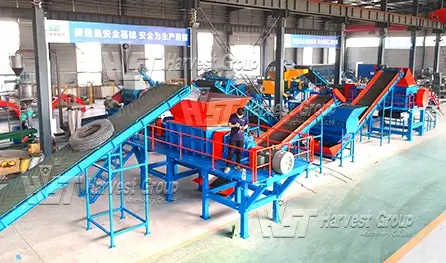
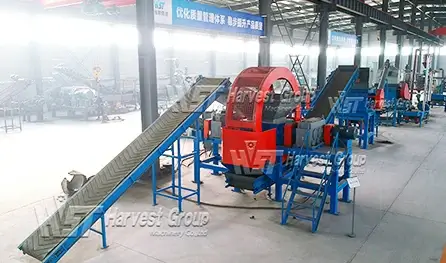
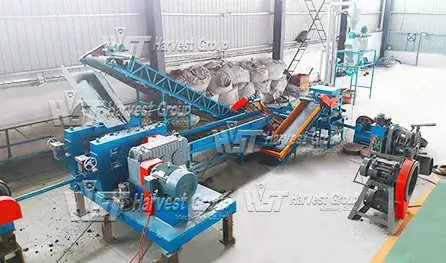
Producing high-grade rubber powder involves much more than simple crushing. A modern production line goes through multiple controlled steps to ensure quality, purity, and uniformity.

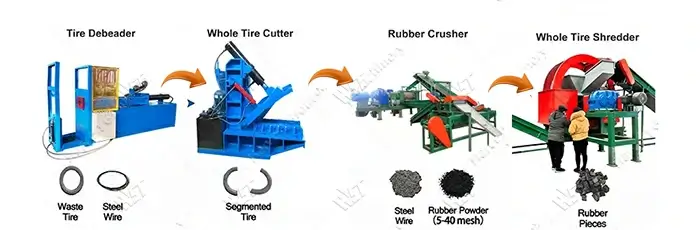
The process begins with rubber chips sized around 10–30 mm. These may come from an in-house shredding line or be purchased from external suppliers. Before entering the grinding equipment, the chips typically undergo:
Magnetic separation to remove remaining steel wires
Drying to reduce moisture and prevent material agglomeration
Visual inspection to ensure a consistent feed size
A stable and clean feedstock is the foundation of high-quality powder production.
Rubber chips then enter a granulator where rotating blades cut the material into 3–8 mm granules. Key engineering features of this stage include:
Controlled rotor speed to minimize heat buildup
Water-cooling or air-cooling to maintain rubber elasticity
Replaceable sieves to define output size
Heavy-duty blades designed specifically for tire rubber
The goal is to create a uniform intermediate product that is ready for fiber separation and deeper grinding.
Truck and bus tires contain reinforcing textile fibers. During granulation, these fibers loosen and must be removed to reach required product quality. Most plants use a combination of:
Air separation systems to lift light fibers away from denser granules
Zig-zag classifiers to capture residual fiber
Cyclone systems for fine purification
Reducing fiber content is essential for high-value applications such as modified asphalt, molded surfaces, and elastomer compounds.
This is the most critical stage, where 3–8 mm granules are refined into fine-mesh powder. Depending on the targeted particle size, producers may use:
Ambient grinding for standard 20–40 mesh powder
High-speed dual-disk mills for finer product control
Cryogenic grinding (liquid nitrogen) for ultra-fine powder above 80 mesh
Particle size is determined by the spacing between grinding plates, rotor speed, cooling method, and sieve selection. A consistent grinding temperature ensures the powder maintains elasticity and does not degrade.
Even after grinding, a high-quality powder line must include a final purification sequence to guarantee product consistency:
Vibrating screens ensure particle size uniformity
High-intensity magnetic separators remove any traces of steel
Dust collection systems capture ultra-fine particles and improve air quality
These steps ensure that the final powder meets industry standards for purity, mesh size, and stability.
Finished rubber powder is typically packed in:
25–50 kg bags for small and medium buyers
1-ton jumbo bags for industrial clients
Bulk loading systems for large asphalt producers
Powder must be stored in a clean, dry, and well-ventilated environment to avoid moisture absorption and clumping.
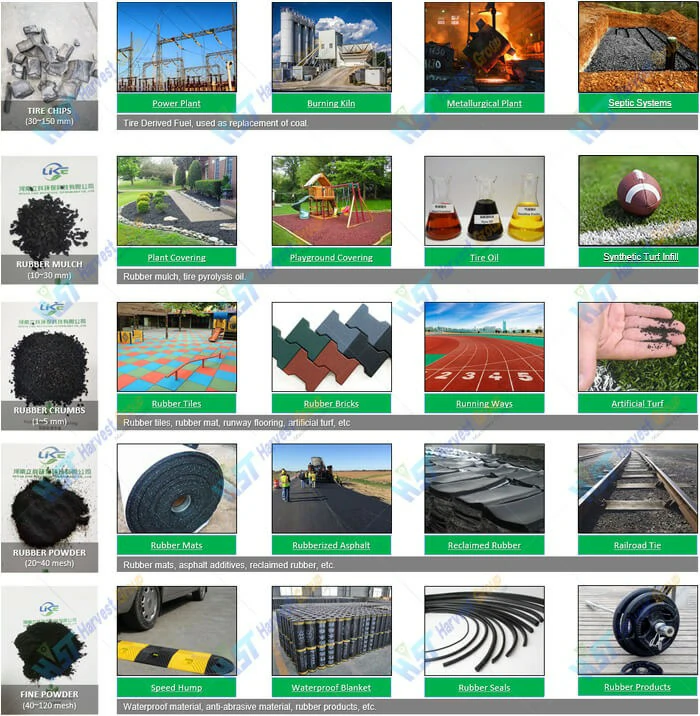
Fine rubber powder is one of the most versatile recycled materials on the market today. Major applications include:
Modified asphalt and road construction
Rubber tiles, playground surfaces, and athletic tracks
Automotive rubber components
Noise-absorbing and shock-absorbing materials
Adhesives, sealants, and bonding compounds
Artificial turf infill
Industrial molded products
As more industries shift toward sustainable materials, rubber powder continues to expand its market presence.

A rubber powder line offers multiple advantages for recycling companies:
High market demand and stable pricing
Strong environmental compliance, supported by government policies
Ability to scale from small regional plants to large integrated factories
Relatively low operating cost compared to pyrolysis and chemical recycling
Strong export opportunities in Southeast Asia, the Middle East, and Africa
For investors seeking long-term, sustainable, and profitable recycling projects, rubber powder production has become a proven and dependable option.
Rubber powder production is not only a technical recycling process—it is a crucial component of modern sustainable manufacturing. By transforming end-of-life tires into a high-value raw material, recycling plants can reduce environmental impact, create profitable business models, and supply industries with a dependable source of recycled elastomers.
For buyers, engineers, and investors, understanding the process from rubber chips to fine powder is the first step toward building a reliable, efficient, and future-ready recycling operation.