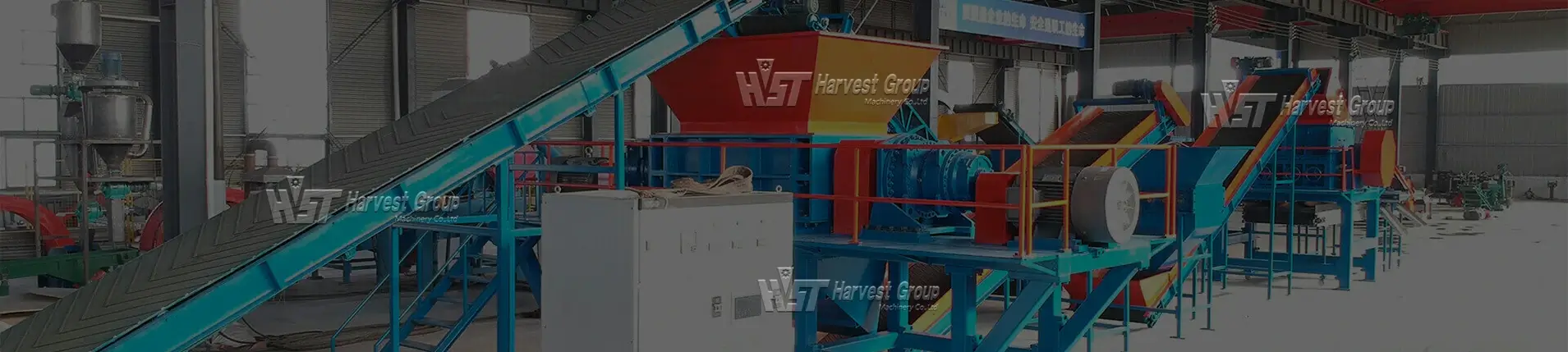
For waste tire recycling investors, factory purchasing managers, and international B2B buyers, selecting the right tyre shredder machine manufacturer can determine the capacity stability, product quality, operating cost, and long-term profitability of the entire recycling project. Industrial tire shredding is not the same as general-purpose waste shredding. A reliable system must process passenger car tires, truck tires, agricultural tires, semi-OTR tires, or pre-cut OTR tires while controlling torque, blade wear, output size, steel liberation, screening efficiency, and downstream material purity.
The commercial target also changes the equipment configuration. A plant producing tire-derived fuel requires a different process from a line producing wire-free rubber mulch, 1–4 mm crumb rubber, fine rubber powder, tire-derived aggregate, or pyrolysis feedstock. The primary shredder is only the first stage. Conveyors, screening, magnetic separation, raspers, granulators, fiber separation, dust collection, and control systems must be matched to the same capacity and final-product specification.
In 2026, buyers are placing greater emphasis on energy efficiency, automation, machine safety, replaceable wear parts, documented factory acceptance testing, and complete-line responsibility. At the same time, premium imported equipment can exceed the available project budget, while lower-priced equipment may create hidden costs through unstable feeding, rapid blade wear, excessive recirculation, poor separation, or weak after-sales support.
This guide combines a manufacturer ranking with a practical purchasing framework. It compares nine internationally recognized foreign brands with HVST, a China-based supplier focused on cost-effective complete tire recycling lines. This structure is designed for buyers who appreciate the engineering and reputation of premium imported equipment but need a more accessible investment level, flexible customization, and factory-direct support from China.
This is an editorial comparison rather than an official global sales ranking. To avoid turning the article into advertising for multiple competing Chinese suppliers, HVST is the only China-based manufacturer included. The other companies are internationally recognized foreign brands selected for their established presence in industrial shredding or tire recycling. Buyers should verify current specifications, references, and service arrangements directly with each manufacturer before purchasing.
The list below includes nine internationally recognized foreign manufacturers and HVST as the only China-based supplier. This makes the comparison more useful for buyers deciding between premium imported equipment and a more cost-effective Chinese complete-line solution.
| Rank | Manufacturer | Country | Core Strength | Best-Fit Project | Commercial Positioning |
| 1 | SSI Shredding Systems | United States | Heavy-duty industrial and OTR tire shredding | Mining, OTR, aircraft, truck, and difficult tire applications | Premium heavy-duty supplier |
| 2 | Eldan Recycling | Denmark | Complete tyre recycling and material recovery plants | High-quality chips, granules, steel recovery, and integrated plants | Premium European turnkey supplier |
| 3 | HVST | China | Customized complete waste tire recycling lines | TDF, rubber mulch, crumb rubber, and rubber powder projects | Cost-effective factory-direct alternative |
| 4 | CM Shredders | United States | Tire-specific shredders and TDF processing systems | TDF, TDA, tire chips, and commercial tire recycling | Established tire recycling specialist |
| 5 | Granutech-Saturn Systems | United States | Shredders, grinders, granulators, and powder-processing equipment | Multi-stage tire and industrial rubber size reduction | Premium industrial processing supplier |
| 6 | Vecoplan | Germany / United States | Secondary shredding and controlled material preparation | Re-shredding, TDF preparation, and steel liberation | Advanced engineering supplier |
| 7 | UNTHA Shredding Technology | Austria | Energy-efficient single-shaft shredding and automation | Controlled TDF, alternative fuel, and pyrolysis feed preparation | Premium automation supplier |
| 8 | TANA | Finland | Mobile high-torque tire shredding | On-site tire reduction, TDF, and mobile recycling operations | Premium mobile shredder brand |
| 9 | WEIMA | Germany | Robust single-shaft tire and rubber shredding | Secondary shredding, controlled output, and alternative fuel | Established German shredder manufacturer |
| 10 | ECO Green Equipment | United States | Modular turnkey tire recycling systems | TDS, wire-free chips, mulch, crumb rubber, and powder | Integrated tire recycling specialist |
Many first-time buyers begin by comparing quotations and motor power. However, the lowest machine price does not always produce the lowest cost per ton. A shredder that suffers from unstable feeding, frequent overload, rapid blade wear, excessive recirculation, inconsistent particle size, incomplete steel removal, high energy consumption, or weak after-sales support can create far more cost than the initial price difference between suppliers.
A professional manufacturer should help the buyer select the correct process instead of simply offering the largest available machine. The supplier should understand local tire supply, tire construction, target capacity, final-product market, labor conditions, energy price, factory space, environmental requirements, and the buyer’s plan for future expansion.
The manufacturer must understand more than the primary shredder. It should be able to explain how the selected machine fits into the final production route. A plant producing 100 mm TDF chips has a very different configuration from a line producing 1–4 mm crumb rubber or fine rubber powder. The required shredding stages, magnetic separation, fiber separation, screening, dust control, cooling, and control system all change with the target product.
Before selecting a supplier, the buyer should be able to answer four questions: What tires will be processed? What final material will be sold? What realistic hourly capacity is supported by the local tire supply? What level of installation and technical support is required in the destination country?
A useful manufacturer comparison should be based on project compatibility rather than brand size alone. The following selection matrix converts the most important procurement questions into practical checkpoints.
| Evaluation Criterion | Why It Matters | Buyer Checkpoint |
| Tire type capability | Passenger tires, truck tires, agricultural tires, and OTR tires create very different loads. | Confirm the maximum tire diameter, tire weight, steel content, and whether pre-cutting is required. |
| Real processing capacity | Rated capacity can change according to feedstock, output size, blade condition, and screen arrangement. | Ask whether the stated capacity is based on passenger tires, truck tires, mixed tires, or pre-cut material. |
| Target output size | The final size determines the number of shredding, separation, and screening stages. | Define TDF shreds, wire-free chips, mulch, crumb rubber, powder, or pyrolysis feedstock before requesting a quotation. |
| Blade and cutting system | Blade material, tooth design, thickness, heat treatment, and replacement method directly affect operating cost. | Request blade material, hardness, expected service conditions, repair method, and spare-blade pricing. |
| Complete-line capability | A good primary shredder can still fail commercially if downstream equipment is poorly matched. | Check conveyors, screens, magnetic separators, raspers, granulators, fiber separators, dust collection, and controls. |
| Safety and compliance | Tire recycling involves stored mechanical energy, exposed rotating parts, steel wire, dust, heat, and fire risk. | Verify guarding, emergency stops, pull-cord switches, interlocks, overload protection, fire precautions, and required regional documentation. |
| Engineering documentation | Overseas projects require more than a machine drawing. | Request the process flow, layout, foundation drawing, electrical load, compressed-air requirement, water requirement, and maintenance access. |
| Overseas support | Installation and commissioning problems can delay production for weeks or months. | Confirm installation scope, operator training, remote troubleshooting, spare-parts lead time, and warranty procedure. |
| Total cost of ownership | Purchase price is only one part of the long-term project cost. | Compare energy, labor, consumables, blades, downtime, recirculation, maintenance, and qualified output per hour. |
Country: United States
Core strength: Heavy-duty one-, two-, three-, and four-shaft industrial shredding systems
Best for: Large truck tires, agricultural tires, aircraft tires, OTR tires, mining tires, and demanding industrial applications
Buyer profile: Large recyclers and industrial operators prioritizing high mechanical strength and difficult-feedstock capability
SSI Shredding Systems is widely recognized for industrial shredders engineered for difficult materials. Its tire applications cover car, truck, aircraft, agricultural, OTR, and mining tires. SSI offers several machine architectures, allowing a project to use a low-speed, high-torque primary shredder followed by a single-shaft machine when more controlled secondary reduction is required.
The company is particularly relevant when the raw material is too large, too heavily reinforced, or too inconsistent for a standard commercial tire shredder. SSI equipment is also suitable for projects where the primary machine must be integrated with trommel screening, recirculation, secondary size reduction, or TDF preparation.
Key advantages: Strong heavy-duty engineering, broad shaft configurations, large-tire processing experience, and suitability for custom industrial systems.
Points to consider: SSI is generally positioned for demanding industrial projects. Smaller recyclers should compare the required capital investment, foundation requirements, power demand, and local service arrangements with the actual scale of their tire supply.
Country: Denmark
Core strength: Complete tyre recycling systems for shreds, chips, granules, and recovered steel
Best for: Buyers seeking integrated European engineering and high-quality recovered output
Buyer profile: Established recyclers, premium industrial projects, and operators requiring flexible downstream material recovery
Eldan Recycling supplies complete tyre recycling plants rather than focusing only on one shredder. Its systems can be configured for whole passenger tires, truck tires, pre-cut large tires, tire chips, granules, and further material separation. The company combines primary shredding, rasping, granulation, screening, magnetic separation, and fiber removal according to the required final product.
Eldan is a strong choice when the buyer wants one supplier to take responsibility for a technically integrated plant. The company is particularly relevant for projects where steel purity, particle classification, plant flexibility, and long-term production consistency are more important than minimizing the initial purchase price.
Key advantages: Deep tyre recycling specialization, broad plant configurations, strong material separation capability, and established international project experience.
Points to consider: Premium European systems normally require a higher investment budget. Buyers should compare not only the machine price but also the landed cost, installation support, local electrical standards, service response, and replacement-part lead time.
Country: China
Core strength: Complete waste tire recycling equipment and customized production-line integration
Best for: TDF, wire-free rubber mulch, crumb rubber, and rubber powder production
Buyer profile: Overseas recycling companies, project investors, rubber processors, and industrial operators seeking a complete production solution at a competitive investment level
HVST specializes in tire recycling equipment, heavy-duty tyre shredder machines, and complete production lines for international projects. The company can configure the system according to tire type, hourly capacity, target particle size, factory layout, electrical standard, environmental requirements, and the buyer’s downstream market.
For primary reduction, an HVST waste tire shredder machine can process car tires, truck tires, and suitable OTR feedstock into coarse rubber chips. The complete line can then add screening, magnetic separation, secondary crushing, granulation, fiber separation, fine grinding, and dust collection according to the required final product.
HVST is best positioned when the buyer needs more than a standalone shredder. Typical projects include TDF preparation, pyrolysis feed preparation, wire-free mulch production, 1–4 mm crumb rubber systems, and fine rubber powder plants. A complete tire recycling plant can be arranged as one integrated process rather than purchasing unrelated machines from several suppliers.
Key advantages: Competitive investment cost, customized plant configuration, broad downstream equipment range, international voltage customization, factory layout support, spare-parts packages, and overseas installation guidance.
Points to consider: Buyers should clearly define the required CE documentation, safety level, FAT scope, installation responsibility, operator training, warranty conditions, and local service expectations before contract confirmation. Project-specific references should be requested for the intended tire type and final output.
Country: United States
Core strength: Tire-specific primary shredders, chipping shredders, screens, and complete processing systems
Best for: TDF, TDA, tire chips, wire separation, and commercial tire recycling operations
Buyer profile: Tire processors seeking an established specialist with a broad range of tire-focused equipment
CM Shredders has developed equipment specifically for tire recycling, including primary shredders, chipping shredders, chip shredders, disc-screen classifiers, and final-stage milling, screening, and cleaning systems. This makes CM relevant to both standalone shredder buyers and companies developing a complete tire processing operation.
CM’s product structure is useful for projects that need controlled size reduction in several stages. Whole tires can first be reduced to shreds or chips, while secondary machines and screens help produce a more consistent output for TDF, TDA, mulch, or crumb-rubber feed preparation.
Key advantages: Tire-specific engineering, multiple shredding stages, patented knife-system options, established North American presence, and turnkey system capability.
Points to consider: The equipment is positioned for professional commercial operations. Buyers outside North America should compare shipping, import cost, installation support, service coverage, and the availability of local wear parts.
Country: United States
Core strength: Heavy-duty shredders, grinders, granulators, powderizers, and refiner mills
Best for: Multi-stage rubber reduction, industrial recycling, and projects requiring several particle-size reduction technologies
Buyer profile: Industrial processors that want a broad size-reduction equipment portfolio from one manufacturer
Granutech-Saturn Systems manufactures a broad range of industrial size-reduction machinery. Its portfolio includes heavy-duty shredders for primary reduction, grinders and granulators for secondary processing, and equipment for finer material preparation. This makes the company relevant to tire and rubber projects that require several mechanical reduction stages.
The main commercial advantage is equipment breadth. A buyer can evaluate different technologies according to feed size, steel content, required particle size, and downstream use rather than selecting one universal shredder for every stage.
Key advantages: Long industrial recycling experience, broad equipment range, heavy-duty construction, and the ability to support multi-stage reduction projects.
Points to consider: Granutech-Saturn serves many industrial materials, not only tires. Buyers should request tire-specific references, expected blade and screen wear, steel-liberation performance, and complete-line responsibility for the intended project.
Country: Germany / United States
Core strength: Single-shaft tire re-shredding and separation of rubber from steel
Best for: Secondary processing of pre-shredded tires for TDF and recycled rubber products
Buyer profile: Existing tire processors that need controlled secondary reduction and improved wire liberation
Vecoplan’s tire-related strength is re-shredding rather than basic whole-tire primary reduction. Its RTR machines are designed to process pre-shredded tires and liberate rubber from steel. This makes Vecoplan particularly relevant when a plant already has primary shreds but needs a more consistent secondary product and cleaner separation.
The equipment can support TDF preparation, recycled rubber products, mulch, and other applications that benefit from controlled particle reduction and marketable rubber and wire streams.
Key advantages: Specialized re-shredding design, strong engineering background, controlled secondary reduction, and focus on clean rubber and clean wire recovery.
Points to consider: A Vecoplan RTR system normally requires pre-shredded feedstock. Buyers seeking a complete whole-tire line should confirm which supplier is responsible for the primary shredder, upstream feeding, screening, and downstream material classification.
Country: Austria
Core strength: High-performance single-shaft shredding and energy-efficient drive technology
Best for: TDF, pyrolysis feedstock, and projects seeking controlled output from a single primary machine
Buyer profile: Industrial operators prioritizing energy efficiency, automation, and premium European engineering
UNTHA supplies shredding systems for rubber and used tires, with output configured according to the final application. Its XR series has been used for single-stage processing of scrap tires into defined fractions for alternative fuel and pyrolysis applications.
The company’s main differentiation is the combination of controlled single-shaft cutting, automation, and energy-focused drive technology. In the right application, this can reduce the number of machines required for a specified output. However, the actual result depends on tire type, feed preparation, metal content, desired fraction, and the downstream separation system.
Key advantages: Energy-efficient drive concepts, strong automation, mobile and stationary options, controlled output, and proven industrial references.
Points to consider: The buyer should verify whether the selected configuration can process whole tires directly, whether debeading or pre-cutting is required, and whether the final product needs additional magnetic separation or screening.
Country: Finland
Core strength: Mobile low-speed, high-torque shredders with integrated screening and metal separation options
Best for: On-site tire volume reduction, car and truck tire shredding, mobile TDF preparation, and projects that move between collection locations
Buyer profile: Professional recyclers, waste-management contractors, landfill operators, and companies that value mobility and operational flexibility
TANA is internationally known for mobile industrial shredders used in demanding waste applications. Its tire-shredding solutions are relevant where whole car and truck tires must be reduced directly at the collection or processing site. Depending on the operating method and machine configuration, the system can combine size reduction with screening and overband magnetic separation.
The main advantage of TANA is mobility. Instead of transporting large volumes of whole tires to a fixed plant, an operator can reduce their volume closer to the collection point. This can improve transport efficiency and allow one machine to serve several locations. TANA is therefore different from a conventional stationary crumb-rubber or rubber-powder line.
Key advantages: Strong international reputation, mobile operation, high-torque shredding, flexible particle-size control, and integrated performance monitoring on selected models.
Points to consider: A mobile shredder may be ideal for coarse tire reduction and TDF, but it does not replace a complete stationary line for wire-free mulch, crumb rubber, or fine powder. Buyers should also compare fuel consumption, transport arrangements, local service, and the cost of imported wear parts.
Country: Germany
Core strength: Heavy-duty single-shaft shredders for tires, rubber waste, alternative fuel, and industrial recycling
Best for: Secondary tire shredding, controlled particle size, rubber waste processing, and TDF or RDF preparation
Buyer profile: Industrial operators seeking established German engineering and a configurable single-shaft shredding platform
WEIMA is a well-known German manufacturer of shredding and recycling machinery. Its tire and rubber applications use robust single-shaft shredders designed to process the combination of rubber, steel wire, and textile reinforcement found in scrap tires. Hydraulic drive options and accessible maintenance features are particularly relevant in high-wear tire-processing environments.
WEIMA is most suitable when the project requires controlled secondary reduction or when tire material forms part of a broader alternative-fuel or industrial-rubber process. The correct configuration depends on feed preparation, desired output size, screen selection, drive system, and downstream magnetic separation.
Key advantages: Recognized German brand, robust single-shaft technology, strong industrial references, configurable drive and screen options, and maintenance-oriented machine design.
Points to consider: WEIMA is a broad industrial shredder manufacturer rather than a tire-only turnkey plant supplier. Buyers needing a complete line from whole tires to crumb rubber or powder should confirm which upstream and downstream equipment will be supplied by WEIMA and which parts require other system partners.
Country: United States
Core strength: Modular systems covering tire-derived shreds, wire-free chips, mulch, crumb rubber, and fine rubber powder
Best for: Buyers seeking a clearly structured progression from primary shredding to higher-value rubber products
Buyer profile: Commercial recyclers planning a turnkey or expandable tire recycling operation
ECO Green Equipment focuses specifically on tire recycling and offers modular systems for primary shredding, wire-free chip production, crumb rubber, and rubber powder. Its equipment structure helps buyers visualize how a plant can begin with coarse tire reduction and later add downstream modules as the market develops.
This modular approach is useful when the buyer wants to sell several final products or expand the project in stages. A plant may initially produce rough tire shreds or TDF, then add steel liberation, granulation, and fine grinding when stable markets for mulch, crumb, or powder are available.
Key advantages: Tire-specific turnkey systems, modular expansion, multiple final-product routes, and a clear commercial focus on tire-derived materials.
Points to consider: Buyers should compare total landed cost, local installation resources, replacement-part availability, system power demand, and the economic case for each downstream module.
| Project Requirement | Manufacturers to Shortlist | Why |
| Large OTR and mining tires | SSI, ECO Green, HVST | SSI is a premium heavy-duty benchmark, ECO Green offers dedicated large-tire equipment, and HVST can configure a cost-effective line when tire dimensions and required pre-cutting are clearly defined. |
| Premium complete European plant | Eldan, UNTHA, Vecoplan | Strong engineering, automation, controlled output, and established European industrial references. |
| Cost-effective complete export line | HVST | HVST is the only Chinese supplier included in this comparison and is positioned for buyers seeking customized complete-line integration at a more accessible capital cost. |
| TDF and tire chip production | CM, SSI, Eldan, TANA, UNTHA, HVST | These suppliers offer relevant primary shredding, screening, controlled chip production, or mobile TDF preparation solutions. |
| Secondary shredding and controlled output | Vecoplan, WEIMA, Eldan, ECO Green | Strong re-shredding, screen-controlled reduction, and downstream material preparation capability. |
| Crumb rubber and rubber powder | Eldan, Granutech-Saturn, ECO Green, HVST | These suppliers can be evaluated for multi-stage granulation, steel and fiber separation, screening, and fine rubber processing. |
No supplier is automatically the best for every project. Premium foreign manufacturers may offer stronger brand history, mature local networks, and highly developed specialized platforms, but their total investment can exceed the budget of many private recycling projects. HVST is positioned for buyers who need a practical balance between equipment capability, complete-line integration, customization, and purchase cost.
A double-shaft shredder uses two low-speed, high-torque shafts to pull, shear, and tear whole or pre-cut tires. This design is widely used for primary size reduction because it can accept irregular feedstock and tolerate the steel reinforcement inside tires. The resulting output is normally coarse and may require screening and recirculation.
Single-shaft shredders use one rotor and a screen to create a more controlled particle size. Depending on the machine and feedstock, they can be used for primary, secondary, or re-shredding duties. They are especially useful when the buyer needs consistent output rather than only volume reduction.
Secondary shredders reduce coarse primary shreds to smaller chips. They may be combined with screens so oversized material returns to the machine. This stage is important for producing specified TDF, TDA, mulch feed, or material suitable for a rasper.
A rasper further reduces tire chips and separates rubber from embedded steel. Magnetic separators remove liberated wire after the cutting stage. The quality of steel liberation strongly influences the value and safety of wire-free rubber mulch and crumb-rubber feedstock.
Granulators reduce wire-free rubber into smaller crumb sizes. Fine rubber powder requires additional grinding, classification, temperature control, and dust management. A primary tyre shredder cannot directly produce clean rubber powder in one step.
Mobile machines are useful for on-site volume reduction, temporary collection centers, landfill projects, and contracts where the shredder moves between locations. Stationary systems are normally better for continuous production, integrated separation, stable feeding, and higher-value final products. Buyers considering mobility can compare the operating model with a dedicated mobile tire shredder configuration.
The exact production sequence changes according to tire type and target product. The following process is a practical reference for a complete waste tire recycling line.
| Process Stage | Main Equipment | Purpose | Typical Output |
| Feedstock preparation | Debeader, sidewall cutter, OTR cutter, or tire cutting machine when required | Reduce steel load, control oversize tires, and prepare difficult feedstock | Whole tires or manageable tire sections |
| Primary shredding | Double-shaft or heavy-duty primary shredder | Reduce tire volume and create coarse chips | Approximately 50–150 mm shreds, depending on screen and machine design |
| Screening and recirculation | Disc screen, trommel, or vibrating screen | Separate qualified material and return oversized pieces | More consistent chip size |
| Primary metal removal | Overband or drum magnetic separator | Remove liberated steel when the process route requires it | Reduced metal contamination |
| Secondary reduction | Chipper, rasper, or secondary shredder | Further reduce chips and release embedded steel | Wire-liberated rubber chips |
| Granulation | Rubber granulator or crusher | Produce smaller rubber granules | Commonly 1–4 mm crumb, depending on the line |
| Fiber and dust separation | Air separator, fiber separator, cyclone, and dust collection | Remove textile and dust from rubber granules | Cleaner classified rubber |
| Fine grinding and classification | Rubber mill, cracking mill, fine grinder, and vibrating screen | Produce and classify rubber powder | Specified mesh ranges according to the market |
For a project focused on fine granules or powder, the supplier should explain the complete tire crushing line, not only the first shredder. The qualified-output rate, recirculation load, fiber content, remaining steel, and dust-control method are as important as the nominal input capacity.
Tire-derived fuel is one of the most established commercial routes for shredded tires. Properly prepared chips can be supplied to suitable cement kilns, industrial boilers, pulp and paper facilities, and other permitted thermal users. The buyer normally specifies chip size, maximum exposed steel, moisture, contamination, and delivery form. A TDF project should therefore be designed around the fuel user’s written acceptance specification rather than a generic shredder output.
This route usually requires fewer downstream stages than crumb rubber or powder production, which can reduce initial investment. However, profitability depends on a stable off-take agreement, transport distance, local fuel regulations, and the plant’s ability to maintain consistent chip size.
Shredded tires can be used in approved civil-engineering applications such as lightweight fill, drainage layers, vibration control, and landfill construction. Local regulations, engineering design, and environmental requirements determine whether this outlet is commercially available.
Rubber mulch is used in landscaping, playground surfacing, protective ground cover, and decorative applications. Compared with rough TDF chips, the product normally requires stronger steel liberation, repeated magnetic separation, controlled screening, and careful inspection for exposed wire. A specialized rubber mulch production line can include secondary crushing, magnetic separation, screening, cleaning, and optional coloring.
Mulch can offer a higher selling value than rough fuel chips, but market access depends on local product standards, safety requirements, color stability, packaging, and customer acceptance.
Crumb rubber, commonly produced in millimeter-range fractions such as 1–4 mm, can be used in molded rubber products, sports surfaces, flooring, artificial turf systems, asphalt modification, and other industrial applications. The market value depends on particle size, steel content, fiber content, cleanliness, color, and batch-to-batch consistency.
This route generally requires secondary crushing, steel liberation, granulation, fiber aspiration, dust removal, and multi-deck screening. The qualified-product percentage is often more important than the gross input capacity.
Rubber powder is a finer output used in asphalt, reclaimed-rubber processes, rubber products, waterproofing materials, modified plastics, and other industrial formulations. Fine grinding can create higher-value products, but it also increases power consumption, heat generation, dust load, screening difficulty, and maintenance requirements.
Before selecting this route, buyers should confirm the required mesh range, market demand, acceptable fiber content, cooling method, dust-control standard, and realistic yield of qualified powder.
Shredding can improve pyrolysis feeding consistency and reduce the handling problems associated with whole tires. However, the required chip size and steel content depend on the reactor design. The pyrolysis equipment supplier should provide the feed specification before the tire recycling line is finalized.
| Final Product | Common Size Direction | Important Quality Requirement | Typical Downstream Market |
| TDF or rough tire chips | Coarse shreds or specified chips | Consistent size and controlled contamination | Cement kilns and approved industrial fuel users |
| Pyrolysis feedstock | Specified chips according to reactor design | Stable feeding and acceptable steel content | Tire pyrolysis plants |
| Wire-free mulch | Commonly medium-sized rubber chips | No dangerous exposed steel and stable classification | Landscaping and surfacing |
| Crumb rubber | Commonly millimeter-range granules | Low steel, fiber, and dust content | Sports, flooring, molded products, and asphalt |
| Rubber powder | Fine classified mesh ranges | Particle consistency, temperature control, and cleanliness | Industrial rubber and modified-material applications |
Modern projects increasingly use controlled feeding, current monitoring, automatic reversal, overload protection, screen recirculation, and coordinated line control. Automation should not be evaluated only by the number of sensors. The real goal is to keep the shredder loaded efficiently without creating repeated overloads, empty running, or downstream bottlenecks.
Installed motor power alone does not show efficiency. Buyers should compare energy consumption against qualified output, not only input throughput. A system that accepts more material but returns a large oversize fraction may consume more energy per ton of saleable product.
Blade material is important, but maintenance access is equally important. Buyers should check whether the cutting tools can be removed individually, whether damaged edges can be repaired, how spacers and seals are replaced, how the shafts are accessed, and how much production time is lost during a normal blade-maintenance cycle.
Tire recycling lines combine stored mechanical energy, rotating equipment, exposed steel wire, frictional heat, combustible rubber, textile fiber, and dust. Industrial buyers increasingly expect guarded transmission parts, emergency stops, pull-cord switches, access interlocks, overload protection, temperature monitoring, dust extraction, and a documented fire-risk strategy.
A modular plant can begin with TDF or rough chip production and later add steel liberation, granulation, fiber separation, or powder grinding. This reduces the risk of investing immediately in a complex line before the local market for higher-value products has been confirmed.
There is no universal tyre shredder machine price because a small machine processing pre-cut passenger tires is not comparable with a heavy-duty system designed for whole truck tires or OTR sections. A complete line producing crumb rubber or powder also includes much more equipment than a standalone primary shredder.
| Price Factor | How It Affects the Project |
| Hourly capacity | Higher throughput requires larger shafts, stronger bearings, heavier frames, larger drives, and more downstream equipment. |
| Tire type | Truck and OTR tires require more torque, stronger cutting systems, and sometimes pre-cutting equipment. |
| Output size | Coarse shreds require fewer stages; crumb rubber and powder require multiple reduction and separation stages. |
| Blade design and material | Higher-grade blade systems increase initial cost but may improve life, repairability, and production stability. |
| Screening and recirculation | Controlled output requires screens, return conveyors, and additional controls. |
| Steel and fiber separation | Cleaner rubber products require magnetic separation, rasping, aspiration, and classification. |
| Automation and safety | PLC control, VFDs, overload protection, interlocks, fire precautions, and monitoring increase cost but reduce operating risk. |
| Export package | Voltage customization, documentation, packing, freight, installation, spare parts, and commissioning affect the landed cost. |
| Factory conditions | Foundation, electrical supply, lifting equipment, dust extraction, noise control, and available space can change the final project cost. |
| Required product purity | Lower steel, fiber, and dust content requires additional separation stages, recirculation, and quality control. |
Buyers should request both the equipment quotation and the assumptions behind the operating cost. The comparison should include power consumption, expected blade maintenance, number of operators, recirculation rate, spare-parts pricing, downtime risk, and qualified final output. A lower-priced machine may become more expensive if it produces excessive oversize material or requires frequent blade replacement.
Do not begin with the question, “How much is a tyre shredder?” Begin with, “What product will the plant sell?” TDF, TDA, pyrolysis feedstock, mulch, crumb rubber, and powder require different machine combinations and different quality-control standards.
Estimate the available passenger, truck, agricultural, and OTR tires by month. A large plant cannot operate profitably if the collection network cannot supply enough feedstock. Transport distance, tire-storage rules, seasonal variation, and local competition should be included.
| Capacity Range | Typical Buyer | Commercial Consideration |
| Around 1 t/h | Startup or small local recycler | Lower investment, but labor and unit operating cost must be controlled. |
| Approximately 2–3 t/h | Commercial regional recycler | Balanced investment and throughput when tire supply and product sales are established. |
| 5 t/h and above | Large industrial operator | Requires a strong collection network, stable product buyers, higher electrical capacity, and organized maintenance. |
A supplier experienced in TDF is not automatically experienced in producing low-fiber rubber powder. Ask for process diagrams, equipment lists, output samples, videos, and references that match the same tire type and final product.
A serious proposal should include the process flow, equipment list, plant layout, foundation loads, electrical load, compressed-air requirement, water requirement, dust-control plan, equipment access, maintenance clearances, and product-collection method.
Safety requirements should be discussed before the contract is signed. Depending on the market and machine scope, the buyer may require CE documentation, risk assessment, guarding, emergency stops, pull-cord switches, safety interlocks, overload protection, lockout points, dust control, temperature monitoring, or fire-suppression provisions.
Factory inspection should verify the machine structure, shaft and blade manufacturing, reducer and motor brands, electrical cabinet, welding quality, assembly condition, and spare parts. The FAT should use representative tire feedstock and record running time, current, throughput, output size, vibration, temperature, safety functions, and abnormal-load response.
Ask which parts are covered, which parts are considered consumables, how warranty claims are handled, who pays international freight, and how quickly technical support is available. Confirm whether installation is on site, remote, or supervised by the supplier.
| Quotation Item | What the Buyer Should Confirm |
| Feedstock basis | Tire type, maximum diameter, maximum weight, steel content, and whether debeading or pre-cutting is required. |
| Capacity basis | Input capacity, qualified output, screen size, recirculation rate, and expected production conditions. |
| Equipment scope | All machines, conveyors, screens, magnetic separators, platforms, dust collection, electrical control, and product collection. |
| Utility requirements | Installed power, operating power estimate, voltage, frequency, compressed air, cooling water, and ventilation. |
| Safety scope | Guards, emergency stops, pull cords, interlocks, overload protection, lockout points, and optional fire precautions. |
| Engineering documents | Process flow, layout, foundation drawing, electrical diagram, manuals, parts list, and applicable conformity documents. |
| FAT and acceptance | Test material, test duration, target throughput, output-size method, safety-function test, and acceptance criteria. |
| Installation and training | Supplier responsibility, buyer responsibility, engineer cost, local labor, lifting equipment, wiring, and operator training. |
| Warranty and spare parts | Warranty period, excluded wear parts, recommended two-year spare package, prices, and delivery lead time. |
What tire type was used to calculate the stated capacity? Capacity based on passenger tires cannot automatically be applied to truck or OTR tires.
Does capacity mean input or qualified output? A machine may accept several tons per hour but produce less qualified product after screening and recirculation.
What is the maximum tire diameter and weight? This determines whether debeading, sidewall cutting, or OTR pre-cutting is required.
What blade material, hardness, tooth design, and heat treatment are used? These details influence service life, repair method, and spare-parts cost.
What percentage of the output is within the target size? The supplier should explain the screen, return system, and recirculation load.
How are steel wire, textile fiber, and dust removed? The answer should match the purity required by the final market.
Which safety devices are included in the standard quotation? Do not assume interlocks, pull cords, temperature monitoring, or fire precautions are included.
What documents will be supplied? Request drawings, manuals, electrical diagrams, parts lists, certificates, risk documentation, and maintenance schedules.
What is included in installation and commissioning? Confirm travel, accommodation, local labor, tools, lifting equipment, wiring, and raw materials for testing.
What spare parts are recommended for the first two years? The list should include blades, spacers, seals, bearings where appropriate, screen parts, belts, sensors, contactors, and other critical items.
Many international buyers do not reject premium U.S. or European equipment because of quality. The main issue is whether the project can support the higher purchase price, imported spare-part cost, installation expense, and long-term service requirements. HVST is intended for buyers who want a complete tire recycling solution from China without competing only on the lowest machine price.
| Procurement Factor | Premium Foreign Brands | HVST Positioning |
| Initial investment | Often higher because of premium engineering, brand value, regional labor cost, and imported components. | More accessible factory-direct investment for private and commercial recycling projects. |
| Brand history and references | Usually stronger global brand recognition and long-established reference networks. | Growing international project base with a stronger focus on practical export customization. |
| Complete-line customization | Available from some suppliers, but standardized platforms and premium engineering changes can increase cost. | Flexible configuration according to tire type, capacity, final product, voltage, layout, and budget. |
| Spare parts and wear parts | Original imported parts may involve higher prices and longer international delivery routes. | Factory-direct spare-parts packages and more competitive replacement-part pricing. |
| Installation and service | Often stronger in markets with established local subsidiaries or dealer networks. | Remote support, overseas installation guidance, operator training, and project-specific service planning; local coverage must be confirmed by country. |
| Best-fit buyer | High-budget municipal, corporate, or specialized industrial projects prioritizing premium brands and local networks. | Private investors and commercial recyclers seeking a cost-effective complete tire recycling line without sacrificing essential engineering documentation and process integration. |
HVST’s strongest position is not simply selling a lower-priced primary shredder. Its value is providing a factory-direct, complete tire recycling solution for buyers whose project budgets do not justify premium imported systems. The equipment configuration can be developed around local tire supply, available investment, factory conditions, final-product market, required safety level, and future expansion plans.
For a basic volume-reduction or TDF project, the line may use a feeding conveyor, primary shredder, screen, return conveyor, and optional magnetic separation. For wire-free mulch, the project adds stronger steel liberation and classification. For crumb rubber or powder, the system continues through rasping, granulation, fiber separation, fine grinding, screening, and dust collection.
This complete-line approach reduces the risk of purchasing individual machines that do not match in capacity, feed size, discharge height, control logic, or maintenance requirements. Compared with importing several premium machines from different suppliers, HVST can provide one coordinated process, equipment configuration, plant layout, electrical requirements, spare-parts package, and quotation from a single manufacturing source.
Before requesting a proposal, the buyer should prepare the tire type, maximum tire size, required capacity, final product, target particle size, local voltage, available factory dimensions, environmental requirements, and destination port.
The best supplier depends on project size, tire type, final product, budget, and service requirements. SSI is strong in heavy-duty and OTR applications. Eldan is strong in premium complete tyre recycling plants. CM is a tire-specific specialist. TANA is strong in mobile tire shredding. Vecoplan, UNTHA, and WEIMA are established choices for controlled industrial shredding. HVST is the value-focused option in this list for buyers seeking a customized complete line from China at a more competitive investment level.
The price depends on capacity, tire type, motor power, shaft and blade design, output size, screen system, automation, safety configuration, and whether the quotation covers only one shredder or a complete line. Buyers should compare total operating cost and qualified output, not only the initial machine price.
A heavy-duty low-speed, high-torque double-shaft shredder is commonly used for primary truck-tire reduction. The exact machine depends on whole-tire diameter, steel content, required chip size, and hourly capacity.
Not always. Large OTR and mining tires may require debeading, sidewall cutting, segmentation, or a dedicated heavy-duty shredder. The buyer must provide the maximum tire diameter, width, and weight before equipment selection.
No. A primary shredder produces coarse chips or shreds. Rubber powder requires further steel liberation, granulation, fiber separation, fine grinding, and screening.
Primary shredders commonly produce coarse chips, often in a range such as 50–150 mm depending on the screen and cutting system. Smaller wire-free chips, crumb rubber, and powder require additional machines.
A tyre shredder normally uses low-speed, high-torque cutting to tear whole or pre-cut tires into coarse pieces. A tire crusher, rasper, granulator, or cracking mill normally performs a later reduction stage and produces smaller rubber particles. Manufacturers sometimes use the terms differently, so the equipment function is more important than the product name.
A standalone shredder may be enough for volume reduction, rough TDF, or feeding an existing downstream process. A complete line is required when the buyer needs controlled particle size, steel removal, fiber removal, crumb rubber, mulch, or rubber powder.
Request the process flow, equipment layout, foundation drawing, electrical diagram, installed power, utility requirements, machine manual, spare-parts list, warranty, FAT procedure, installation plan, safety documentation, and applicable conformity documents.
The most suitable tyre shredder manufacturer is not necessarily the company with the largest machine, the longest history, or the lowest quotation. It is the supplier that can match the tire feedstock, required capacity, target output, local market, factory conditions, regulatory requirements, and long-term operating plan.
Established U.S. and European manufacturers remain strong choices for premium industrial applications, advanced automation, mobile systems, and specialized heavy-duty shredding. HVST provides a different purchasing path for buyers who value complete-line customization and factory-direct pricing but cannot justify the capital cost of premium imported brands.
The final decision should be based on verifiable engineering documents, representative test results, relevant project references, clear safety responsibility, reliable spare-parts support, and a realistic total-cost-of-ownership calculation. A tyre shredder is only the first stage. The real objective is to build a stable process that converts local waste tires into a consistent and saleable product.