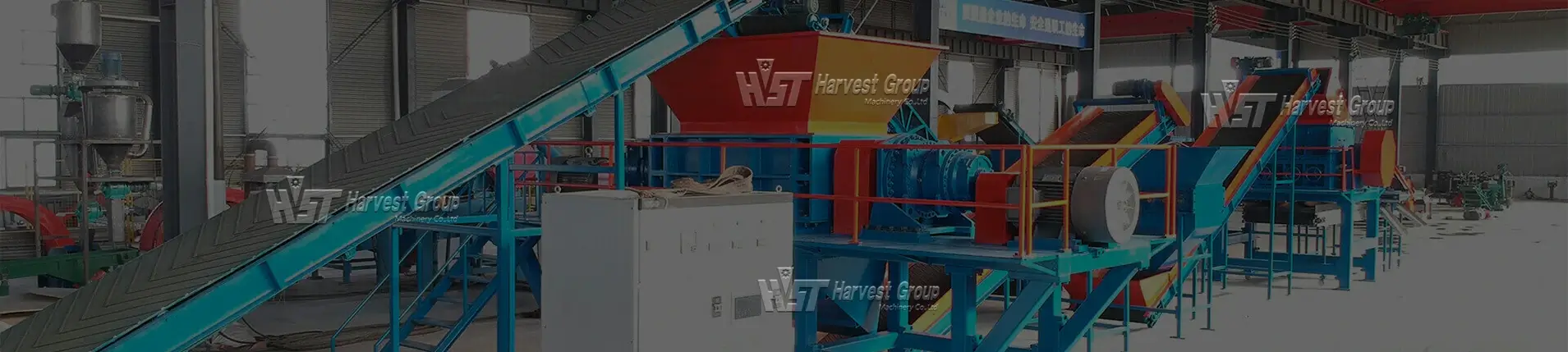
End-of-Life Tires (ELT) refer to tires that can no longer be safely used on vehicles due to wear, damage, or performance degradation. Based on application scenarios, they are mainly classified into:
Passenger car tires used for private vehicles and small buses
Commercial vehicle tires used for trucks and large buses
Special tires including engineering tires, aircraft tires, and off-road tires
Passenger car and truck tires account for more than 90% of global ELT generation.
With the continuous growth of global vehicle ownership, ELT has become a worldwide environmental challenge. Key data shows that approximately 1 billion ELTs are generated annually, equivalent to tens of millions of tons of solid waste. Currently, about 4 billion tires have been accumulated or landfilled, while only around 20% are effectively recycled into materials.
Even in regions with mature recycling systems, structural issues remain:
Europe generates 317 million tires annually, with a recycling rate exceeding 84%, but 50% relies on export processing
The United States generates 299 million tires annually, with some states still relying on landfilling
Japan generates 103 million tires annually, mainly focusing on energy recovery
In developed countries, each person discards approximately one passenger tire per year, highlighting severe resource waste.
Improper handling of ELT leads to multiple environmental and public health risks:
Land occupation occurs because tires are difficult to degrade naturally, with a void ratio as high as 75%
Fire hazards are significant, as ELT piles are highly flammable and difficult to extinguish
Pollution emissions release CO₂, SOx, and heavy metals
Public health threats arise as ELT piles become breeding grounds for mosquitoes and rodents
Modern tire recycling transforms ELT into high-value recycled materials, forming a closed-loop system of tire → recycled material → new tire.
Environmental value includes reduced carbon emissions, lower landfill pressure, and replacement of virgin resources
Economic value includes high-value products, policy incentives, and strong market demand
Recycling Path
Core Model
Main Products
Value
Environmental Impact
Application
Material Recycling
Physical / Chemical
Rubber granules, powder, rCB, steel, fiber
High
Excellent
Tires, construction, electronics
Energy Recovery (TDF)
Combustion
Heat, electricity
Low
Medium
Cement plants, power plants
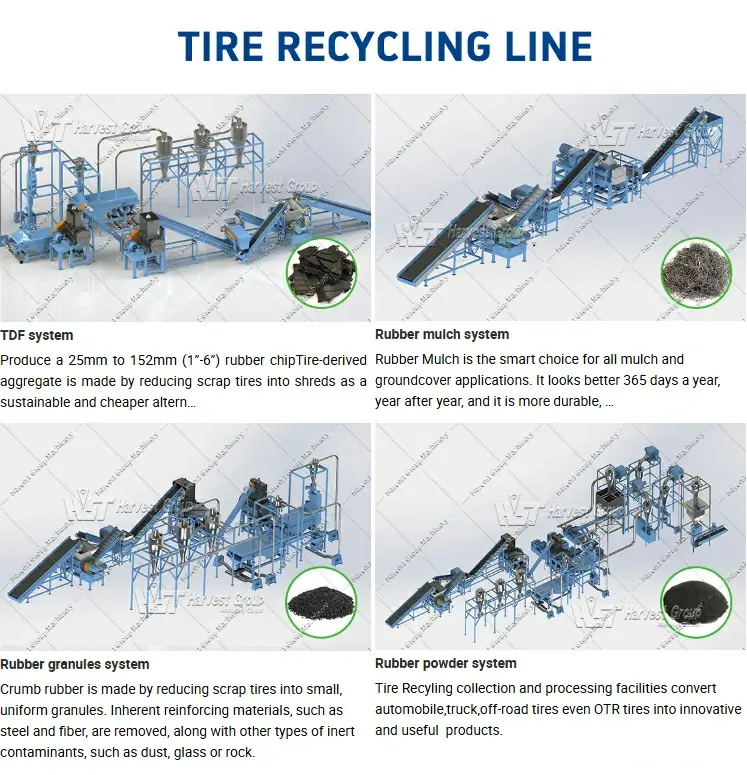
Mechanical recycling is the most mature and widely used method, suitable for most investment projects due to stable performance and low cost.
Ambient grinding produces 1–5 mm rubber granules with low cost
Cryogenic grinding produces 0–1 mm powder with higher value but higher cost
Advanced pyrolysis technology improves recycling efficiency up to 98%, producing:
Pyrolysis oil
Recovered carbon black
Combustible gas
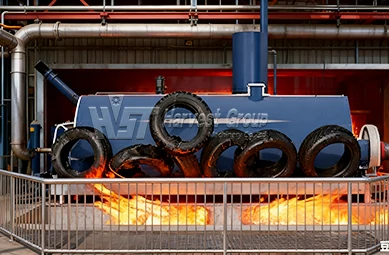
Modern recycling plants rely on automation and AI systems:
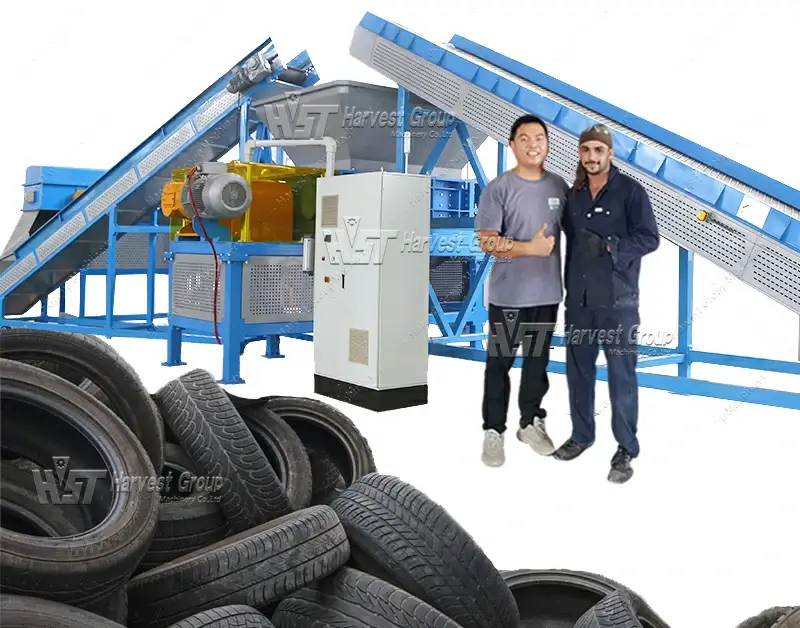
Automatic feeding, shredding, separation, and discharge processes
Real-time monitoring of equipment, energy consumption, and product quality
Predictive maintenance reduces downtime
Adaptive control optimizes efficiency and protects equipment
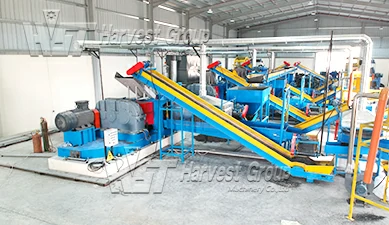
Pre-treatment removes impurities and cuts tires into manageable sizes
Crushing and grinding reduce particle size step by step
Separation removes steel and fiber with high efficiency
Final output includes rubber blocks, granules, powder, steel, and fiber

| Plant Size | Capacity | Equipment | Application |
|---|---|---|---|
| Small | 400–700 kg/h | Shredder + simple granulator | Small markets |
| Medium | 2–6 t/h | Shredder + rasper + automation | Regional markets |
| Large | 8–12 t/h | Multi-line + pyrolysis + automation | National centers |
Raw material type, contamination level, and pre-treatment quality influence output
Equipment condition, blade wear, and maintenance impact efficiency
Product size and purity requirements affect throughput
Costs include equipment, labor, energy, raw materials, and maintenance
Product prices vary:
Rubber granules: 800–1500 RMB/ton
Rubber powder: 2000–3000 RMB/ton
Recovered carbon black: 5000–8000 RMB/ton
Investment payback ranges from 1.5 to 5 years depending on scale
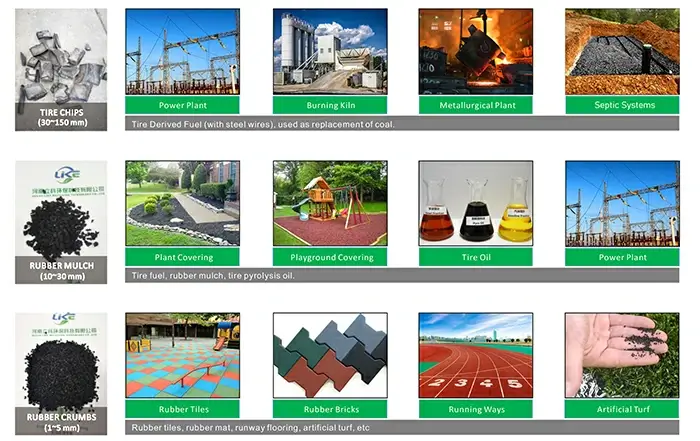
Rubber-modified asphalt improves durability, noise reduction, and safety
GRMs are used in earthquake-resistant foundations, drainage systems, and retaining walls
Rubber is widely used in playground surfaces, athletic tracks, and artificial turf
Recycled rubber is used in seals, conveyor belts, and construction materials
Recovered carbon black is used in electronics and battery components
TDF replaces coal in industrial furnaces
| Model | Description | Regions | Advantages | Challenges |
|---|---|---|---|---|
| EPR | Producer responsibility | EU, Japan | Stable system | Requires regulation |
| Government-led | Public system | US, Australia | Wide coverage | Funding dependence |
| Market-driven | Free market | Developing countries | Flexible | Disorder risk |
Material recycling rates will increase
Technology integration will improve efficiency
New applications will expand market demand
Choose capacity based on market size
Select technology based on product goals
Match configuration with budget and long-term plans
Technological innovation is the key driver transforming ELT recycling from waste disposal to resource utilization.
ELT is not waste but a valuable “urban resource,” and green technology is the key to unlocking its value.
Global demand will continue to grow
Policy and technology will drive industry expansion