Every year, more than one billion tires worldwide reach the end of their service life. Designed for durability, heat resistance, and safety, tires are also among the most challenging solid wastes to dispose of responsibly. Left unmanaged, waste tires become long-term environmental liabilities.
With the advancement of industrial tire recycling technologies, old tires are no longer waste. They are becoming valuable secondary raw materials that support circular economy goals. This article explores how waste tires move through a structured, sustainable recycling journey—from environmental burden to industrial resource.
Tires degrade extremely slowly in natural environments, often taking centuries. Improper disposal such as landfilling, illegal dumping, or open storage leads to serious environmental and safety risks.
Large tire stockpiles occupy massive land areas, create persistent fire hazards, and become breeding grounds for disease-carrying pests. Over time, chemical additives and heavy metals can leach into soil and groundwater, threatening ecosystems and public health.
Industrial recycling provides a controlled, scalable solution. By converting waste tires into reusable materials, recycling reduces pollution, conserves land resources, and creates long-term economic value.
Unlike single-material waste streams, tires are composite products. They consist primarily of vulcanized rubber, high-strength steel reinforcement, and textile fibers such as nylon or polyester.
The vulcanization process gives rubber its durability but prevents simple remelting or reshaping. Steel bead wires and textile layers further complicate separation. Manual or low-tech processing is inefficient, unsafe, and prone to secondary pollution.
Mechanical tire recycling remains the most widely adopted solution worldwide due to its scalability, product consistency, and commercial reliability.
Industrial recycling lines can operate continuously, processing dozens to hundreds of tons per day. Output products such as rubber granules and powder meet consistent quality standards, supporting stable downstream markets with predictable returns.
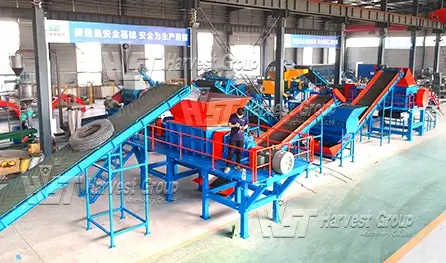
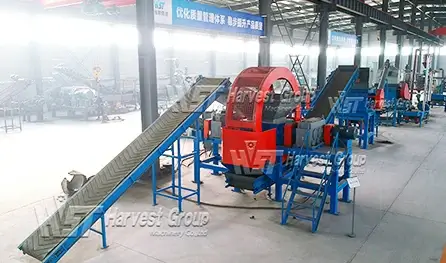
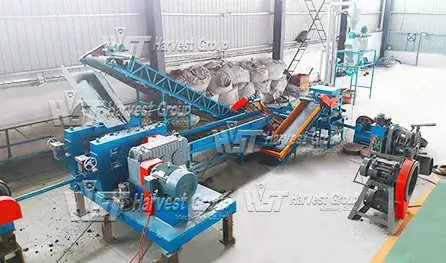
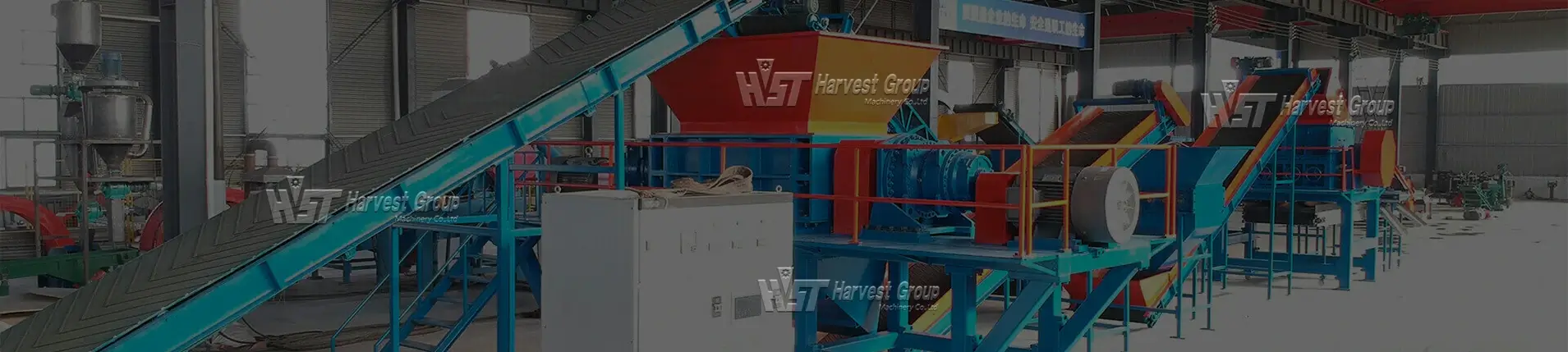
Tire recycling is not a single machine operation. It is a modular, step-by-step industrial system designed to maximize material recovery while minimizing energy consumption and equipment wear.
Waste tires are sourced mainly from tire dealers, vehicle service centers, end-of-life vehicle dismantling facilities, and municipal or industrial waste systems.
Proper classification is essential. Passenger car tires, truck and bus tires, and off-the-road tires differ significantly in size, steel content, and structure. Sorting improves processing efficiency, protects equipment, and ensures stable output quality.
Before shredding, tires undergo pre-processing to reduce mechanical stress on downstream equipment. In this stage, a waste tyre cutting machine is commonly used to cut whole tires into manageable sections and remove bead wires before further size reduction.
Sidewall cutting breaks the tire structure, while bead wire removal extracts high-tensile steel rings that would otherwise accelerate blade wear. Large off-the-road tires are often segmented to fit standard shredder inlets.
This stage significantly reduces energy consumption and extends tool life, improving both environmental and economic performance.
Primary shredding converts whole or pre-cut tires into rubber blocks or strips, typically ranging from 50 to 300 mm.
Industrial tire shredders operate at low speed and high torque, allowing them to handle steel-reinforced rubber continuously. Overload protection and stable operation ensure reliable 24-hour processing.
At this stage, material volume is reduced and internal bonding between rubber, steel, and fiber begins to loosen.
Secondary crushing and granulation refine the shredded material into smaller, application-specific sizes.
Common outputs include coarse rubber chips for civil engineering, crumb rubber for asphalt modification and sports surfaces, and fine rubber powder for molded products and material modification. Cooling and controlled feeding maintain consistent particle size and physical properties.
High-purity separation is critical for downstream applications.
Magnetic separation removes steel with purity levels exceeding 99 percent. Airflow or vibration systems separate lightweight textile fibers from rubber granules. The result is clean rubber material suitable for demanding industrial uses.
Recovered steel is recycled as scrap metal, while fibers can be reused in construction materials or energy recovery, enabling near-zero waste processing.
Crumb rubber is widely used in rubber-modified asphalt, reducing road noise, improving durability, and extending pavement life. Sports surfaces, playground flooring, and artificial turf infill benefit from rubber’s elasticity and safety performance.
Rubber powder serves as raw material for mats, tiles, seals, hoses, and automotive accessories, reducing dependence on virgin rubber.
Shredded rubber provides lightweight fill for roadbeds, bridge abutments, and foundation cushioning layers. Its elasticity helps absorb vibration and reduce structural stress.
In slope protection and erosion control, rubber mixed with soil offers long-term stability and resistance to water washout.
For materials unsuitable for high-purity recycling, tire-derived fuel offers an alternative pathway.
TDF delivers high calorific value comparable to heavy fuel oil, with lower emissions when used in controlled environments such as cement kilns and power plants. Ash residues can be reused in cement production, further closing the resource loop.
Beyond industrial applications, recycled tires find use in landscaping, agriculture, and furniture. As material science advances, recycled rubber is expanding into acoustic insulation, synthetic turf systems, and even additive manufacturing materials.
Mechanical recycling remains the foundation of the global tire recycling industry due to its technical maturity and stable markets.
Pyrolysis can produce oil, carbon black, and gas, but investment costs and market volatility limit large-scale adoption. Devulcanization enables rubber reuse but remains costly and niche-focused.
From a practical perspective, mechanical recycling offers the most balanced solution in terms of scalability, environmental control, and commercial reliability.
Recycling waste tires reduces landfill demand, lowers carbon emissions, and eliminates long-term pollution risks. Producing recycled rubber consumes significantly less energy than producing virgin materials.
Economically, tire recycling creates stable revenue streams, supports job creation, and reduces material costs for construction, infrastructure, and manufacturing sectors.
From an energy perspective, both material recycling and controlled energy recovery contribute to broader carbon-reduction and resource-efficiency goals.
Despite its potential, the tire recycling industry faces challenges including separation efficiency, equipment investment costs, market price fluctuations, and uneven collection systems.
Solutions lie in automation, intelligent sorting, energy-efficient equipment design, policy support, and closer collaboration across manufacturers, recyclers, and end users.
Future tire recycling will focus on recyclability-oriented tire design, intelligent and low-energy processing technologies, and fully closed-loop material systems.
By integrating production, use, recovery, and reuse, the tire industry can reduce reliance on virgin resources and build a sustainable material lifecycle.
The eco-friendly journey of old tires depends on industrial capability, sound process design, and coordinated action across the value chain. Modern tyre recycling machine systems play a critical role in enabling large-scale, stable, and sustainable waste tire processing worldwide.
As sustainability and carbon neutrality gain global momentum, tire recycling is evolving from waste management into a long-term green industry. Each recycled tire represents not an endpoint, but a renewed contribution to environmental protection and resource efficiency.