More than a billion tires reach the end of their life every year. Built to be durable and heat-resistant, they do not break down easily. When abandoned or dumped in open areas, they quickly become an environmental burden:
Tire stockpiles take up valuable land
Illegal dumping pollutes soil and groundwater
Tire fires release toxic smoke and are extremely difficult to extinguish
This is why tire recycling has moved from being “waste handling” to a structured industrial activity. Instead of paying to dispose of old tires, companies now turn them into valuable secondary materials and energy products.
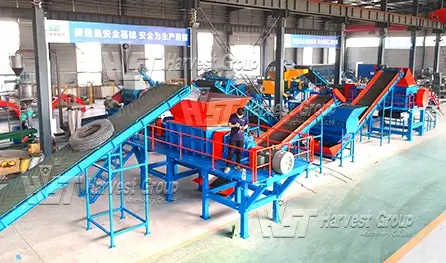
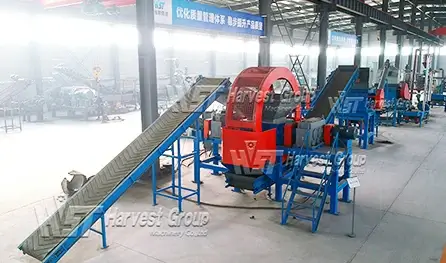
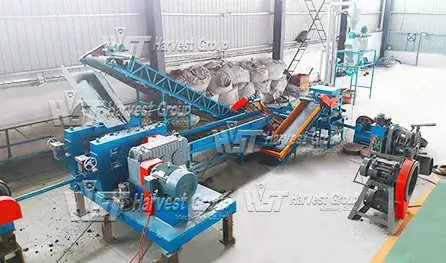
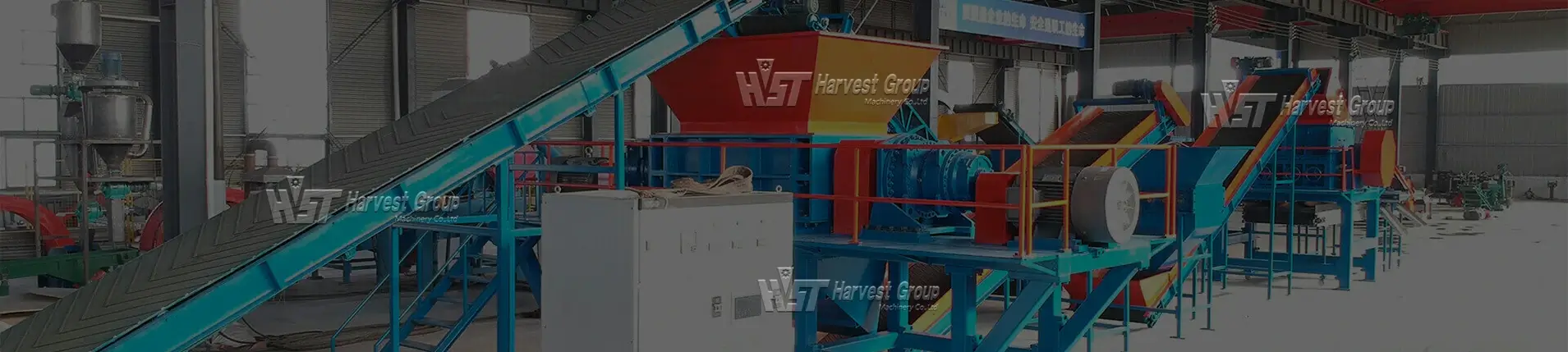
At the center of this trend is the tire recycling machine—a complete system of shredders, granulators, mills and separation units designed to transform waste tires into clean rubber granules, rubber powder, steel wire and fibers.
The efficiency, automation level and capacity of this equipment directly influence:
Operating cost per ton
Product purity and selling price
ROI and long-term profitability
This guide explains tire recycling from an international, investment-focused perspective—covering technologies, process steps, equipment types and practical selection advice for global buyers.
Tire recycling is not a matter of cutting tires into pieces or burning them. In the industrial sense, it means converting scrap tires into reusable materials without melting or incinerating the rubber.
Common feedstocks include:
Passenger and truck tires
Radial and bias tires
OTR (off-the-road) mining and construction tires
Agricultural and industrial solid tires
The aim is simple: reduce volume and separate materials to recover:
Rubber granules, crumb rubber and fine rubber powder
High-tensile steel wire
Nylon or polyester fiber
These products create new value in construction, sports surfaces, modified asphalt, molded rubber goods and even fuel markets.
Tire recycling is now recognized for its environmental benefits (lower landfill burden), economic advantages (new materials at lower cost) and industry value (supporting circular manufacturing).
Mechanical recycling remains the most widely used approach today. It relies on physical size reduction and separation, without changing the chemistry of the rubber.
The two main stages include:
Primary shredding (turning whole tires into chips)
Secondary granulation and fine grinding
Modern mechanical lines integrate cutting, screening, magnetic separation and air separation to reach rubber purity above 99.8%.
Two grinding styles dominate the industry:
Ambient grinding
Rubber is processed at normal temperatures using high-speed blades. This produces 1–10 mm rubber granules suitable for:
Sports surfaces
Rubber tiles
General industrial rubber goods
Lines typically handle 15–20 tons/day at relatively low energy consumption.
Cryogenic grinding
Liquid nitrogen cools rubber to around -150°C, making it brittle. Impact mills then produce ultra-fine powder (100 microns or finer).
This route offers:
Very smooth particle surfaces
High purity (>98%)
Ideal quality for high-value industrial rubber products
Cryogenic systems with nitrogen recovery loops can reduce nitrogen usage significantly, lowering running costs.
Chemical recycling focuses on devulcanization—breaking the sulfur cross-links that give rubber its shape.
The result is a rubber material that can be re-vulcanized and used in:
Certain new tire compounds
High-end seals and industrial rubber parts
With chemical recycling, recycled rubber is no longer limited to low-grade applications.
Pyrolysis breaks down rubber in an oxygen-free reactor into:
Pyrolysis oil
Syngas
Carbon black
Steel wire
Modern pyrolysis plants include gas recovery, heat reuse and emission control systems, making them more efficient and compliant with regulations.
Oil can be refined into non-standard diesel, and carbon black can be upgraded for industrial use.
A stable supply of tires is essential.
Tires are usually sourced from:
Tire retailers
4S auto service shops
Municipal collection centers
Transportation companies
Incoming tires are checked for stones, metal or excessive dirt, as cleaner feedstock delivers higher product purity and better market prices.
Proper storage prevents fire risks and rubber degradation.
Many operators now use GPS routing and IoT-based inventory systems to control logistics and reduce costs.
Traditional processes use a bead puller to remove the steel bead ring, which is extremely hard and durable.
New-generation heavy-duty shredders can now process whole tires—including the beads—thanks to:
Staggered knife discs
Reinforced cutting chambers
Smart torque control systems
These machines can turn whole tires into 10–15 cm chips in just over a minute while separating most steel in-line.
This simplifies the plant layout and increases total capacity by more than 40%.
Primary shredders are the backbone of tire recycling lines.
Modern machines offer:
Dual-motor drives with strong reducers
Hardened alloy cutters (HRC > 60)
Throughput from 1 ton/hour up to 35 tons/hour
These chips can be sold as TDF or go to further processing.
Steel typically accounts for about 20% of a tire’s weight.
Magnetic separators remove and clean the steel, which is then sold to steel mills for recycling.
In many regions, steel revenue can cover a meaningful share of the operating costs.
After primary shredding:
Granulators reduce size to 1–5 mm
Additional mills produce 30–60 mesh crumb rubber
Fine mills can produce 80–100 mesh rubber powder
Different particle sizes match different markets:
Granules → turf infill, playground flooring
Crumb rubber → modified asphalt, running tracks
Fine powder → shoe soles, industrial rubber compounding, even new tire production
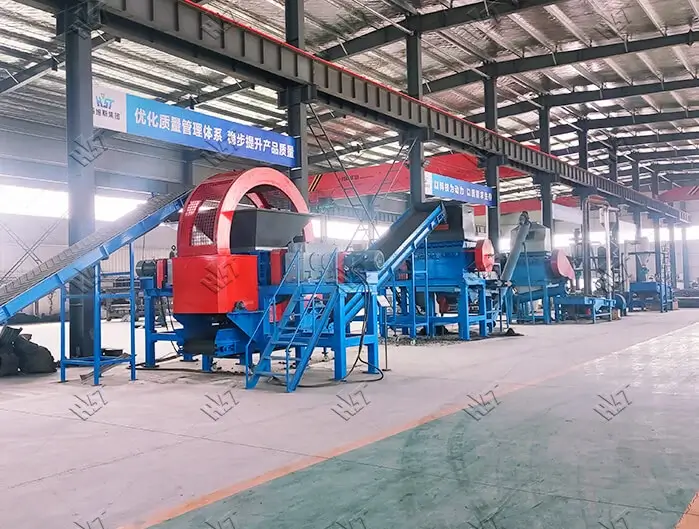
Customers expect stable, clean products.
Typical 2025 quality targets include:
Rubber purity ≥ 99.8%
Steel residue ≤ 0.1%
Fiber residue ≤ 0.1%
Achieving this requires multi-stage separation, precise screening and consistent machine calibration.
Higher purity rubber can sell for 10–15% more.

Used to cut whole tires into chips:
Handles passenger to large OTR tires
Capacity from 1 to 35 tons/hour
Blades made from high-strength alloy steel
Suitable for TDF production or further processing

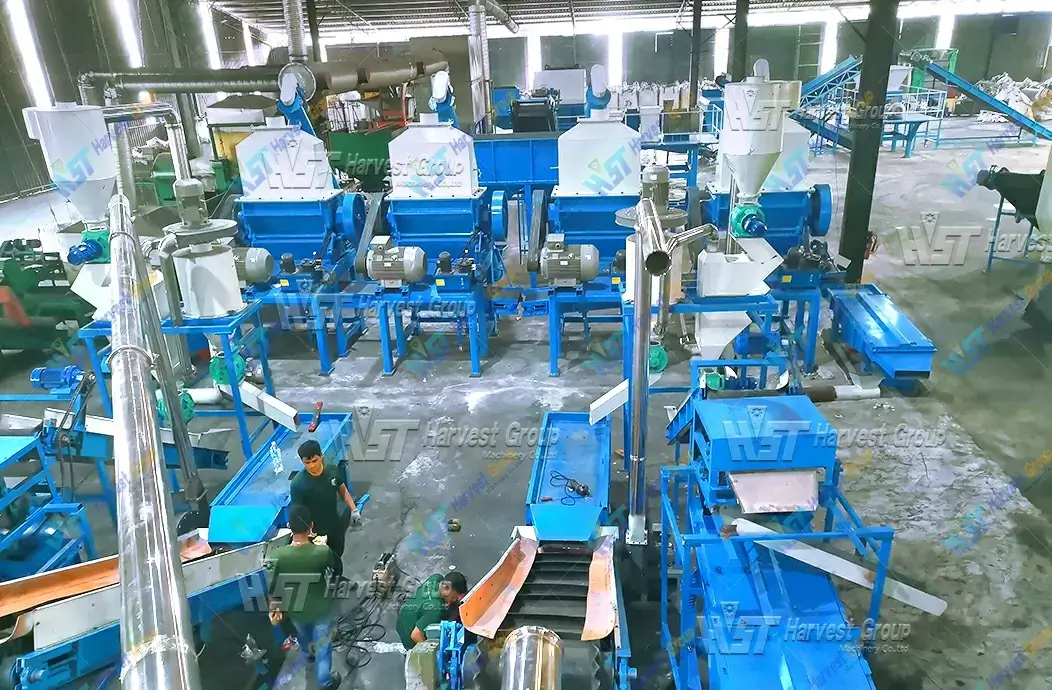
Consist of shredders, granulators, magnets, air separators and screens:
Produce 1–5 mm rubber granules
Capacity from 500 to 5000 kg/hour
Purity up to 99.9%
Ideal for artificial turf, rubber flooring and molding applications
A common choice for medium-sized recycling plants.
Designed for fine grinding:
Produce 30–100 mesh powder
Includes cooling systems to avoid oxidation
Used in shoe soles, tire compounds, industrial rubber goods
Strong market growth driven by the asphalt and footwear industries

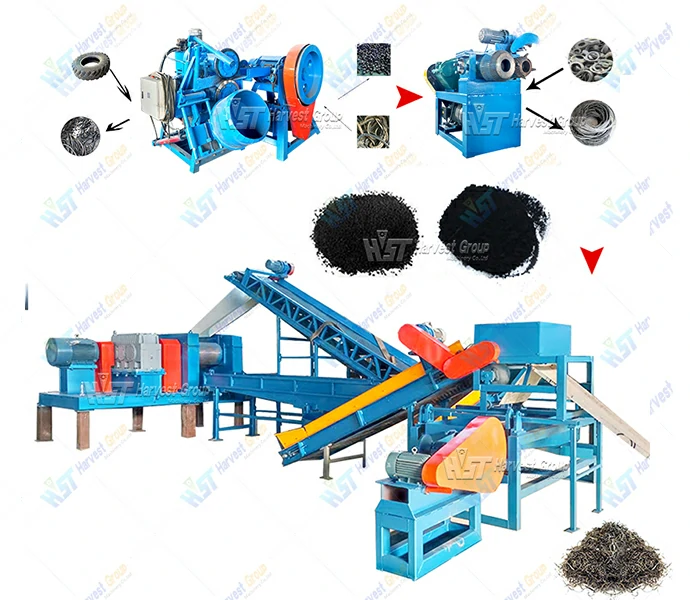
Compact, entry-level systems using dual rollers:
Low energy consumption
Suitable for small investors
Capacity 300–3000 kg/hour
Lower equipment cost (30–50% cheaper than a full granulation line)
Convert tire rubber into:
Oil
Carbon black
Syngas
Recovered steel
Modern designs allow continuous feeding, automated control and higher oil yields.
These plants benefit from policies promoting waste-to-energy solutions.
The type of equipment (shredder, granulator, powder mill)
The type of tires (OTR tires process slower than car tires)
Whether the line is integrated with conveyors, PLC, dust control
Modular design that allows expansion without redesigning the plant
Integrated systems can operate 20–30% faster than stand-alone machines.
Rubber purity affects:
Price
Market access
Long-term customer relationships
High-purity materials are essential for premium markets like sports fields, high-grade asphalt and OEM manufacturing.
Rubber chips with calorific value of 30–35 MJ/kg, widely used in:
Cement kilns
Industrial boilers
Waste-to-energy plants
Lightweight, porous material for engineering:
Retaining wall backfill
Landfill drainage layers
Slope stabilization
Lightweight road construction
Shock-absorbing, durable and low-maintenance surface material for:
Playgrounds
Parks
Walking paths
Used for:
Modified asphalt
Artificial turf infill
Running tracks and playgrounds
Used in:
Shoes
Industrial rubber materials
New tire compounds
Sold to steel mills for remelting.
Used in:
Composite materials
Low-grade fillers
Energy supplement for TDF combustion
The tire recycling sector faces challenges—cost pressure, quality consistency, and uneven market acceptance.
But four trends are reshaping the landscape:
More efficient pyrolysis systems with higher-grade carbon black
Lower-cost devulcanization technologies
Tire designs that are easier to recycle
Smarter, AI-assisted recycling lines with remote maintenance
With tightening regulations worldwide, tire recycling is entering a long-term growth phase driven by both economics and sustainability.
Choosing the right solution depends on your target products.
For TDF → invest mainly in primary shredders
For rubber granules → choose complete granulation lines
For fine powder → add milling units
For energy recovery → consider an integrated pyrolysis plant
Before investing, secure feedstock sources, research end-product buyers, and check local subsidies for recycling and waste-to-energy projects.
A successful plant is built on three pillars:
Stable supply of scrap tires
High-quality output
Solid downstream markets
2025 marks a transition point for global tire recycling. Regulations are tightening, technology is advancing and demand for recycled rubber is steadily increasing.
With the right equipment and a clear market strategy, waste tires become not a burden—but a valuable raw material.
A modern tire recycling machine transforms each discarded tire into granules, powder, energy and steel, contributing simultaneously to profitability and environmental sustainability.