On every trip, your tires quietly endure road friction and pressure. But have you ever wondered where they go when they become too worn to use? Handling worn tires is far from as simple as installing a new set. Behind it lie environmental impacts, safety risks, and innovative solutions that turn “waste” into “resources.”
Worn-out tires may look like “scrap parts,” yet they are made of multiple complex materials. If mishandled, they can cause environmental pollution and even safety issues; with proper treatment and recycling, however, they can be transformed into valuable resources that support sustainability. This article starts with tire composition and then examines the tire lifecycle, post-wear risks, and sustainable treatment routes. In short, understanding where worn tires go is critical for both driving safety and environmental protection. Let’s begin with the tire’s “internal structure” and unveil the secrets of worn-out tires.
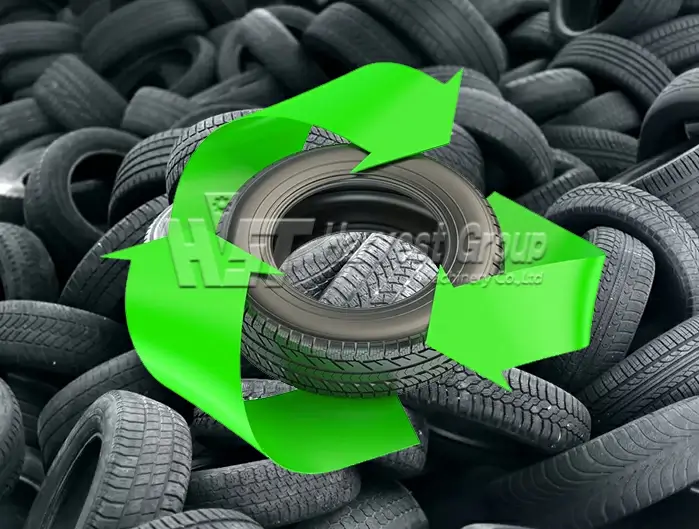
When tires are mentioned, most people immediately think “they’re made of rubber.” In reality, modern passenger car tires are far more complex—containing an average of 25 different components and up to 12 rubber compounds. These work together to deliver wear resistance, grip, and stability. Their makeup also directly affects how tires should be treated after they wear out.
Rubber: The “Structural Backbone” of a Tire
Tire rubber is mainly divided into natural rubber and synthetic rubber:
Natural Rubber: Derived from the latex of specific rubber trees, then processed by acid coagulation, rinsing, and pressing into blocks. It offers excellent elasticity and abrasion resistance and is an important raw material for the tread, sidewall, and other key sections.
Synthetic Rubber: Produced by mixing chemicals in a controlled process independent of natural rubber. During manufacturing, blocks of natural and synthetic rubber are cut, weighed, and mixed with other ingredients to optimize high-temperature resistance, aging resistance, and other properties.
Reinforcements: Making Tires More “Robust”
Beyond rubber, various reinforcement materials enhance strength and stability:
Reinforcing Cords: Manufactured from rayon, nylon, polyester, and aramid fibers from the textile industry, mainly used to create tire cord fabric that strengthens the structure and prevents deformation.
Steel: High-strength steel from the steel industry is partially processed into steel belts (steel cords) to enhance shape retention and directional stability; another portion becomes bead wire to ensure the tire is firmly locked on the rim.
The complex composition ensures high performance but also means worn tires cannot be handled with a “one-size-fits-all” approach. Different materials (rubber, steel, textile fibers) must be separated and recovered using specialized processes—raising the bar for precision in tire recycling.
Many assume a tire’s “life” only refers to its time mounted on a vehicle. In fact, the full lifecycle spans multiple stages, each closely connected to the tire’s end-of-life destination and overall environmental/resource efficiency.
Manufacturing: The “Transformation” from Raw Materials to Tires
Production begins with raw-material processing—rubber, steel, and chemical additives go through mixing, forming, and vulcanization to become usable tires. This stage carries an environmental footprint: raw-material extraction (e.g., rubber tree cultivation, steelmaking) consumes natural resources, and manufacturing may emit waste gas and wastewater with potential environmental impact.
Distribution & Use: The Tire’s “Service Period”
Once manufactured, tires are transported to retailers and finally installed on vehicles. This is the most visible stage, and the tire’s service life depends on two key factors:
Routine Maintenance: Regular pressure checks, tire rotation, and timely removal of stones lodged in the tread can extend tire life; neglect accelerates wear.
Driving Habits: Frequent hard acceleration/braking, high-speed cornering, or long-term travel on rough roads increases stress and shortens service life.
Wear Stage: Signs of “Retirement”
Over time, tires inevitably wear—tread depth decreases, cracks appear on the tread, and bulges may form on the sidewall. These are all signs of retirement. When tread depth falls below 1.6 mm (a widely accepted international safety standard) or significant damage appears, the tire is no longer safe for road use and must be replaced.
Despite the large volume of worn tires, the good news is that about 88% of end-of-life tires worldwide are collected for sustainable treatment (much higher than the 14% recycling rate for plastic packaging). Retired tires primarily gain a “second life” via three routes: material recovery, energy recovery, and reuse/upcycling.
Pre-Treatment:
Upon receipt, recycling companies initiate automated dismantling lines. Under precision cutting equipment, tires are rapidly broken into 5–10 cm chunks. At the same time, steel-cord separation units operate in parallel—using mechanical grabbing and magnetic extraction to completely strip high-strength steel wires embedded in the rubber. After pre-treatment, the purity of separated rubber blocks can exceed 90%, laying a high-quality foundation for subsequent processing.
Fine Processing:
Before cryogenic grinding, rubber blocks undergo strict impurity inspection. They are then sent into dedicated cryogenic units where, at around −150 °C, they become brittle almost instantly. High-precision mills reduce them to 80–120 mesh fine, uniform rubber powder. Advanced lines add further magnetic separation to capture tiny metal particles and use air classification to remove residual fibers, ensuring rubber powder purity meets high industry standards.
High-Value Applications:
Thanks to excellent physical properties, recycled rubber powder finds broad uses. In sports facilities, blended with binders, it forms resilient, wear-resistant, anti-slip running tracks. In construction, it goes into waterproof membranes and sealing strips to enhance building waterproofing. In automotive manufacturing, it is used for interior parts such as sound-insulation pads and dust boots. With advanced devulcanization processes, rubber molecular chains can be re-activated to restore elasticity and plasticity; such regenerated rubber can be used for tire sidewalls, inner tubes, and other parts—creating a true closed loop for tire recycling.
Regulation & Certification:
The EU’s tire-recycling conformity framework is regarded as a global benchmark. Companies entering the EU market must pass stringent CE conformity procedures that cover the entire chain from raw-material recovery and production to finished products. In addition, companies are required to upload production data to the ETRMA (European Tyre & Rubber Manufacturers’ Association) traceability system in real time. Consumers and regulators can use this system to query the source, processing steps, and quality reports for each batch of recycled materials—ensuring transparency and quality control across the supply chain.
Cutting & Separation:
Recycling facilities employ intelligent cutting systems that tailor cutting programs to tire size and structure. During cutting, onboard identification locates inner tubes, steel belts, textile fibers, and the rim precisely. The rim, a high-value component, is separated and sent to specialized metal-recycling lines; inner tubes, steel belts, and textiles are also collected separately for targeted processing.
Rubber Size Reduction:
Separated rubber enters multi-stage size-reduction systems. It is first processed into larger particles in a coarse shredder and then refined in a fine shredder to produce uniform rubber granules. The entire process uses closed-loop dust-collection to control particulate emissions, with online particle-size monitoring to ensure end products meet different application requirements.
Metal Separation:
In the metal-separation stage, multiple high-strength magnet arrays with gradient design efficiently capture steel in the rubber granules. Even tiny steel fragments are removed accurately. With vibrating screens, steel and rubber are completely separated. The recovered steel is cleaned and compacted and then sold as high-quality scrap.
Material Reuse:
After rigorous QC, rubber granules and steel are stored by grade and supplied to downstream buyers based on demand. Rubber granules can be used as fillers in plastic products or as modifiers to enhance asphalt performance; steel is remelted for various metal goods. This resource-reuse model reduces solid-waste discharge while decreasing reliance on virgin resources.
Typical End Uses Include:
Construction: sound/thermal insulation materials (e.g., building envelope layers), asphalt modifiers (more durable, quieter pavements), road speed bumps, railway rubber barriers;
Consumer Goods: anti-slip mats, sneaker soles, pet toys; recovered steel is remelted into new metal products.
In addition, about 11% of worn tires undergo “feedstock recycling”—recovering premium rubber and carbon black from tires to produce new tires, achieving “tire-to-tire” circularity.
About 34% of worn tires are converted to energy, primarily as Tire-Derived Fuel (TDF):
Applications: With unique energy attributes, TDF is widely used in industry. In cement plants, TDF serves as an alternative fuel for rotary kilns, helping stabilize kiln temperature and improve clinker production efficiency. In the pulp & paper industry, it provides heat for cooking and drying processes to keep production stable. In power plants, TDF co-fires with other fuels for efficient power generation. This approach addresses scrap-tire stockpiles while opening new energy channels to replace coal and heavy oil, realizing resource circularity.
Clear Advantages: From an energy perspective, rubber’s calorific value is about 9.0 kWh/kg, comparable to high-grade coal, with strong combustion performance. Environmentally, it is stated that TDF combustion does not produce carbon dioxide or heavy-metal emissions, and that pollutant releases are far lower than with fossil fuels. For example, SO₂ emissions are said to be reduced by roughly 80% versus coal. For enterprises, this means meeting production needs while cutting fuel costs by about 15–25% and reducing pollution—supporting greener operations and sustainability goals.
Beyond Direct Combustion: Pyrolysis
In an oxygen-free environment, shredded tires are heated to 400–600 °C. Rubber and plastics decompose into gases (which can be refined to natural gas), liquids (which can be processed into diesel or gasoline), and solids (carbon black and steel). Carbon black can be reused in tire manufacturing, and steel is recyclable—achieving dual recovery of energy + materials.
Outside industrial recycling, worn tires can be transformed into practical products:
Outdoor Facilities: After cutting, sanding, and painting, tires can become outdoor seats, planters, and children’s play structures (e.g., swings, climbing frames).
Sports Surfaces: Rubber granules mixed with binders can be used for artificial turf (soccer, tennis), running tracks, and playground surfaces—offering anti-slip, shock absorption, and longer service life.
Agriculture: Tires can be converted into irrigation conduits, protective sleeves for agricultural machinery, or used as windbreaks for crops.
Recycling Is Not Simple: Precision Matters
Recycling worn tires is not about a single smash-and-grab step. It takes seven refined steps to effectively separate components and maximize resource recovery.
Collection Channels: Gas stations, tire retailers, and repair shops are the main collection points. When replacing tires, owners can hand in old ones (many regions mandate recovery and prohibit random disposal).
Safety Controls: Recyclers store collected tires in dedicated facilities and inspect them regularly to prevent fire risks from excessive stacking (large piles can trap heat and pose self-ignition hazards).
Note: Most landfills now refuse worn tires. Mandatory collection reduces environmental pollution and helps protect public safety.
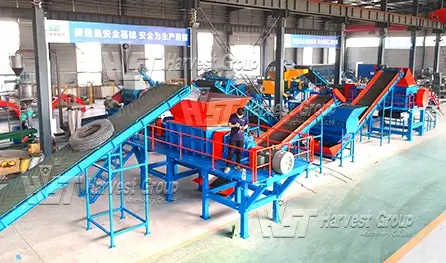
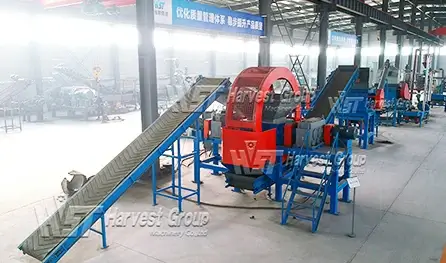
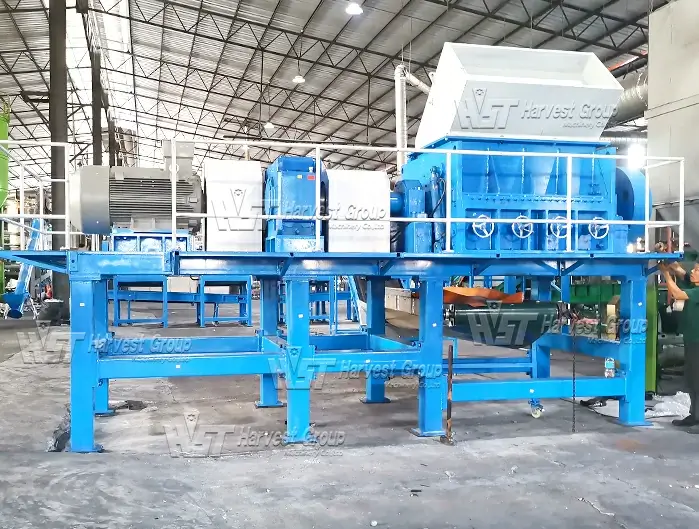
Collected tires go into a primary shredder—the first gateway to rebirth. Equipped with serrated alloy-steel rollers spinning hundreds of rpm, it tears whole tires into 5–10 cm pieces. During intense tearing, steel cords and textile plies separate progressively, forming an initial rubber-particle mix. The pre-shredded material then passes under magnetic separation to lift out steel precisely; the remaining rubber and fiber proceed to fine grinding.
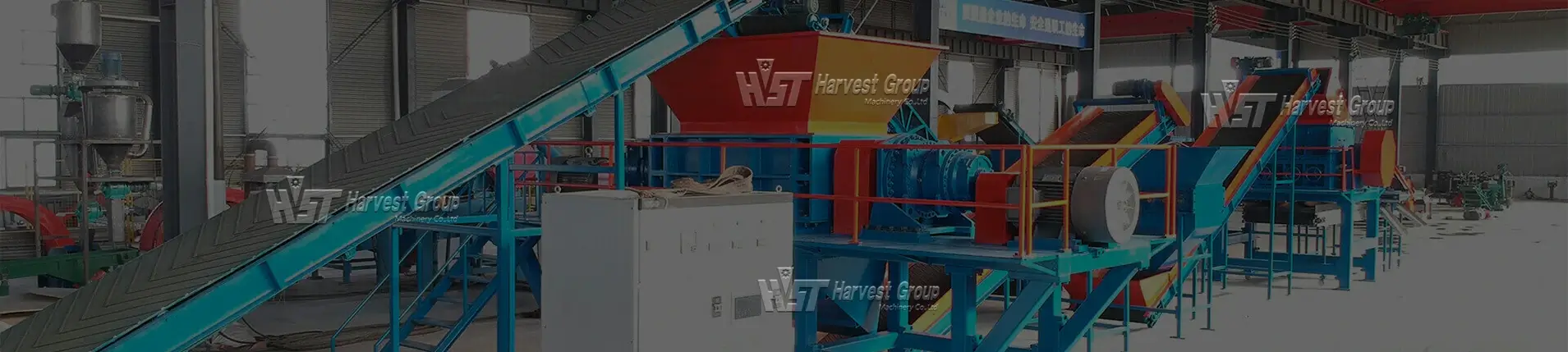
Working Principle: In primary shredding, a special infeed conveyor delivers tires into a dual-shaft shear shredder. Two counter-rotating drums at about 150 rpm, with spiral-staggered wedge-tooth cutters, bite into the rubber carcass under high torque. Through combined shearing and tearing, a whole tire is reduced within 8–12 seconds into 6–12 in (≈15–30 cm) strips. This method offers controlled sizing and effective liberation of embedded steel cords and textiles.
Throughput: Industrial dual-shaft shredders use hydraulic drives and smart load monitoring to adjust force based on tire hardness. High-quality machines can process 30 tons/hour of scrap tires in continuous duty—roughly 1,200 passenger tires/hour—standardizing feed for downstream steel separation and fine milling while lowering unit costs via scale.

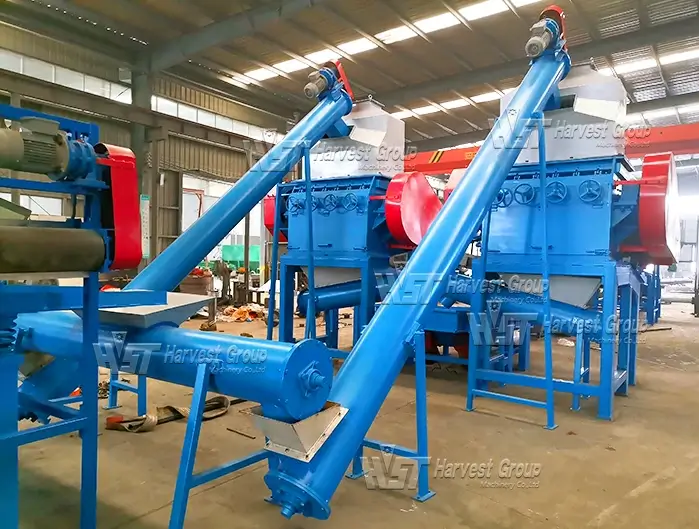
Post-primary strips feed a secondary shredder. Using intermeshing, serrated rollers, it further reduces material to 5–10 mm particles with uniform size and micro-porous surfaces—improving devulcanization efficiency and blendability. Built-in magnets separate steel cord and other metals to ensure product purity.
Further Size Reduction: Secondary shredders can reduce to 1–3 cm rubber granules.
Metal Separation: Strong magnets lift steel (belts, bead wire, etc.) from the granules—crucial since most downstream rubber uses require “metal-free” rubber.
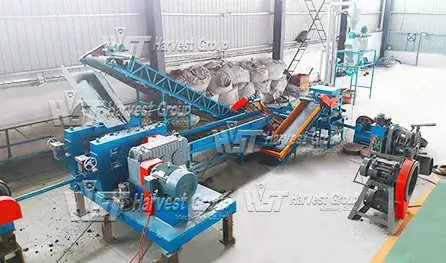
Secondary granules enter a granulator—a key stage in recycling. Precision rolling and cutting heads, through thermal plasticizing and mechanical extrusion, re-form irregular particles into uniform rubber granules. These have smooth surfaces and dense structure, typically 2–5 mm. Depending on the end use, sulfur, carbon black, and other additives may be introduced for tailored properties, enabling wide application in sports surfacing and rubber goods.
Processing: A high-speed single-rotor system can refine particles to about 0.6 cm (¼ in) “rubber granules” (commonly called crumb).
Applications: For artificial turf infill and anti-slip mats, granules can be used directly—so this step may be the “endpoint” for some lines.
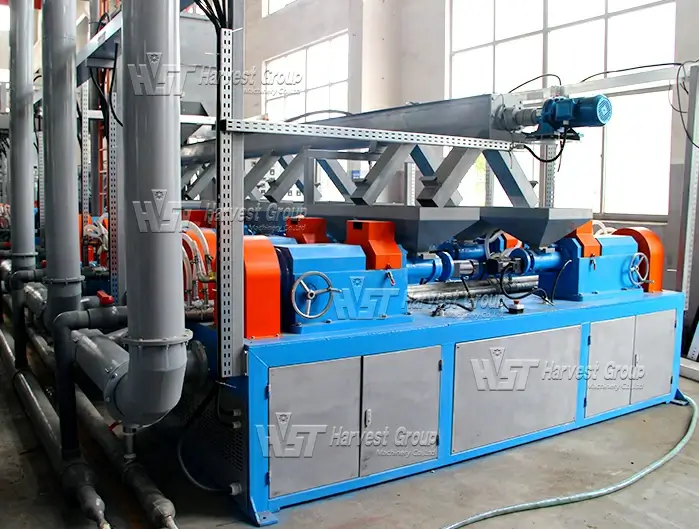
For finer raw material, granules go to a fine mill with high-precision grinding rolls and multi-deck screens, reducing particle size to 0.1–1 mm. In the high-speed grinding chamber, granules undergo uniform breakage via centrifugal force and toothed rollers. Low-temperature nitrogen is introduced to avoid heat-induced degradation. The resulting powder is smooth and consistent; mesh can be tuned by adjusting screens—ideal for tire retreading compounds, running tracks, and rubber tiles that demand precise raw materials.
Effect: Fine mills can produce ≤850 μm rubber powder (roughly flour-like), with good plasticity for rubber goods, coatings, and sealants.
Equipment Advantage: Compared with traditional cast-iron crushers, Krumbustor systems with advanced hydraulics can double output while cutting maintenance time and recycling costs.
The goal of recycling is reuse. Different outputs serve different markets:
Rubber Powder: New tire sidewalls, seals, cable jackets.
Rubber Granules:Sports surfaces; blended with asphalt for roads; garden mulch to suppress weeds.
Steel: Returned to steelworks for remelting.
Innovative Uses: “Rubber + plastic” composites—mixing recycled rubber with PE/PP to create TPEs for medical tubing, snowmobile tracks, and other high-end products.
Tire recycling offers environmental value and attractive economics:
Raw-Material Sales: Strong demand for granules, powder, and recovered steel provides steady revenue.
Finished Goods: With molds and coloring, granules can be made into planters, mats, and pet toys—higher added value than raw materials.
Policy Support: Many countries offer tax incentives and subsidies for eco-friendly recyclers, further lowering operating costs.